
Wichita State has pummeled opponents when Markis McDuffie plays this position
There’s no question Markis McDuffie is Wichita State’s most proven player entering this season.
After all, he’s the only player on the roster who has more than one year of Division I experience, and no one can come close to his career totals of 33 starts, 853 points and nearly 2,000 minutes.
But there is a reasonable question of which forward position McDuffie should play for the Shockers in 2018-19.
What makes McDuffie valuable
In the college basketball world, McDuffie is a valuable commodity because of the mismatches he can create.
At 6-foot-8, McDuffie can shoot over most small forwards who match up with him. Traditional power forwards who can match his height have problems keeping up with his athleticism. Even though he’s a wiry 198 pounds, McDuffie has proven he can hold his own (remember he led WSU in rebounding at 5.7 boards per game in 2016-17) in the post.
McDuffie is excellent as a cutter to the basket and has just a good enough jump shot to make defenders respect him from the outside. In his last fully healthy season, McDuffie ranked in the 87th percentile nationally in spot-up opportunities, per Synergy.
Those traits have made McDuffie the ideal piece to unlock lineup combinations for WSU the past two seasons. Gregg Marshall was able to exploit his team’s depth in a variety of ways, as WSU could win playing a super athletic, small-ball lineup with McDuffie at the four or it could win with a traditional lineup with McDuffie playing alongside two posts.
McDuffie’s positional usage has varied greatly in the last two seasons. For the 31-win team in 2016-17, McDuffie logged 23 starts and played 44 percent of his minutes at power forward. However, last season McDuffie played almost exclusively (88 percent) at small forward.
WSU’s 2017 success with McDuffie
Since a foot injury derailed McDuffie’s junior year, it’s only fair to look back at when he was WSU’s leading scorer and rebounder in 2016-17 and split time at both positions.
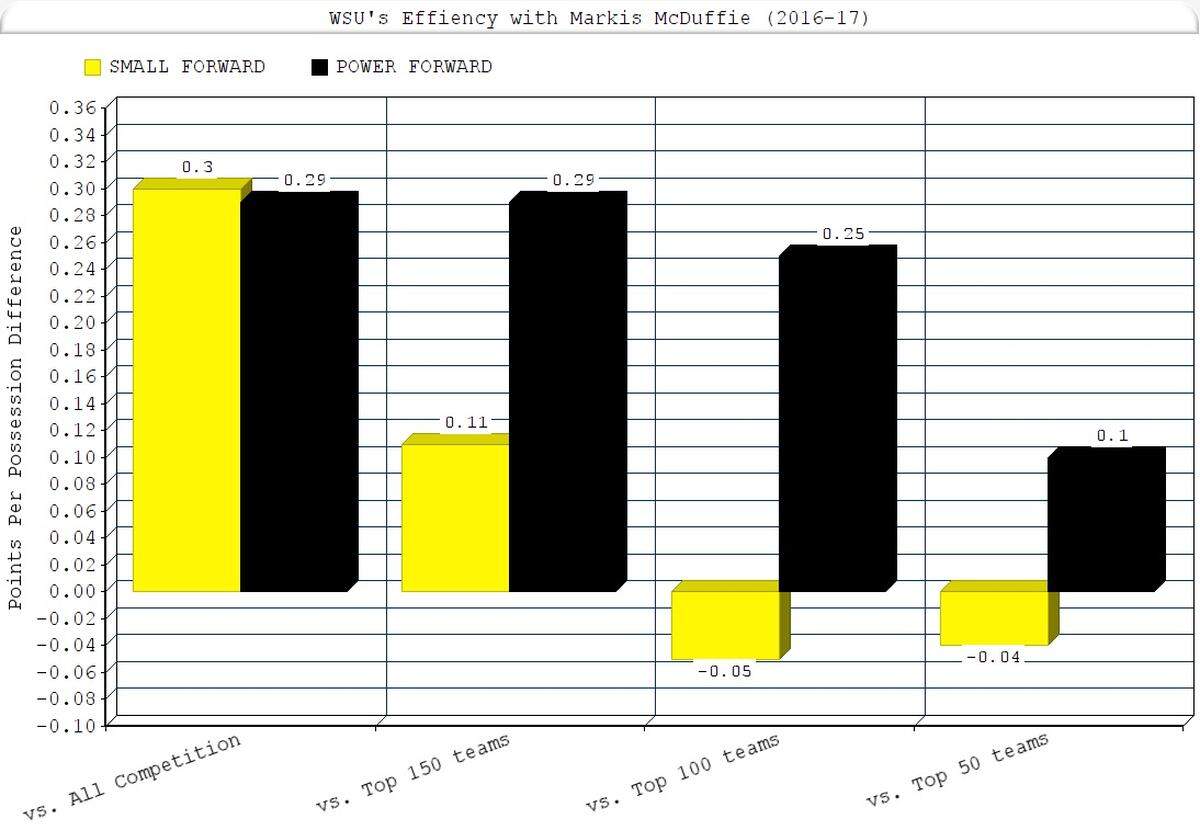
The Shockers were very good that season, outscoring opponents by 0.26 points per possession. When you look at the raw numbers, it appears WSU was just as good with McDuffie at either position. The Shockers outscored opponents by 0.30 PPP with him at small forward and 0.29 PPP with him at power forward.
But that season, WSU played 18 games against competition outside of KenPom’s top 150 teams. When you start to eliminate the outmatched opponents, then you begin to notice the trend.
Against top-150 teams, WSU’s advantage over opponents shrunk to 0.11 PPP with McDuffie at small forward but remained the same (plus-0.29 PPP) with him at power forward. But peel it back one more layer, and the difference becomes eye-popping.
In the 181 minutes McDuffie played small forward against top-100 teams, WSU was outscored by opponents by 0.05 PPP. In 147 minutes against the same competition, only with McDuffie at power forward, the Shockers were still shredding teams by 0.25 PPP.
A silver lining for 2018
It might be wise to throw out the sample size from last season, as it was clear McDuffie was never comfortable after returning from a stress fracture injury mid-season.
McDuffie stopped attacking the basket and started relying more on a jump shot that never was right. His shooting percentages plummeted, as did his efficiency ratings.
The silver lining of 2017-18 for McDuffie perhaps came in the 50 minutes when he played at power forward. Keep in mind, WSU was pummeled when McDuffie was on the floor last season. But in those 50 minutes, WSU actually did the pummeling as it outscored teams by 0.48 points per possession.
That number even holds up when you only look at top-150 competition (plus-0.38 PPP).
Could it be a coincidence? It’s entirely possible. But when taken in context with the past two seasons, the data shows WSU has been better off against good competition when McDuffie is at power forward.
What it means for this year
It’s almost certain McDuffie starts Nov. 6 when WSU opens its season against Louisiana Tech. But who joins him?
Two guards from Samajae Haynes-Jones, Ricky Torres, Erik Stevenson, Chance Moore, and Jamarius Burton seems likely. Will McDuffie play the three or will that go to a freshman in Dexter Dennis or Rod Brown? Or will McDuffie play the four, so Marshall only has to play one of his inexperienced posts in Morris Udeze, Isaiah Poor Bear Chandler, Jaime Echenique, and Asbjorn Midtgaard?
There are many questions, and it’s likely Marshall will tinker with the lineup the entire season with so many newcomers. That’s why a fully-healthy McDuffie is invaluable this season: he gives Marshall an answer.
Marshall knows McDuffie can be a two-way force at small forward for the Shockers and he knows WSU can likely create an advantage with McDuffie at power forward whenever it wants.
Look for Marshall to utilize McDuffie all over the court this season, as the senior is aiming for a bounce-back season to put him back on NBA Draft radars.
This story was originally published September 19, 2018 at 6:59 PM.