
History awaits when the NCAA bracket works its magic (VIDEO)
OMAHA – College basketball is all about the name on the front of the jersey, all about the colors, the tradition and the branding.
Those who fight the power of the brand need an ally and the NCAA Tournament selection committee, unpopular for some decisions, offers a helping hand each March. The committee sets up brackets that high-profile schools can’t gerrymander and gives their would-be rivals a shot on a neutral court. Every year, committee members deny they set things up with juicy stories in mind, and every year they give us a treat.
On Sunday, second-seeded Kansas and seventh-seeded Wichita State play for the first time since 1993, in the NCAA Tournament third round at CenturyLink Center. The game finds kindred spirits in the 1961 and 1962 title games between Cincinnati and Ohio State, 1971 Western Kentucky-Kentucky, the “Dream Game” of 1983 when Kentucky played Louisville, Charlotte-North Carolina in 1998 and last season’s Dayton-Ohio State matchup.
And, of course, Wichita State’s 66-65 win over Kansas in the 1981 NCAA Tournament.
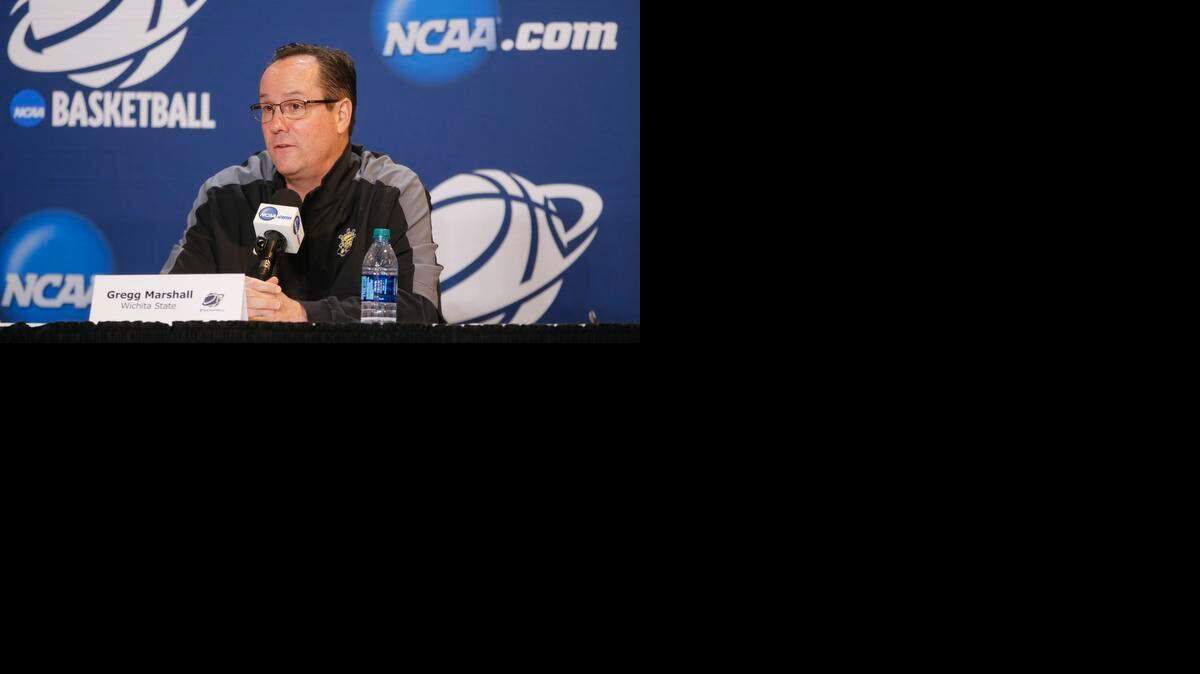
This is Wichita State coach Gregg Marshall’s kind of game, because he made a career of playing and coaching for the little-known and the overshadowed. He helped the College of Charleston move from the NAIA to NCAA Division I. At Winthrop, he handed out Eagles T-shirts when children came to his locker room wearing gear from ACC and SEC schools. When he looks at the lineup for Sunday’s game, he will have Final Four veterans; Kansas does not.
“I’ve generally been the underdog,” Marshall said. “If you’re worried about what’s on the front of the (opponent’s) jersey and you’re Wichita State, you don’t show up. We go in thinking if we play well, we have a chance.”
There is always a well-established power structure in every state and it usually means the prominent state school won’t play less-prominent opponents. The school on top sees no reason to give its neighbor a chance to chip away at its superiority, a strategy that plays academically and athletically. The NCAA Tournament breaks down those barriers and hard feelings with a win-based merit system.
“I’ve learned all about this in the past 12 hours,” Wichita State forward Zach Brown said. “This is something Ron (Baker) and Evan (Wessel) and the Kansas guys have probably been dreaming of since they got here. Coach Marshall’s been dreaming of it, as well.”
So are many others of their kind.
“I don’t look at Wichita State as an underdog,” Missouri Valley Conference commissioner Doug Elgin said. “I think it’s going to be close. This is a chance they’ve been waiting for for a long time.”
Dayton, like Wichita State, is a basketball school with a strong tradition. Ohio State, like Kansas, is prominent enough not to need to play Dayton and doesn’t feel like it needs to explain. They met nine times before last March and not since 1988 in regular-season game.
Then the NCAA intervened in Buffalo, N.Y.
Dayton’s Vee Sanford made a layup with 3.8 seconds to play and the Flyers defeated Ohio State 60-59. Sanford knows the play will never be forgotten in Dayton. He’s watched the video at least 1,000 times.
“We were a team full of three-star (recruits) playing against five stars,” Sanford said. “I’m pretty sure it’s the same thing with Wichita State. I’m pretty sure a lot of those guys wanted to play for Kansas. Being a smaller school, you’ve got to play a lot more hungry than a bigger school.”
The NCAA’s most famous work of bracket engineering came in 1983, when it finally got Louisville and Kentucky together. Kentucky obstinately looked down on Louisville, even when the Cardinals won the 1980 NCAA title and went to the 1982 Final Four. The coaches sniped at each other. Louisville played flashy, up-temp basketball with the Doctors of the Dunk and Kentucky represented the staid establishment.
“It used to eat at all of us about why we didn’t play,” former Louisville star Rodney McCray told the Louisville Courier-Journal in 2012. “It made us angry. We were competitors. We knew we were better than Kentucky. We wanted to prove it to everybody.”
Louisville won 80-68 in overtime and that game opened the door to a series that continues.
All those games are hyped by unique dynamics of money, power and perception. Old money vs. new. Public vs. private. Big vs. small. Elite conference vs. mid-major. Flagship vs. commuter. In Kansas, Wichita State coaches tell stories of trying to recruit athletes from Kansas City and battling Johnson County parents who regard Wichita as the sticks and athletes who would rather walk on at a Big 12 school than take a scholarship.
“When I told people I was going to Wichita State, they asked me if it was a juco,” former Shocker pitcher Foster Vielock, from Olathe, said. “And they’re all big into sports. They have no clue in Kansas City.”
Wichita State guard J.R. Simon has an idea how Marshall will approach Sunday’s pre-game talk. Marshall is used to a brand-name deficit after playing Ohio State, Kentucky and Indiana in recent NCAA Tournaments. He is used to addressing a room full of athletes the other coach didn’t recruit.
“He knows the way to get to his players,” Simon said. “He talked about how Kentucky was one of the greatest basketball programs in the country, but none of that really matters. It’s not about what’s on your chest. It’s about who you are and how well you play and your team plays. He knows we’ve got players and a team that can compete with anyone.”
Reach Paul Suellentrop at 316-269-6760 or psuellentrop@wichitaeagle.com. Follow him on Twitter: @paulsuellentrop.
Those who play
Memphis vs. Tennessee — The schools met 25 times and it was an annual event in recent seasons until Memphis coach Josh Pastner ended the series after a 2013 meeting.
Kentucky vs. Louisville — The 1983 NCAA Tournament “Dream Game” turned this rivalry into an annual event and one of college basketball’s marquee games. The Wildcats lead 33-15 after winning three straight and a 2012 Final Four game.
Xavier vs. Cincinnati — Since 1945, the city of Cincinnati is wrapped up in this rivalry between the large public school and small private school. Things got ugly with a brawl in 2011 and the game moved to a downtown arena for two seasons before returning to campus.
Northern Iowa-Drake vs. Iowa-Iowa State — This used to be the best example of a great in-state relationship when all four played each season, alternating home sites. Iowa and Iowa State tired of road trips to MVC schools and now they play Northern Iowa and Drake in the Big Four Classic in Des Moines. Contrary to myth, none of the games are mandated by the legislature.
Missouri vs. Illinois — The Braggin’ Rights game is a December highlight in St. Louis with half the arena in Illini colors and half backing the Tigers. Illinois leads the series 29-16 after winning the past two meetings.
Philadelphia’s Big Five — The city series changed and diminished over the years as schools joined conferences and Villanova big-footed the less-influential schools. However, Villanova, Temple, La Salle, Penn and Saint Joseph’s still play non-conference games to keep the spirit of the Big Five alive.
Mandated by the NCAA
Cincinnati 2, Ohio State 0 — The Bearcats and Buckeyes played in 1921 and not again until NCAA title games in 1961 and 1962. Cincinnati won both, putting a freeze on the series until 2006. They haven’t played since.
Kansas State 94, Wichita 86 — The Wildcats upset the Shockers in the 1964 NCAA Tournament, their first meeting since 1950. The schools played intermittently over the following years.
Western Kentucky 107, Kentucky 83 — Kentucky coach Adolph Rupp refused to schedule the Hilltoppers and they didn’t meet until this game in the 1971 NCAA Tournament. The Hilltoppers started five black players, athletes Rupp wasn’t enthusiastic about recruiting.
Louisville 80, Kentucky 68 (OT) — The 1983 bracket matched these teams for the first time since a 1959 tournament game. Before that, they last met in 1922. Kentucky refused to play in-state schools, even after Louisville won the 1980 NCAA title.
Georgetown 75, Maryland 48 — The Hoyas dominated the 2001 NCAA meeting. While they played in a 2008 in-season tournament, they last scheduled each other in 1993.
Dayton 60, Ohio State 59 — Vee Sanford’s layup gave the Flyers a win over Ohio State in the 2014 tournament. The schools had not met in the regular season since 1988.
This story was originally published March 21, 2015 at 7:41 PM with the headline "History awaits when the NCAA bracket works its magic (VIDEO)."