
WSU-KU 1981: The night Mike Jones became a Shocker legend
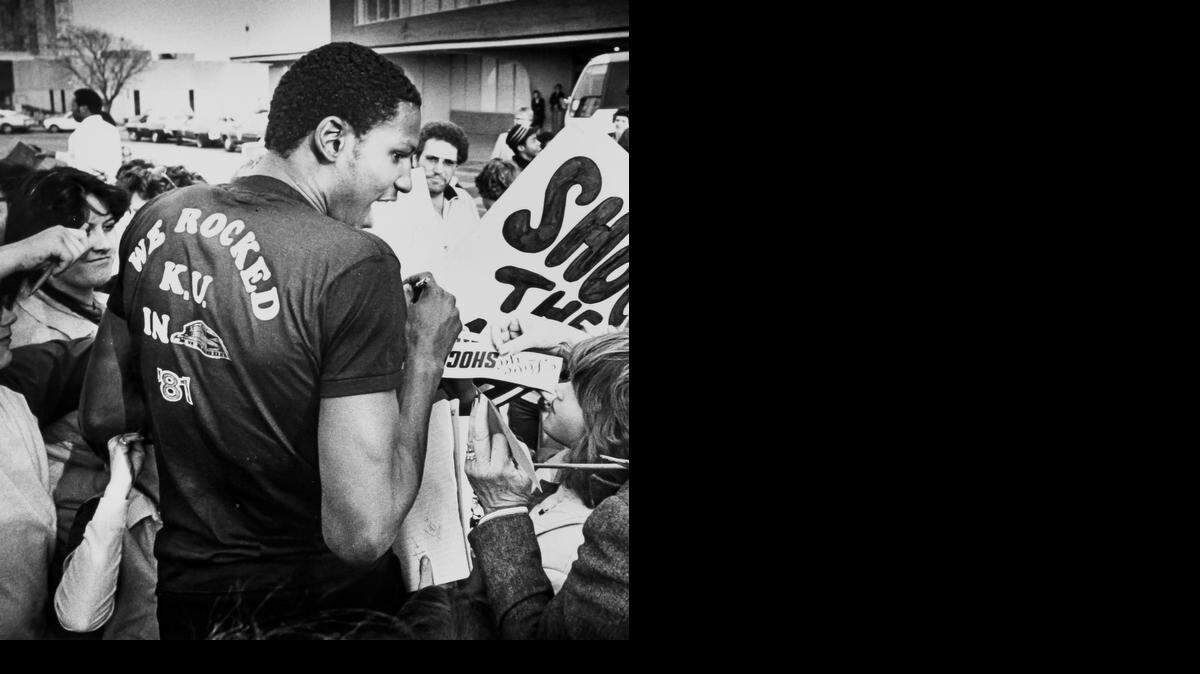
The gathering outside Mid-Continent Airport took place on March 23, 1981, a Monday afternoon.
Thousands of Wichita State basketball fans left work or left school to greet their Shockers. A season of adulation, which had hit a boiling point with the school’s best NCAA Tournament finish in two decades, had ended and everyone could exhale and say thanks.
Thanks for the ride.
Thanks for the memories.
Thanks for beating Kansas.
Thirty-four years later, Mike Jones remembers not being surprised by the turnout.
“You got to understand, we knew we were good and we knew we had the heart of the community,” Jones said.
And Jones had the heart more than anyone.
▪
The WSU-KU rivalry wasn’t a rivalry. As current Shocker Tekele Cotton said Friday, you have to actually play games against each other for it to be a rivalry.
KU and Wichita State had met four times before March 20, 1981, but the last time was 1955. Kansas won all four, then the series went dormant. There was occasional talk of the teams meeting in a non-conference game, but it never happened.
Then the 1981 NCAA Tournament bracket was announced.
▪
The 1980-81 Shockers were Gene Smithson’s third team at WSU, but the first with all the right pieces in place.
“The guys always said one of the things that made that team was the depth and competition in practice,” Shocker radio voice Mike Kennedy said. “If you don’t bust your tail in practice, you don’t just get beat, you get embarrassed.”
Sophomores Antoine Carr (6-foot-9) and Cliff Levingston (6-8) were top-level recruits who could play for anybody nationally. Levingston’s work ethic and knack for being able to get to the ball was complemented by Carr’s raw power and flashes of dominance.
Tony Martin was a junior-college point guard who immediately fit in as the playmaker.
Senior Randy Smithson was the coach’s son, the coach on the floor who seemingly did a lot of little things to give him and WSU the advantage.
Ozell Jones was a piece of the puzzle, too, a 6-11 center who wasn’t as gifted offensively as his frontcourt mates but a defensive presence and tough rebounder.
Jones, though, was declared ineligible prior to the tournament because of a problem with his high school transcript. His grade-point average had been computed using physical education classes that shouldn’t have counted. Without those grades, he didn’t meet minimum requirements for eligibility.
Still, there were enough pieces to make WSU a threat in the tournament.
“You’ve got to understand, we were a pretty close bunch way before the tournament,” Mike Jones said. “We walked to campus together, we partied together on weekends, we slept at each other’s apartments all year. We were very tight-knit.”
▪
Kansas was less of a sure thing for the tournament, at least during the regular season. Darnell Valentine’s senior year included a 14-4 start and 10-game winning streak. A 5-5 regular-season finish meant a tie for second in the Big Eight.
But the Jayhawks got hot in the Big Eight Tournament, routing Oklahoma State, beating Missouri 75-70, then handling Kansas State 80-68 to earn the conference’s automatic bid.
Tony Guy (15.6 points) and David Magley (9.5) were the Jayhawks’ best outside threats, and Valentine (15.6) was a terrific penetrator who averaged 5.3 assists.
Jones and Valentine trained together in Wichita the previous summer. Jones got a look at Valentine’s work ethic and desire.
“He was just getting prepared for his next stop,” Jones said. “He was a great athlete who trained so hard.”
▪
A Wichita State-Kansas matchup in the regional semifinals was one of two things the Shockers noticed when the brackets were revealed. The other was that the NCAA had kept them at home for the first two rounds.
Levitt Arena was a predetermined host in 1981. In those days the host school could play on its home court. But while WSU had won the Missouri Valley at 12-4 (26-7 overall), a game ahead of Creighton and Tulsa, it was Creighton that got the league’s automatic bid when it beat WSU in Levitt Arena 70-64 in the tournament final.
Wichita State and Kansas were assigned to the Roundhouse. On March 13, 7-seed Kansas beat 10-seed Mississippi 69-66, and 6-seed WSU routed 11-seed Southern 95-70.
Two days later, WSU went first and held up its end of the potential showdown by rallying in the second half to beat 3-seed Iowa 60-56. The Shockers seemed to be destined to lose before Hawkeyes coach Lute Olson called a timeout he didn’t have, and free throws put WSU ahead for good.
KU followed with a dominating 88-71 victory over 2-seed Arizona State. Five days later, two groups of Kansans would invade the Louisiana Superdome.
▪
The Superdome was almost six years old when WSU, Kansas, Arkansas and LSU converged for the first NCAA Tournament games in a domed stadium. The Midwest Regional was a test case for domes; it would host the Final Four in 1982.
A Boeing 747 charter took Shocker fans from Mid-Continent Airport to New Orleans. Roughly the same number of Kansas fans headed south, too.
But the Shockers had help in cheering. Athletic director Ted Bredehoft had made a plea to LSU fans – who outnumbered all other fans 4 to 1 or more – to root for the Shockers in the first game. Then WSU fans, he said, would root for LSU to beat Arkansas in the second game.
The crowd of 34,036 was an NCAA record until the 1982 Final Four.
▪
Before the game, 24-year-old Eagle photographer Bill Youmans was preparing to get to work when KU coach Ted Owens approached him.
“He and (assistant coach) Bob Hill asked me where I was from, then they said during the game if I could get some pictures of them on the bench, they’d buy those from me,” Youmans said. “They said they didn’t know if they’d get in a situation where they’d be playing (WSU) again.”
▪
WSU was not only without Ozell Jones, but Martin had injured himself during the Iowa game. A bulging disc threatened to keep him out of the KU game.
“I keep getting asked if he’s going to be able to play,” said Doug Vandersee, the Shockers’ trainer from 1980 to 2002. “I turn to Doc (Eugene) Kauffman and he says, ‘No way he’s going to be able to play.’”
But an injection lessened the pain and Martin played 25 minutes through stiffness.
Martin’s defense was critical because of KU’s backcourt of Valentine, the Wichita Heights All-American, and scoring leader Guy.
“When game time comes,” Vandersee said, “all those aches and pains go away.”
▪
It was not a game of runs and rallies. KU zoned the Shockers’ bookends of Carr and Levingston, blanketing them with Art Housey, John Crawford and Victor Mitchell inside. Wichita State tried to keep Valentine from running fast breaks and getting transition baskets.
With 56 seconds remaining, Valentine was fouled with a three-point KU lead. A 69-percent free-throw shooter, he missed the one-and one. Seven seconds later, Jones fired a no-conscious 25-footer that swished, cutting the lead to one.
“I’ve listened to my play-by-play and when he hits that first shot, there’s incredulity in my voice,” Kennedy said.
Time-out, Kansas, 33 seconds remaining.
▪
WSU pressured the inbounds pass in the KU backcourt. Valentine streaked toward the basket, a step ahead of Smithson, and Guy hit him with a perfect baseball pass.
Valentine caught it, turned his body without dribbling, and jumped for the layup as Smithson sprinted underneath.
The ball came off the backboard, rolled on the rim and fell off.
“The layup that Darnell missed was a sure thing,” Kennedy said. “But Randy … he did something. Darnell was pretty gathered and under control, but Randy was able to get under him as he went up.”
Valentine saw his miss and tried to grab the ball, but Levingston flicked it away to the corner, then hustled to save it and got it to Smithson.
Time-out, Wichita State, 24 seconds remaining.
▪
“I don’t think there’s any doubt in anybody’s mind where that ball’s going to go,” analyst Larry Conley said on the telecast during the time-out. “It’s going to be one of those two bookends, I’ll guarantee you that.”
WSU coaches knew KU’s zone would be packed in even tighter around Carr and Levingston, so they needed another option.
“Randy was supposed to come off the baseline to the corner and get a jump shot and Mike was supposed to get it to him,” former assistant coach Rick Shore said.
Most of that happened.
Kansas packed the zone. Carr and Levingston were smothered. Martin, out front, passed left to Jones, who passed it back. Martin passed right to Smithson on the wing, got it back, and passed left to Jones again. Meanwhile, Smithson cut toward the baseline and the opposite corner, just as the play was designed. Jones passed to Smithson.
“Randy and Tony Martin and I knew what we’d have to do,” Jones said. “The option was to get Randy an open shot, but with Randy he had to get the shot off right away (or get it blocked).”
True, the 6-8 Crawford got to Smithson before he could get a shot. So Smithson reversed back to Jones, who caught it with six seconds remaining.
“The third option, in my mind, was being prepared to shoot,” Jones said.
“They gotta get it up,” Conley said, his voice raised. “There he goes!”
“Six seconds left, Jones from 25…” TV play-by-play man Fred White says, voice getting higher, his sentence lost in cheers as the shot swished.
Time-out, Kansas. Two seconds remaining.
▪
On the WSU bench, Vandersee and team physician Eugene Kauffman had a problem.
“When Michael shot the shot, we all jumped up and everybody starts hugging, and Dr. Kauffman lost a bracelet,” Vandersee said. “Later he told me it was worth about $10,000, but insurance would cover it. I said I’d go back and look for him.”
▪
Jones is the first to admit he was a streaky shooter.
“But I never lacked the confidence in shooting,” he said. “Anywhere on the court. There was no shot I was afraid to take. I always felt like I could hit it.”
“Mike could shoot you into a game and he could shoot you out of one,” Kennedy said. “But he always had that supreme confidence.”
Confidence and good shooting form. Shore, who’s retired and living in Deerfield Beach, Fla., watches college basketball today and see players shooting open jumpers while leaning or fading away.
“If you look at Mike’s jump shots, they were fundamentally sound,” Shore said. “Straight up, good form. He had the shot and he took it.”
▪
The most famous image of Jones’ shot came from an Associated Press photographer, but 34 years later, Youmans is not sure if it was him or not.
Youmans was stationed on the baseline near the Shocker bench during the game. He had the angle to shoot Jones letting the ball fly with Smithson watching and the Superdome scoreboard in the background. But in those days, photographers handed their film to runners, who took them back to the darkroom for processing and transmission to newspapers across the country.
The archived AP image of Jones’ shot doesn’t list a photographer credit.
▪
During the time-out, 6-7 forward Jay Jackson replaced Jones for defensive purposes. Which makes Jones smile.
Also during the time-out, KU coaches told the officials that if WSU tried to guard the inbounds passer, KU would try to draw a charging foul.
Booty Neal faked a long pass to get Jackson into the air, then ran along the baseline. Valentine snuck in behind Jackson, who by then was following Neal along the baseline.
Jackson knocked over Valentine, and everyone waited for a whistle.
It didn’t come. KU had to call another time-out.
“What I heard later was that Ted (Owens) had told the official it was coming, but the official said if (the WSU player) doesn’t run through him, he wasn’t going to call the foul,” Kennedy said.
Jackson made contact, no doubt, but didn’t barrel over Valentine. KU had to call another time-out. Valentine sat on the court for at least 15 seconds.
“To be honest,” Jackson told The Eagle in 2006, “I thought I was going to be the biggest goat in the history of Wichita State basketball.”
▪
There were four more plays in those final two seconds. KU threw the long inbounds pass away. WSU inbounded and Smithson was fouled. He missed the one-and-one – “67-65” or “68-65” wouldn’t have been as memorable on billboards, anyway – and Neal threw the rebound downcourt with no chance of it going in.
66-65. Shockey and many other Shockers fans headed to the French Quarter to get the “I Was There” T-shirts made.
Jones admits that the team found the French Quarter, too. He chooses not to go into detail.
Two days later, top-seeded LSU overwhelmed the Shockers 96-85 in the regional final. The Tigers’ front line of Rudy Macklin, Howard Carter and Greg Cook were as talented as the bookends, and LSU raced to an early lead it didn’t give up.
▪
Wondering about Kennedy’s greatest moments calling Shocker games for nearly 40 years?
The end of the 2013 West Regional final against Ohio State, when he could announce that Wichita State was returning to the Final Four, is up there.
So is Greg Brummett’s strikeout of Texas’ Kevin Pate to end the 1989 College World Series.
And, of course, Jones’ shot.
▪
Ask Mike Jones about his place in Shocker history and he chuckles. He understands it, to be sure. He hit THE shot in Wichita State basketball lore.
But Jones isn’t all about the shot.
“I really appreciate the time I spent there,” he said. “I don’t appreciate how my career went there, but the people there, and the teammates I had and most of the coaches, everyone surrounding the basketball program … it was really like family.”
Jones, a health and safety officer for a Georgia company that helps people and families dealing with mental illness, is 56 now. He came to WSU in 1979 to play for his brother, Jeff, a Shocker assistant. Playing time became an issue over his three seasons.
“As far as my place in history, I get it,” Jones said. “I feel like I was cheated out of some other parts of it, but God gave me a little piece.
“Definitely, I wish I could’ve done more. But that’s the way things turn out. Wichita will always be in my heart.”
Reach Kirk Seminoff at 316-268-6536 or kseminoff@wichitaeagle.com. Follow him on Twitter: @kseminoff.