
Screen test: College basketball offenses move in one direction
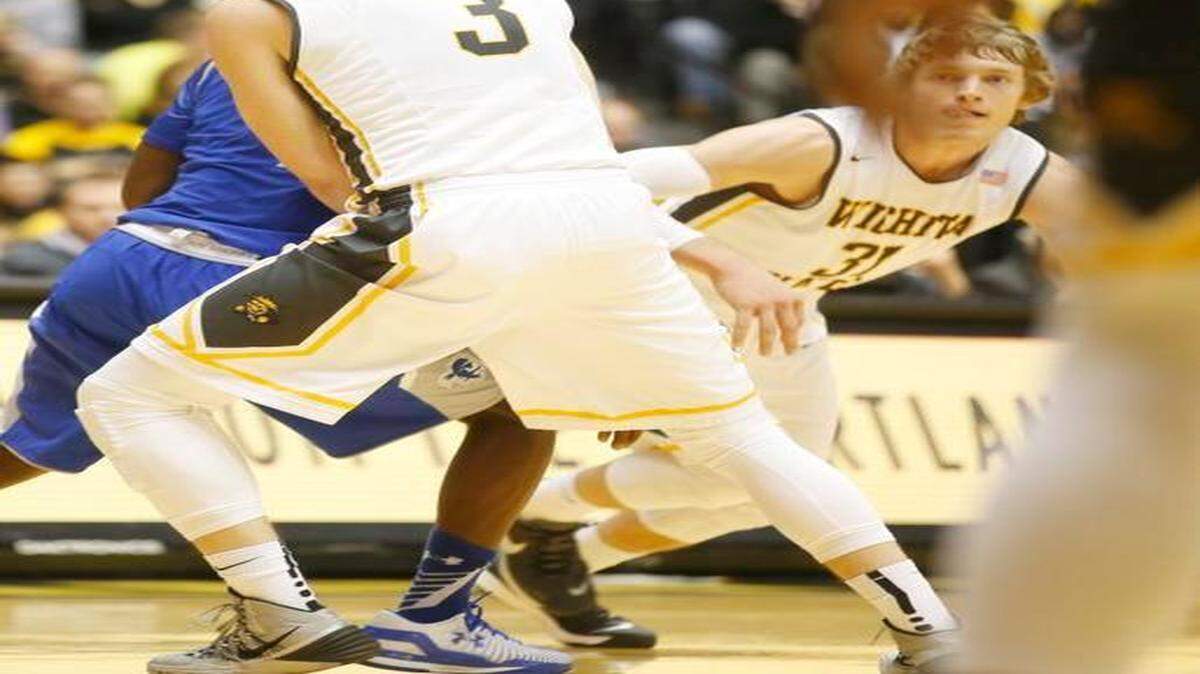
ST. LOUIS – The ball-screen offense no longer needs a name. It is offense in college basketball.
“Darn-near every set we have has some type of ball-screen action in it,” Drake coach Ray Giacoletti said. “You had a ball-screen play, maybe one, maybe two, when I was an assistant at Illinois State in the early ’90s. The evolution has been mind-boggling.”
Watch the Missouri Valley Conference Tournament this weekend and you will see the same familiar scene start most offensive sequences. A big man runs toward the three-point line and puts his body in the way of a defender to free up a guard and create 5-on-4 or 4-on-3 advantage that leads to open shots. While Evansville runs a motion offense with less of a reliance on ball screens, the rest of the Valley largely follows this formula.
“We spend an inordinate amount of our time … discussing how to defend the ball screen, so that shows how you how prevalent ball-screen offenses are,” Wichita State coach Gregg Marshall said.
Eighth-ranked Wichita State also runs a motion offense, one that often uses ball screens. WSU’s use of the ball-screen portion of its offense has increased in recent seasons, following the national trend. For Marshall, the growth of the offense starts with the supply of talent.
“That’s what kids are doing now in high school and AAU,” Marshall said. “That’s what they’re good at. You play to the strengths of your players.”
Marshall’s ball-screen offense is in the hands of a master point guard, junior Fred VanVleet. He leads the MVC with an average of 5.4 assists and ranks 11th nationally with an assist-to-turnover ratio of 3.29. VanVleet is strong enough to handle contact when he navigates past defenders, patient enough to let the play develop properly and his dribbling skills let him go where he wants at the right speed. He knows when to pass to an open shooter, when to take the shot himself and when to let his dribble linger to create something better.
“He’s got an awesome handle, very tight, precise,” Marshall said. “He is also has tremendous vision. The ball screen is designed to create a either a mismatch or a numbers opportunity. He reads those situations very, very well and gets the ball to the open guy.”
VanVleet came to WSU prepared to run that offense in AAU and high school.
“It’s dominating all levels of basketball,” he said. “The NBA model is flowing down through all levels of basketball.”
VanVleet’s goal is to focus on the defenders helping and figure out his next move. A good screen will wipe out his defender and he can do the rest.
Sometimes a teammate is rolling to the hoop — as center Bush Wamukota did early in Saturday’s Northern Iowa game. Sometimes the screener will pop out for an open three-pointer, a skill that made former Shocker Cleanthony Early dangerous. His best option might be Ron Baker or Evan Wessel open across the court because their defender needed to rotate. If a team switches, VanVleet might get the ball to Darius Carter guarded by a small player or he might drive past a center who can’t match his quickness.
“I’m thinking about the second and third guy,” he said. “It’s part of having confidence in your ball-handling skills and your game as an offensive player that you’re not really considering the guy that’s guarding you. You’re trying to know what you’re reading coming off the screen and knowing what you’re looking for and knowing your progressions.”
Northern Iowa went big with the ball screen because of another strong, skilled point guard. Former Panther Kwadzo Ahelegbe led the Panthers to the 2009 and 2010 NCAA Tournament and his ability to beat defenses off the screen caused coach Ben Jacobson to cut back on set plays and give him the freedom to use the screens. Current Panthers Deon Mitchell and Wes Washpun are in a similar mode, although Jacobson uses set plays with them.
“We felt like (Ahelegbe) had the ability to do some things with the ball screen and create,” Jacobson said. “He was big enough and strong enough and had a good enough feel where we could get some offense out of it.”
The ball-screen offense succeeds when the guard navigates past that first screen, leaving a defender trailing the play. Sometimes, the most effective plays start off a second or third ball screen that leaves the defense unorganized and hustling to the proper spots. ESPN’s Jay Bilas played at Duke from 1982-86 and doesn’t remember using ball screens.
“There weren’t any,” he said. “People ran motion and flex and reverse-action and a whole bunch of stuff.”
Now that big bag of offensive strategy is often reduced to some variation of putting a large man in the way of a defender, making the defense adjust and seeing what happens next.
“Once you cause the defense to rotate … they’re scrambling and you’ve got an opportunity to really create some havoc,” Bilas said. “You put a defense in rotation and it makes rebounding hard. That’s why they do it — because it works.”
Coaches say the influence of the NBA and European basketball popularized the ball screen, or pick and roll, attacks. What started as a simple John Stockon-to-Karl Malone pick and roll evolved into a growing species of offense.When Giacoletti coached at Gonzaga, the Zags ran a variety of a ball-screen offense borrowed from David Blatt, then a professional coach in Israel and now coach of the Cleveland Cavaliers.
“You’re trying to find ways to stay on the cutting edge,” Giacoletti said. “We had played six teams in the Big 12 and by the end of the year, half the Big 12 was running some part of that offense.”
Southern Illinois coach Barry Hinson sees some problems with the college game imitating the pro game. If, as some propose, the shot clock is reduced to 30 seconds, the differences between the games will shrink even more and continue to take defense out of the game.
“We are, no question, in a collision course with the NBA on how we play,” he said. “It’s all going to be about spacing and it’s all going to be off ball screens. It bodes well for ‘we don’t care about defense, we just want to see offense.’”
Reach Paul Suellentrop at 316-269-6760 or psuellentrop@wichitaeagle.com. Follow him on Twitter: @paulsuellentrop.
Pick and stop
Wichita State employs eight ways to defend ball screens, some aggressive schemes that try to disrupt the dribbler and some that try to contain and direct. Fans hear four terms most commonly:
Hedge — The second defender stays with the ball handler, trying to slow his progress and keep him from dribbling to the basket, while his teammates gets around the screen and recovers. The player that hedged must hustle back to his man, who may be rolling toward the basket.
Down or ice — This tactic uses the sideline as a defender when the defense wants to keep the ball out of the middle of the court. The on-ball defender stays on the hip of the dribbler to force him away from the screen and toward the sideline.
Switch — Teams with several versatile defenders can switch players on screens, an effictive tactic with the right personnel. With the wrong personnel, it results in mismatches with small defenders guarding big men close to the basket.
Trap or blitz — Defenders aggressively double-team the ball handler to take the ball out of his hands and ruin the offense’s timing.
This story was originally published March 5, 2015 at 3:59 PM with the headline "Screen test: College basketball offenses move in one direction."