
Texas’ size could cause problems for Jayhawks
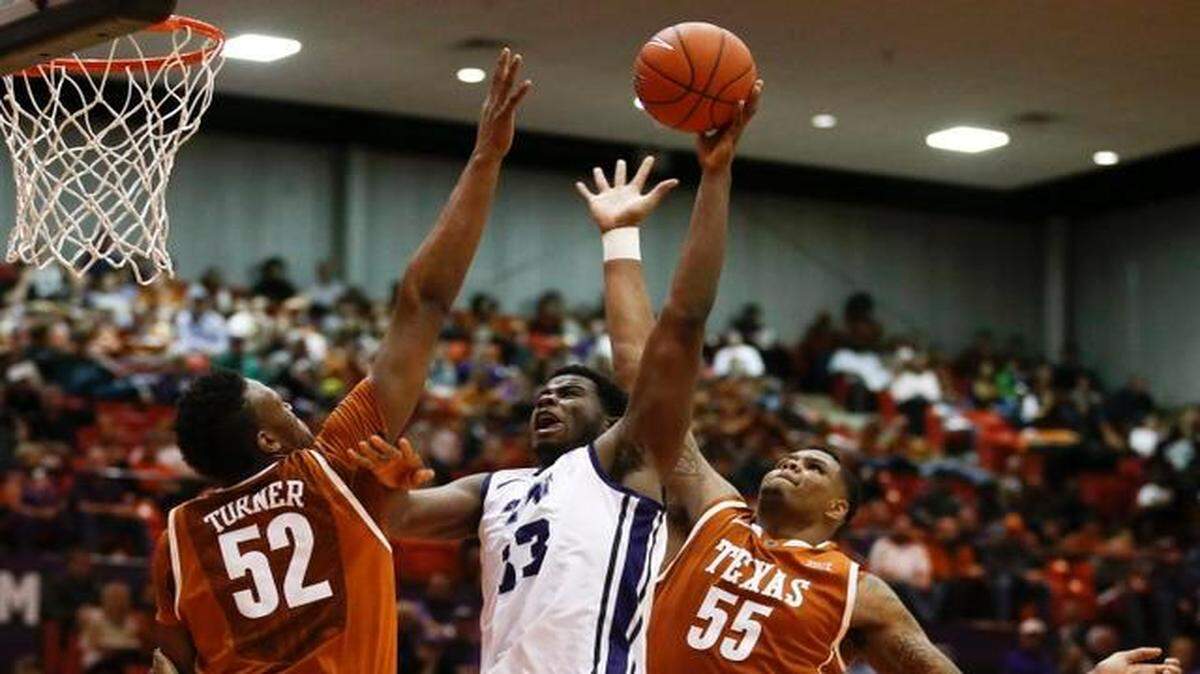
The promising freshman big man, the one with the NBA future and impressive stat line and McDonald’s All-American pedigree, is still not a starter.
The promising big man comes off the bench, a consensus top-10 recruit playing fewer than 23 minutes per game on a ranked team in the nation’s deepest conference. He is his team’s most dangerous shot-blocker, its longest inside presence, but he is still not starting. At least not yet.
For the moment, the freshman big man plays behind a cast of veterans, including one forward averaging fewer than six points per game.
Does this sound familiar? This could be Kansas freshman forward Cliff Alexander, but it is not. This is Texas freshman forward Myles Turner, a 7-footer who leads the Longhorns in scoring (11.8) and rebounding (6.8).
Turner, a native of Euless, Texas, picked Texas over Kansas last spring after a highly publicized recruitment, donning a burnt orange bucket hat inside his high school gymnasium. His decision, which left Kansas without a classic five-man and added to a collection of emerging talent in Austin, appeared to throw the Big 12’s power structure into question. Perhaps Texas, with its five returning starters and massive frontline, would finally be the team to snuff out Kansas’ streak of 10 straight Big 12 titles.
“They’re big,” Kansas coach Bill Self said.
“They’re huge,” Kansas sophomore Wayne Selden said.
So far, though, the Texas-as-Kansas-slayer narrative hasn’t exactly played out perfectly. Despite some solid performances from Turner, the 17th-ranked Longhorns are 14-4 and 3-2 in the Big 12 as No. 11 Kansas arrives for a 1 p.m. matchup on Saturday at the Erwin Center. Still, there is all that size, which perhaps positions Texas as a matchup nightmare for the smallish Kansas frontline.
Loaded with a frontcourt that also features 6-foot-9, 285-pound center Cameron Ridley, 6-foot-9 forward Connor Lammert, 6-foot-10 center Prince Ibeh and 6-foot-8 small forward Jonathan Holmes, the Longhorns have the nation’s most imposing roster in the non-Kentucky division.
“We definitely are going to have to rebound,” junior forward Perry Ellis said. “It’s the key for that game with their length.”
For now, the Longhorns rank second in the country in blocks (7.7 per game) and first in total rebounds (29.3). The Jayhawks have struggled against teams that can protect the rim and seal off the paint on defense. Especially away from Allen Fieldhouse. Exhibit A: Last season, Texas blocked 12 shots while dismantling Kansas 81-69 in Austin. Exhibit B: Earlier this season, No. 1 Kentucky throttled Kansas 72-40 by blocking 11 shots and erasing any offensive opportunities around the basket.
Self prefers his teams to pound the ball inside and beat teams into submission with easy baskets. On Saturday, the Jayhawks could use a solid performance from Alexander, who had 13 points and 13 rebounds in Monday’s victory over Oklahoma. But standing inside Allen Fieldhouse on Thursday afternoon, Self said Kansas would need to play with more pace and more ball movement to combat the Longhorns’ size advantage.
“Our 5-foot guys tried to shoot over a lot of 7-foot guys the last time we played Kentucky,” Self said. “I think we need to challenge them, but we don’t need to fade away from contact. We did that way too much the first time we played Kentucky.”
Unlike last season, the Jayhawks are better positioned to neutralize Texas’ post defense with some efficient three-point shooting. After making 10 of 19 from behind the arc against Oklahoma, Kansas is shooting 39.7 percent from three-point range, which ranks 19th in the country. In addition, Texas coach Rick Barnes is again utilizing a zone defense on a large percentage of possessions, and Self expects to see plenty of zone on Saturday.
“We got to score inside,” Self said. “But on the flip-side, we can play inside-out.”
In Self terms, this means reversing the ball and attacking Texas on the “second and third side” of the court. If the ball sticks — if the Jayhawks’ offense is too stagnant and slow — that could spell trouble against Texas’ length.
Self, though, has never been one to rage against his natural coaching instincts. If Kansas is hoping to pick up a crucial road victory — and maintain at least a share of first place in the Big 12 — the Jayhawks will need to hold their own against Texas in the paint.
“I feel like if we go down there and compete like we have been, I feel like everything will go well,” Ellis said. “The key with us is just the energy.”
Reach Rustin Dodd at rdodd@wichitaeagle.com. Follow him on Twitter: @rustindodd.
No. 11 Kansas at No. 17 Texas
When: 1 p.m. Saturday
Where: Erwin Center, Austin
Records: KU 15-3, 4-1 Big 12; UT 14-4, 3-2
Radio: KFH, 1240-AM, 98.7-FM
TV: KWCH
Kansas at Texas
P | Kansas | Ht | Yr | Pts | Reb |
F | Jamari Traylor | 6-8 | Jr. | 5.2 | 4.1 |
F | Perry Ellis | 6-8 | Jr. | 12.8 | 6.6 |
G | Kelly Oubre | 6-7 | Fr. | 8.6 | 4.5 |
G | Wayne Selden | 6-5 | So. | 8.9 | 2.9 |
G | Frank Mason | 5-11 | So. | 12.7 | x-4.2 |
P | Texas | Ht | Yr | Pts | Reb |
F | Connor Lammert | 6-9 | Jr. | 5.1 | 5.8 |
F | Jonathan Holmes | 6-8 | Sr. | 11.4 | 6.7 |
C | Cameron Ridley | 6-9 | Jr. | 8.7 | 4.8 |
G | Demarcus Holland | 6-2 | Jr. | 7.6 | 3.6 |
G | Isaiah Taylor | 6-1 | So. | 11.4 | x-3.5 |
x-assists
Kansas: The Kansas defense has made measured progress during Big 12 play. After five conference games, the Jayhawks rank third in field-goal percentage defense (38.2) and sixth in scoring defense (66.0 points). But after giving up an average of 82 points to Iowa State and Oklahoma in their last two games, the Jayhawks’ season defensive numbers are still a bit alarming. Kansas ranks 47th nationally in defensive efficiency, according to KenPom.com, which would be the worst ranking of the Bill Self era. Opposing offenses are also shooting 44.7 percent inside the three-point line, the worst mark of Self’s tenure. Oubre has provided a spark on the defensive end during conference play. He’s averaging 2.4 steals and 6.2 rebounds during conference games. Oubre (21 steals) is second on the team behind Mason (25 steals) despite playing more than 250 fewer minutes on the season. Last season, the Jayhawks took one on the chin in Austin, falling 81-69 while the Longhorns’ perimeter speed and inside length overwhelmed a young Kansas team. Before last year, Kansas had won three straight over Texas at the Erwin Center.
Texas: Texas was just short of edging perennial favorite Kansas in the preseason coaches’ poll. The Jayhawks received six first-place votes and 78 points; Texas had three first-place votes and 74 points. The Longhorns returned all five starters off last year’s team and added five-star center Myles Turner, so they were a trendy selection to dethrone Kansas. It hasn’t quite been that smooth. Taylor was sidelined 10 games after suffering a wrist injury in November, and Texas dropped games to Kentucky and Stanford while he was out. Taylor returned for Big 12 play, but the Longhorns began 1-2, getting throttled at home by Oklahoma and losing at Oklahoma State. The Longhorns, who rank sixth in the country in defensive efficiency, have rebounded with impressive victories over West Virginia and TCU, but they need a victory on Saturday to keep pace in the ultra-competitive Big 12. Turner, a major Kansas target in recruiting, has mostly come off the bench while leading the team with 11.8 points per game. Texas ranks second in the country in block percentage, swatting 19.7 percent of teams’ shots inside the three-point line.
RPIs as of Friday: Kansas 2, Texas 17
This story was originally published January 23, 2015 at 5:16 PM with the headline "Texas’ size could cause problems for Jayhawks."