Paul Pierce credits ‘two great traditions’ at KU, Boston for helping him attain Hall
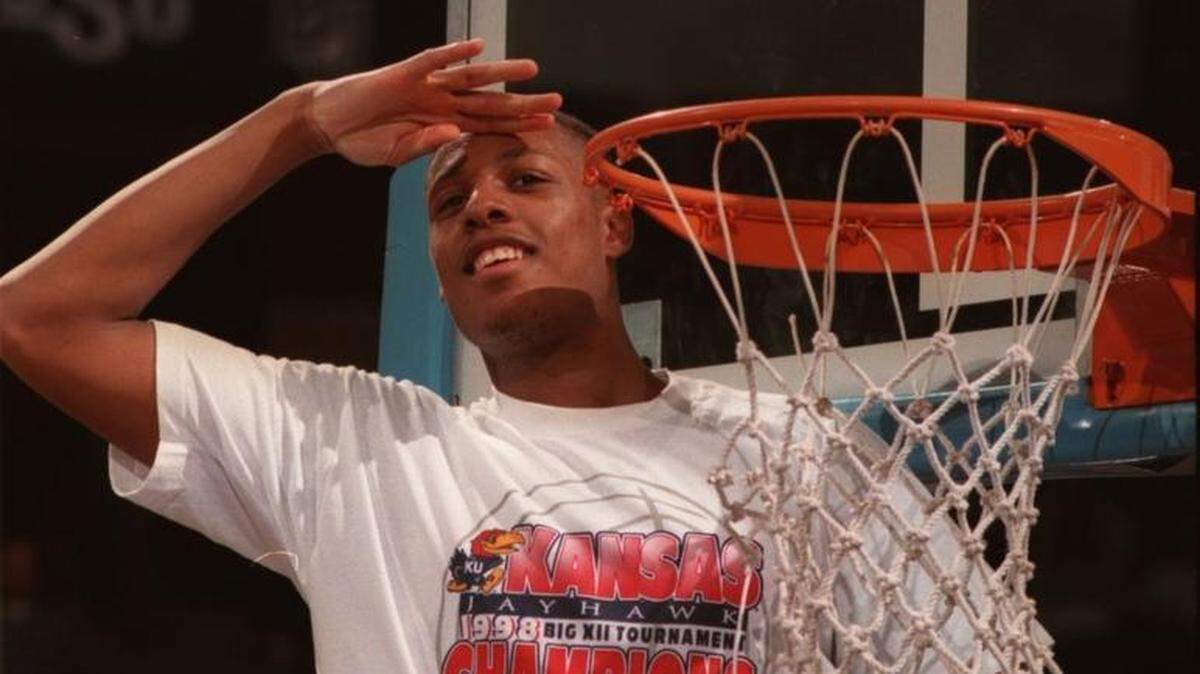
Paul Pierce built his Naismith Memorial Basketball Hall of Fame resumé by starring three seasons at the University of Kansas and 15 more with the NBA’s Boston Celtics.
“I have really been blessed to be a part of two great traditions,” Pierce, who turns 44 on Oct. 13, said the last time he was in Lawrence. That was Sept. 24, 2011 when he played in the Legends of the Phog KU alumni game at a sold-out Allen Fieldhouse.
“It’s a special feeling when you come into Allen Fieldhouse. It’s a players’ gym,” 6-foot-8 small forward Pierce added of a building in which he never lost a game. The Los Angeles native went 44-0 in KU’s historic building covering the 1995-96, 96-97 and 97-98 seasons.
“Once you walk into the Fieldhouse the adrenaline starts going. If you’re the opposite team then you are in trouble. I’m glad I went here and didn’t have to play as an opponent here,” Pierce added of KU.
Similar to college, Pierce during the first 15 seasons of a 19-year NBA career played his home games at equally historic Boston Garden.
Pierce’s achievements as a collegian and pro — which included one NBA title, one runner-up finish and 10 all-star game appearances to go with his status as a consensus first-team All-American and first-team all-conference pick at KU — have led to him being enshrined into the Hall of Fame at 6 p.m. Central time Saturday, in Springfield, Massachusetts.
His jersey No. 34 hangs in the rafters of both basketball palaces.
“In my career. I go from one tradition at Kansas to another basketball tradition,” Pierce said March 19, 2020 in an appearance on the “All the Smoke” podcast, hosted by his NBA peers Matt Barnes and Stephen Jackson.
“Legends were everywhere and they came to the games. I’d look in the stands and see Jo Jo White, Bill Russell. You saw legends like Red Auerbach, Tom Heinsohn, Cedric ‘Cornbread’ Maxwell, Hondo Havlicek,” Pierce added, referring to Boston Celtics greats.
In the third and final season of his KU career he had a chance to meet a seemingly larger than life Jayhawk legend.
Wilt Chamberlain returned to Lawrence to have his jersey hung in the south fieldhouse rafters at halftime of the KU-Kansas State game on Jan. 17, 1998.
“You look at a player like Wilt who paved the way for a lot of players at Kansas and also the NBA. That’s really where I saw the first type of family atmosphere because when I was at Kansas they brought back some of the old teams,” Pierce said. “Wilt came back and other former players were always coming around. KU is just a special place where we’re always welcome back as players.”
It’s interesting to see how Pierce wound up as one of the best players in both Kansas and Celtics history.
“When I look back at my career I think some stuff was meant to be,” Pierce said. “When I was in high school (Inglewood High) I was recruited by the Pac-10 teams — USC, UCLA, all the West Coast schools. UCLA actually just won a national championship. I was supposed to be next in line to help them win again,” noted Pierce, a late bloomer who played baseball and football in his birthplace of Oakland until the age of 10 when he moved to the East side of Los Angeles. He took up basketball when he moved to Inglewood at the age of 11.
“I knew myself. I was getting in trouble on the streets. It was just me and my mom. I’m doing pretty much whatever I want. She was working two jobs, night shifts, not getting home until late. My older brothers were out of the house. I was like, ‘I need to get out of here. I need to get to Kansas,’’’ Pierce said.
“I was like, ‘I need to get away from everything, focus on school and just hoop.’ I had friends who were getting killed, friends who lost their life in high school. Something could happen to me. I lived in a volatile area. No kid should ever grow up around gun shots firing every other night. Putting hands over your ears, losing friends at a young age, you see that you grow up fast. You make tough decisions. I needed to get out.”
A trip to Allen Fieldhouse made KU the front runner in the recruitment of Pierce.
“When I stepped on the court and saw a Kansas game it was like nothing I knew,” Pierce said. “I just knew I had to go there. The crowd … you see it on TV. It was like, ‘That’s something I have to play for,’’’ Pierce stated.
Then-KU coach Roy Williams and assistant Steve Robinson closed the deal.
“When we recruited Paul, we had four starters coming back but no small forward,” Williams told The Star in a phone interview Tuesday. “I asked Steve Robinson (KU assistant) to make a little puzzle. He got pieces of cardboard of Jerod (Haase), Jacque (Vaughn), Scot (Pollard) and Raef (LaFrentz) and sent it to Paul.
“The next day we sent the other piece to him. We sent the final piece of the puzzle. It was Paul’s space to put in there (the puzzle). There was a message that read, ‘You are the missing piece to the puzzle,’’’ Williams related.
Pierce still remembers that final pitch.
“I played with Jacque Vaughn. He made the pros. Scot Pollard played in the pros. Raef LaFrentz played in the pros. We had a scrappy guard, Jerod Haase, who is coach at Stanford now. He was tough. We had Billy Thomas, a shooter off the bench. He played in the pros, too. We had a pro squad. We were supposed to win it. I was the final piece to the puzzle,” Pierce said on the “All the Smoke” podcast.
KU, which went 98-11 during Pierce’s years at KU, didn’t reach the Final Four during his college career. The Jayhawks went 34-2 his sophomore year — one in which the Jayhawks were stunned by eventual national champion Arizona in the Sweet 16.
“The tournament is unforgiving,” Pierce said in an article he wrote for the Players Tribune in 2015. “If you have one bad game, that’s it. Throughout my career I’ve had many losses, but all these years later, this is one that still stings.”
He left KU after his junior season amid reports he’d likely be selected No. 1 or 2 in the 1998 NBA Draft. Instead, he somehow fell to No. 10 overall — the slot in which he was selected by the Celtics.
“The Clippers had the No. 1 pick. I was like, ‘I want to go home and play,’’’ Pierce said. “I worked out for them. Then I asked for a second workout. The Clippers wanted a big man. They picked (Michael) Olowokandi. I was, ‘OK. I’m locked in. I’m going to go to Vancouver and play with Shareef Abdur-Rahim.’
Instead, Vancouver took Arizona’s Mike Bibby at No. 2.
“After that I just slipped. I’m an All-American. I’m a top five player in college. I’m up for national player of the year so I’m wondering, ‘Why is it that I’m slipping in the draft?’’’ Pierce said.
“I can tell you the order: Denver (took KU’s LaFrentz at No. 3), Toronto (Antawn Jamison), then you’ve got Golden State (Vince Carter), Dallas (Robert Traylor), Sacramento (Jason Williams), Philadelphia (Larry Hughes), Milwaukee (Dirk Nowitzki).
“I went to the gym after I got taken by Boston at 10 and I started shooting. I said, ‘Clippers,’ then shot it in; ‘Denver, Vancouver,’ all the teams that passed on me. This became my motivation.
“I was competitive,” he continued. “I wanted to be the No. 1 pick, at worst 2. I said, ‘These eight, nine teams that passed on me, you are all going to feel this one.’’’
Pierce was surprised he went to Boston. “I didn’t work out for the Celtics,” he said. “I didn’t know life would come full circle, coming from L.A. to living in Boston all those years.”
He noted that he “came in (the NBA) with a chip on my shoulder. I wasn’t going to wait for anybody. I’m here. I’m (ticked) at the other teams that didn’t draft me: I said, ‘This is it. You only get one shot. This is my shot. I need to make a name for myself right now.’
“That was the fire in me, the competitiveness. I wasn’t going to take a back seat to anybody. That was my mentality. I was like, ‘You are going to love me or hate me. This is how I’m going to play every night, like it or don’t.’’’
Pierce was an instant sensation. He averaged 16.5 points and 19.5 points a game his first two years with the Celtics.
Misfortune arrived on Sept. 25, 2000 when he was stabbed 11 times in a Boston nightclub. Despite suffering a collapsed lung and other serious injuries, he was fully recovered by opening night and played in all 82 games that season, averaging 25.3 points a game.
Pierce, who was nicknamed “The Truth” by the Lakers’ Shaquille O’Neal after scoring 42 points against L.A. in a game in March of 2001, went on to win an NBA title — he was MVP of The Finals against the Lakers in 2008 — and two seasons later played for a Celtics team that lost to the Lakers in The 2010 Finals.
“Who would have thought a kid from L.A., playing in Boston, playing against the Lakers in the championship wins, then plays them again,” Pierce reflected on the Matt Barnes/Stephen Jackson podcast. “My only two Finals were against the Lakers. The sacrifice, the blood I spilled, the sweat, the late hours, not being around family members ... so much stuff I missed. It’s because of that,” he added of pursuit of a title. “We dedicate our whole lives for this.”
Of his entire career, Pierce, who played for Brooklyn in 2013-14, Washington in 2014-15 and for the L.A. Clippers in 2015-16 and 25 games in 2016-17 before electing to retire, stated: “I still look back and say, ‘Man I played 19 years?’ Sometimes I catch myself like, ‘Let me look at some Youtube of me. Let’s see if I could have played in this era.’ You catch yourself watching some of your old highlights.
“We all go through struggles for a reason, even me for being stabbed in the nightclub. I don’t think there’s anything I’d change in my story. I think it molds you to who you are. Through the good and bad, it molds you. I feel blessed,” he added.
This story was originally published September 9, 2021 at 6:02 AM with the headline "Paul Pierce credits ‘two great traditions’ at KU, Boston for helping him attain Hall."