Two analysts’ favorite KU hoops play: ‘Aesthetically pleasing’ — with Istanbul roots
Jordan Sperber had already sent out seven tweets about the Kansas-Baylor game on Feb. 22, but none had caught on quite like this.
Sperber — a former college basketball video coordinator who now runs the subscription site Hoop Vision Plus — recorded video on his computer of a successful play KU ran for an alley-oop. He uploaded it to Twitter, then added his own commentary: “The most aesthetically pleasing ball screen set in the country strikes again.”
Coaches around the country certainly took note. The tweet received more than 1,400 likes — reaching the type of viral status that only happens about once or twice a month for Sperber.
“Hyping it up in the caption probably helped,” Sperber says now.
There was a good reason for that, though. Sperber — well-respected nationally for his knowledge when it comes to college basketball X’s and O’s — had spoken of his admiration for this KU play before, and when asked by The Star last week, he picked this one as his favorite from coach Bill Self’s playbook.
He’s not alone.
The Star also reached out separately to Gibson Pyper, a high school assistant coach whose Twitter account — Half Court Hoops — has 40,000 followers while serving as a brainstorming factory for coaches at all levels who want to watch or share clever basketball plays.
Pyper’s choice for KU’s best play? The same one as Sperber selected.
So what makes this set effective? It turns out quite a bit, including false motion, a Self specialty and also the intentional distraction of key defenders.
Before getting deeper into the details, though, Self stops to tell a story.
If you want to talk about this play, he says, you need to learn about Bill Pope.
Turkish roots
Pope is ready to talk about his text message to Self, but first, he has a question to ask.
“He actually gave me credit for something?” he says with a laugh.
It’s the type of ribbing you’d expect from two longtime friends. Pope, now the director of pro personnel for the Orlando Magic, first met Self on Larry Brown’s KU staff in 1985-86. At the time, Self was a graduate assistant, while Pope was team manager; the two lived across the fairway from each other at then-Alvamar Country Club in Lawrence, and Pope was later a participant in Self’s wedding.
This helps explain why Pope, a former college assistant coach, feels comfortable texting his old friend every couple weeks when he discovers a new basketball play he likes.
“It’s more often than he probably wants,” Pope says, “but he filters through it.”
This instance was no different.
Pope, a few years ago, came across a tweet from basketball coach Ryan Pannone. The short video highlighted a play from coach Željko Obradović of Fenerbahçe, a EuroLeague team based out of Istanbul, Turkey.
The point guard’s action in particular intrigued Pope, and also made him think back to Self, believing that KU might have the right sort of lineup to make the play successful.
He pulled out his phone and sent a message to Self — “I have an affinity toward my Jayhawks winning games,” Pope says — without any expectation.
Self said he looked at the set, tinkered a bit, then came up with two versions of it so his team could run it to both the left and right. Since then, the movement has remained a staple of KU’s offense each of the last two seasons.
In this case, Sperber says, the trick is in the execution.
The “aesthetically pleasing” part? That’s actually the reason it works so well.
‘(A) different feel from normal’
Let’s begin as simple as possible.
Why is this play so successful? Sperber says if the timing is right, it’s as straightforward as this: “The lane opens right up for the Doke’s (Udoka Azubuike’s) roll to the basket.”
The details needed to get that exact setup — Azubuike charging to the basket with little to no help defense — are subtle but also worth exploring step by step.
Let’s examine KU’s alley-oop against Baylor. Everything starts with action to get the defense moving, with Devon Dotson passing to Ochai Agbaji, who hands off to Marcus Garrett.
Those who have studied Self know that he values getting the ball from side to side while attempting to make a defense work. Here, KU has gotten the ball from right to left to right in three seconds, which creates more opportunities for the defense to be unset.
The first person to focus on is Agbaji and his defender, as he moves to the corner on the side opposite of the ball screen. In this instance, Baylor’s defenders switch and Jared Butler is on Agbaji.
All this action, though — Agbaji catches a pass, hands off, then clears — creates confusion. When Azubuike rolls, it’s typically the job of the lowest weakside defender — that’s Butler here — to “tag” or impede his run toward the basket.
Butler, though, gets lost in everything else going on. He watches the play, searches for Agbaji, turns his head just for a second ... and that’s all KU needs. Garrett lofts the pass to Azubuike, who slams it down while uncontested at the rim.
There’s good reason for Butler to be a bit confused, and it’s caused by the other player worth watching. That’s Dotson here, who makes a pass, then circles around the lane and lifts back to the top.
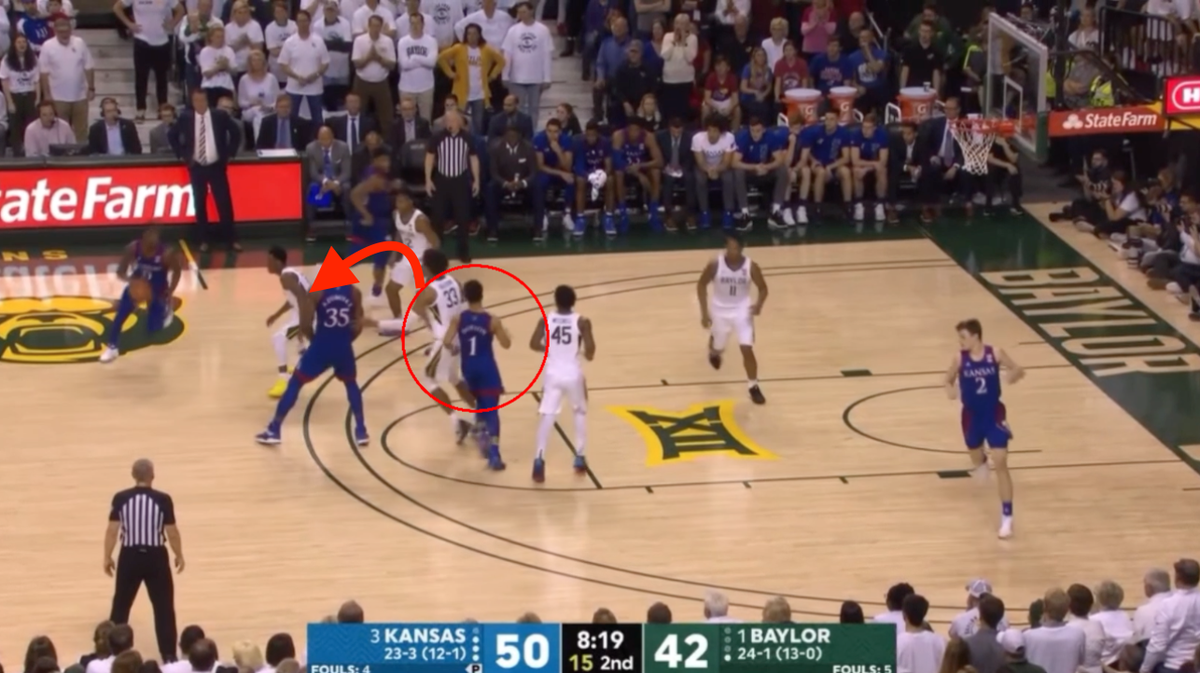
If Dotson had run to the corner by Agbaji, his defender would have been helping on Azubuike’s roll. That’s a much more common action that defenses see.
But because he comes back to the top while clearing the lane ... Butler is now the helper. And he needs to be paying close attention to even know it.
“It just creates a different tag and different look, a different feel from normal,” Pope says. “I think that’s the big thing.”
Dotson’s specific movement can create other openings as well. Against Duke, KU ran this play twice with success; Dotson bumps into Garrett’s defender the first time to create a layup, while the second time, Duke’s Tre Jones (guarding Dotson) steps up to help Garrett’s drive, which leaves Dotson wide open.
“I love this set because of the way it creates natural movement that the defense has to account for,” Pyper says.
“Most of my commentary would really be applicable to most of Self’s plays,” adds Sperber. “He uses false motion to distract help defenders from realizing they need to help.”
Self likes it for a few reasons: It gets the ball side to side, creates a potentially open ball screen and also leaves plenty of time at the end of the shot clock to run something else in case the defense is sound early.
This also could have some extra benefit in the college game. Pope says because teams often have long amounts of time to prepare, the point guard’s lift here potentially adds another item to the opponents’ scouting report against KU.
He also is quick to credit Self. The difference between good coaches and great ones, Pope believes, is the ability to adapt and create plays that fit a team’s roster.
Self, in this case, took a video text, looked at his players’ skill-sets and added a couple details, which eventually led to a dunk in KU’s biggest game last season.
It’s the exact reason, Pope says, that he sends Self all his crazy ideas in the first place.
“It’s fun to watch,” Pope says, “when they run a play and it works.”
This story was originally published April 17, 2020 at 9:28 AM with the headline "Two analysts’ favorite KU hoops play: ‘Aesthetically pleasing’ — with Istanbul roots."