They committed to KU football, then had scholarships stripped. NCAA rules allow it
The alarm sounded at 5 a.m. every Saturday, but Jackson Stoefen set it voluntarily. He figured it a small sacrifice.
After committing to play football for Kansas in May, he didn’t want to miss game day in Lawrence — even if it was a six-hour drive from his hometown of Eldridge, Iowa.
He had developed a routine: On the road by 6, two Sausage McGriddles from McDonald’s for the trip down and a couple of Bang Energy drinks stashed in the car for that long drive home.
His 2011 Toyota Camry LE would get him there — not only the 6-foot-5 Stoefen, but also two of his best friends he’d asked to tag along. Once, he even brought along another offensive line prospect, hoping he’d commit to KU too.
A few months earlier, Stoefen had called KU football coach Les Miles to commit to his program. He remembers the sound of KU’s assistant coaches hollering in the background during a staff meeting.
“Felt really wanted,” Stoefen said, “just like any other kid when they commit to a program.”
The Jayhawks needed offensive linemen for 2020, so the staff suggested he graduate early so he could make it to Lawrence in January; Stoefen was hesitant at first, then thought, “Why not?” It would put him in the best position to chase his dreams.
Indiana wanted him to visit campus, but that didn’t feel right. Stoefen told the Hoosiers he had committed to KU, declining an invitation to the Ohio State game that likely would have netted him another offer from a Power Five conference team.
It’s why, months later in a restaurant parking lot, Stoefen hung on every additional text his mother sent him.
Stoefen was with his girlfriend in November, six months after he had committed to KU, when he said he received a call from Miles asking if his parents were with him. A few minutes later, Miles called his mother, who relayed the news to Stoefen a few characters at a time.
As it turns out, this message hasn’t been unique with KU football in the past few months, and it’s had a recent ripple effect in the Kansas City area.
KU had pulled Stoefen’s scholarship offer before the NCAA’s signing period opened the next month.
A KU Athletics spokesperson said the school and coaches can’t discuss past recruits who are at other schools, because of NCAA compliance rules.
And though the practice of revoking scholarship offers before a player can sign has been rare around this area, KU football’s actions here — in a technical sense — remain within the rights of college football teams.
If one wants to really get at the heart of eliminating recruits getting dropped … well, that’s something the NCAA can best address with a change in its rulebook: a manual that currently allows colleges to offer more scholarships than they can fill as they compete for the best kids in the nation.
Then leave the rest as an afterthought.
“It was just like my entire life,” Stoefen said, “was broken at that moment.”
KC area players affected
Jaylin Richardson, while meeting with then-KU assistant coach Clint Bowen, was unprepared for the words that came next.
Richardson, a running back from F.L. Schlagle High School in Kansas City, Kansas, received his KU scholarship offer in late May after an impressive camp performance. Two weeks later, he’d thought about it enough.
He was ready to commit to KU.
Schlagle coach Taylor Wallace said Richardson’s loyalties were clear after that. Texts he received from Richardson’s family ended with the two familiar words: “Rock Chalk.” Everyday when Wallace saw Richardson at school, it seemed like he was either wearing a KU shirt or hat.
“It was almost like he was on their roster already,” Wallace said.
Richardson, like Stoefen, started plans to become an early enrollee. KU had helped clear him with the NCAA, he said, with his move-in day set for Jan. 10.
That was until KU’s final home game against Baylor on Nov. 30. Bowen texted Richardson the night before to ask if he was coming to the game, saying he’d meet with him then.
The next day, Bowen pulled him into an office before the game to deliver the message: His scholarship offer, like Stoefen’s before him, was stripped.
Richardson left the room, grabbed a couple more bites of food around other KU recruits, then left the game before halftime.
“It was really hard to process what was told to me at the moment, because I was in shock,” Richardson said. “It was nearing the end, so it caught me off guard.”
With early graduation just two weeks away, his options were limited. Many other Division I programs had already filled their recruiting classes, while other schools that might be interested in him had no way of knowing he was available.
Richardson began texting and calling other colleges, serving as his own self-promoter while searching for that perfect match of coach and school; both needed to not only be interested in him, but also ready to accept him to campus the very next month.
He felt fortunate to find a fit in Northern Iowa, an FCS school that also has taken on recent KU football transfers Dom Williams and Quan Hampton.
After staying quiet a few weeks, Richardson also spoke up on Signing Day. In a Twitter post titled, “To clear the air,” he explained that he didn’t decommit from KU, but instead the program had decommitted from him.
“The bad end of recruitment that you guys don’t see,” Richardson wrote.
He wasn’t the only KC metro player that affected by a late curveball.
Raymore-Peculiar receiver Luke Grimm, a longtime KU pledge and planned early enrollee, reopened his recruitment on Dec. 18, saying the switch came because of “changes in scholarship expectation.” Two days later, he recommitted to KU, confirming to The Star that he’d accepted a blueshirt — a workaround that allows a team to use a scholarship from the next year’s class.
For Grimm, though, the revised offer meant he couldn’t come to KU on scholarship this semester. So he’s working out on his own with a trainer while also taking a couple college classes online.
He can train with his high school track team ... but is unable to compete this spring because he’s graduated. He’s ready for college ... but also waiting for it now because of an unforeseen change of events.
The word on Richardson and Grimm spread quickly. Wallace said he had multiple KC-area high school coaches call him after Signing Day, asking him what had happened with Richardson in particular.
“They didn’t like it. A lot of them were upset about it too. Said it’s a bunch of BS,” Wallace said. “A lot of them were saying, ‘It’s like they’re like Alabama and the LSU and the Clemson of the neighborhood.’”
‘It has raised some eyebrows’
Jeremy Crabtree — a KC-based national recruiting analyst and former editor for ESPN and Rivals — has seen scenarios like Richardson’s play out in the past at other schools.
It still never takes away from the emotion of each particular case.
“It’s heartbreaking for a lot of these kids,” Crabtree said. “ … They essentially begin to plan what the next four to five years of their lives are going to be like, then have it — for whatever reason — yanked away at the last second.”
Crabtree says this sort of maneuver is rare for colleges around this area. The last time he could remember a coach at KU or K-State pulling a scholarship offer late from a local kid was more than a decade ago, as former K-State coach Ron Prince changed Wichita Bishop Carroll player Brayden Burris’ offer in 2008 to a grayshirt; Burris later committed to Iowa State.
“I don’t recall a ton of these situations just in the Kansas City metro area,” Crabtree said. “When it does happen, people want to know more to the story.”
It’s why Crabtree heard from plenty in KC’s coaching community following Richardson and Grimm’s shifts with KU. There’s at least some danger there of burning area recruiting contacts, Crabtree said, because high school coaches are the gatekeepers for college coaches who are recruiting.
“From what I have gathered, this ruffled some feathers with some high school coaches, and high school coaches are a tight-knit community and once one talks to another, they talk to others,” Crabtree said. “It can lead to having to do some damage control.”
Crabtree is quick to point out that hearing from only recruits provides just one side of the story, while leaving room for the possibility that there is more from KU’s side that can’t be discussed.
For example: Should anything be made of the fact that after Richardson committed to KU, Miles didn’t post his typical “Here come the Jayhawks!” message on Twitter that typically immediately follows a player pledging to play for Kansas?
KU’s current roster situation also has to be taken into account. The team has been fighting to get back to the full 85 scholarship players for years now, which perhaps could have led the coaches to be especially cautious when committing scholarships to players who might have had question marks with injury or fit.
Also, is this the start of a trend, or just a blip? It was only Miles’ first year with the program, so it’s impossible to know whether the Jayhawks will continue to operate with similar methods during the next recruiting cycle or beyond.
Crabtree also notes that, on a strictly non-emotional level, KU fans could see it as a positive sign that the staff was able to shift around its class late, with that perhaps indicating coaches believing they were able to land better players. The Jayhawks’ 2020 class ranks 48th according to Rivals, which was tied for seventh in the Big 12 with K-State.
KU already is well into recruiting for next year, with Rivals reporting that the staff has already offered 285 players in the class of 2021 to fill the team’s potential 25 open scholarships.
“You maybe just have to force yourself as recruiters and coaches to be smarter about accepting a kid’s commitment,” Crabtree said. “But again, it’s kind of one of those slippery slopes, because you’ve got to build a class, and you want to be able to have momentum, especially with the early signing period what it is now. So it’s a really unfortunate situation for everybody involved.”
The easiest fix — and one that Crabtree has heard proposed before — is for the early signing period to be moved up before the season in August. If that happened, players who sign early would have their scholarships protected during their senior seasons regardless of injuries or over-signing by their colleges.
Then again, the flipside is that schools would have little protecting them from potential roster holes if a few of their recruits’ circumstances change.
“There isn’t a fix-all cure. You can’t wave a magic wand and fix over-signing and pulling scholarships at the last minute,” Crabtree said. “It’s just a really sad side effect of the whole world that’s been created with college football recruiting these days.”
Richardson, the running back from Schlagle, especially stands out to Crabtree. It’s not often that KC public school kids earn scholarships to local Division I football teams, so Richardson’s early commitment to KU became a big deal to many around the area.
The final resolution, then, also turned into a big story as well.
“It has raised some eyebrows, there’s no question about that,” Crabtree said. “When you’re in a situation like KU where you’re trying to turn around the program, that’s probably not a perception or a thing you want out there. You want to be talking about all the positives Les Miles has brought to the program so far, and all the recruiting successes that he’s had. Not having people talk about, ‘Well, did you see what happened here?’”
Wallace has already started using Richardson’s situation as a teaching moment for his younger athletes.
Even if you love a college program ... keep your options open.
“That’s what I tell them: ‘Never just be settled on just one,’” Wallace said. “‘Continue to do what you’ve got to do. Keep it in your hands, not theirs.’”
‘I wound up at the right place’
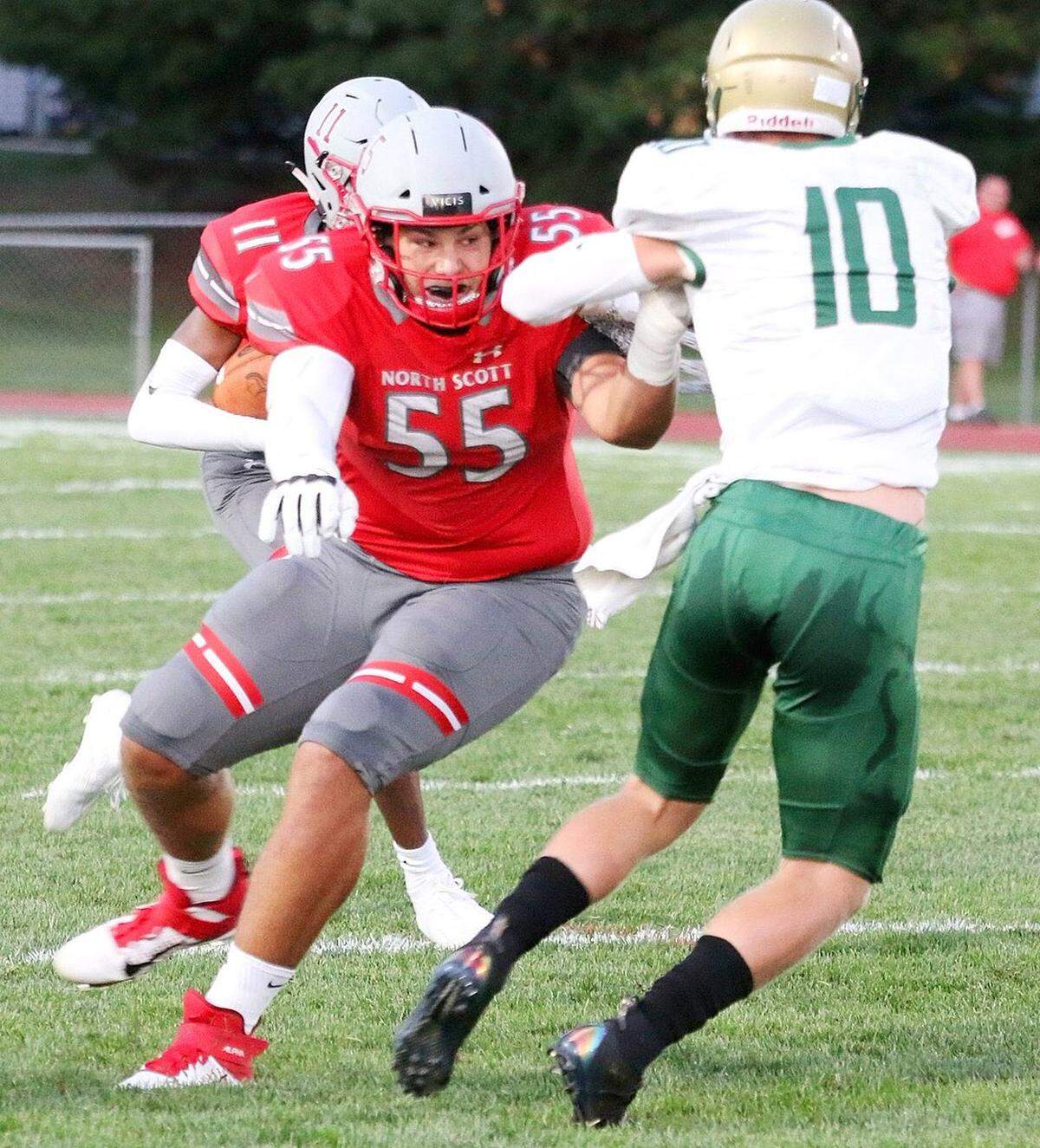
Jackson Stoefen had a decision to make.
This was after his team’s second high school game, and a teammate hit the inside of his right knee during a drill in practice.
The injury was serious, no doubt, but Stoefen was told he still had a viable option of playing through with a knee brace.
So, what should he do? Finish off his high school career and try to win a state title? Or get the knee taken care of to ensure he’d be ready for spring football at KU?
Stoefen said he reached out to KU’s coaches for guidance. They told him the best option was to have surgery on the knee right away, he said.
That decision ended his high school football career. Stoefen remembers gathering his teammates around him — ones he’d been with for nine years — to explain why he wouldn’t be playing with them in their final push for a state title.
A life at KU awaited.
Or so he thought.
Through it all, Stoefen said he religiously asked KU’s staff day after day, week after week: “Hey, am I still good with my scholarship?” He said the message from KU’s coaches was always similar: You’re fine. No worries. The team needs linemen. You’ll be here for spring ball.
That was until Miles called his parents on that day in mid-November.
“I would’ve given my entire life to go play football at KU,” Stoefen said, “and they basically said, ‘You know what? We don’t want you.’”
After months of being labeled as a D-I player, Stoefen couldn’t escape questions about his status change. He remained mostly quiet about what had happened, not wanting to talk ill about KU while he pursued other options.
Some KU fans also criticized him for his “decision” on Twitter, while message boards questioned his loyalty to the school.
“That’s the part that really truly pisses me off is that all these people are like, ‘Well, he decommitted. He did this and he did that,’” Stoefen said. “That’s the one thing that I really wanted cleared up, because I didn’t decommit at all.”
Once KU dropped him, Stoefen said his “mental health kind of went out the window, and I had to sort of pull myself back together.” He had trouble focusing in class, with much of his attention going to the constant texting of about 30 college coaches, hoping they’d give him the opportunity to get recruited again.
There was a lot working against him. Stoefen was rehabbing his knee injury. Because of the surgery, he had limited tape from his senior year, and those bigger schools that had earlier interest in him had already filled their scholarships.
Richardson’s timeline was even shorter. He had just 18 days between his conversation with Bowen and his early signing with Northern Iowa.
For both Stoefen and Richardson — they still keep in touch over Snapchat and Xbox because of their shared experience — losing their KU scholarship earlier in the process likely wouldn’t have been greeted well either, but it at least would have given them more options and reduced stress as they attempted to find new schools.
Stoefen, though, wants you to know that he’s made it through to an ideal situation.
After committing to Toledo on Dec. 10, the last two months have been a whirlwind. He’s sharing a room with three teammates from Georgia, and also has joined a bowling group with his fellow offensive linemen.
“The whole KU thing sucks,” Stoefen said, “but at the end of the day, I know I wound up at the right place.”
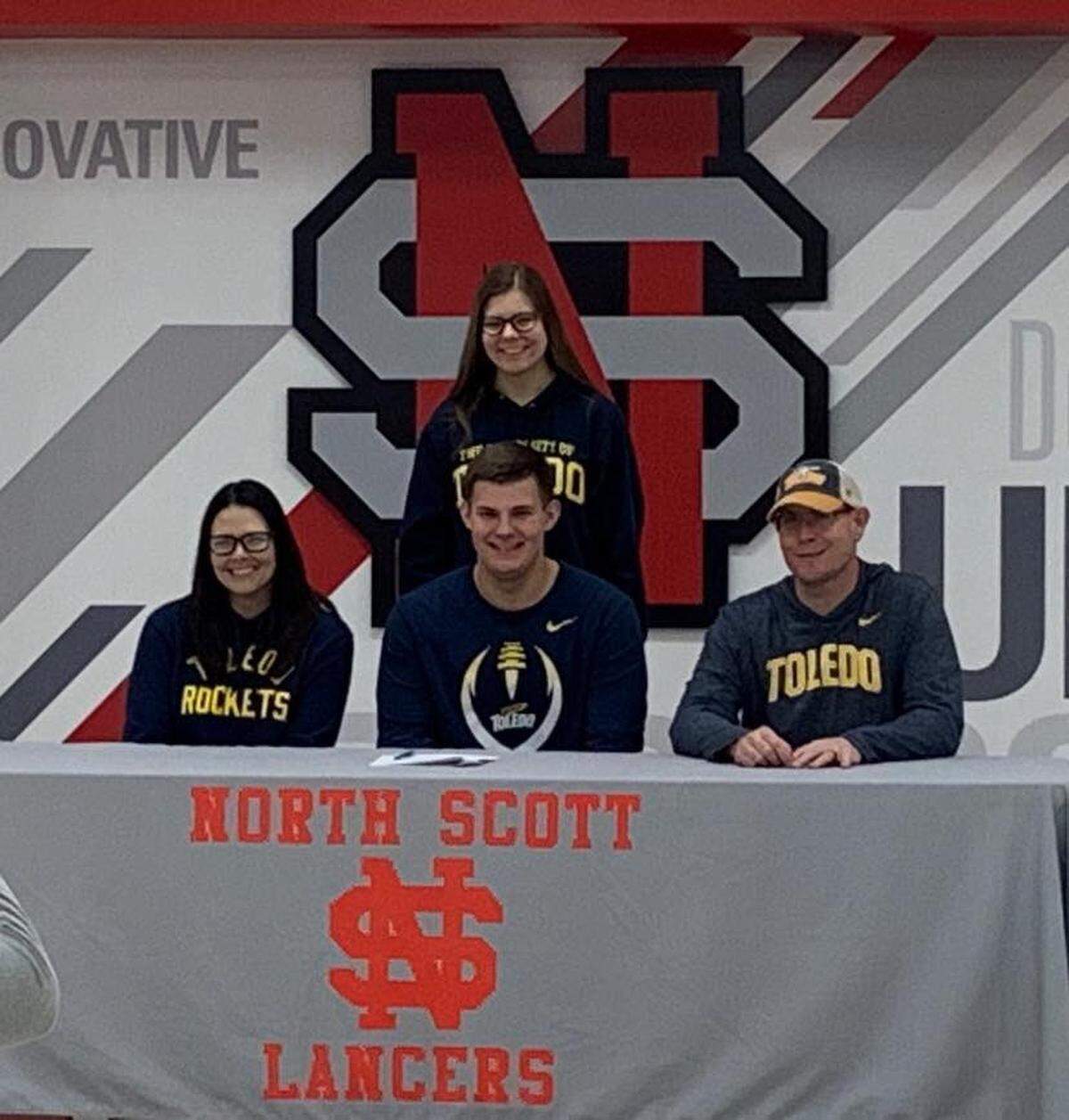
It all led to last week’s breakthrough. On Toledo’s first day of practices — thanks to his early-morning rehab sessions — Stoefen was medically cleared to be a full participant.
“Super pumped about that,” Stoefen said. “And it’s been quite the process to get there.”
A reminder of how he made it through remains fastened to the push board on the wall of his room.
During his toughest time — just after KU had pulled his scholarship — Stoefen was helped by his sister Joie, who wrote him a motivational letter as part of an English class assignment.
The second paragraph sticks out to Stoefen most when he reads it everyday: “You’re a person that I can see that can break through any brick wall that’s in your way.”
What’s missing from his new residence in Toledo is any reminder of what once was. Well, what almost was.
Lawrence, Kansas.
But those do exist somewhere. For now.
Stoefen says he always wanted to keep one KU T-shirt for motivational reasons, serving as a symbol that he should always be striving to succeed. He’s done that, but decided before leaving for college that it should remain at the bottom of a pile in his room in Iowa.
He has more keepsakes. Stacks of them. He estimates he received 10 pounds of mail from KU during his recruitment. He’s had some ideas about what he might do with all those papers now.
Perhaps he’ll just dump them in the trash. Maybe they’ll collect dust in a storage room back home.
Or maybe, as he recently discussed with his parents, he will strike a match — standing back so he can watch them burn.
Note: A previous version of this story misidentified the former KU coach who texted and met with Richardson.
This story was originally published March 11, 2020 at 5:00 AM with the headline "They committed to KU football, then had scholarships stripped. NCAA rules allow it."