
Kansas football picks up the tempo for new coach David Beaty
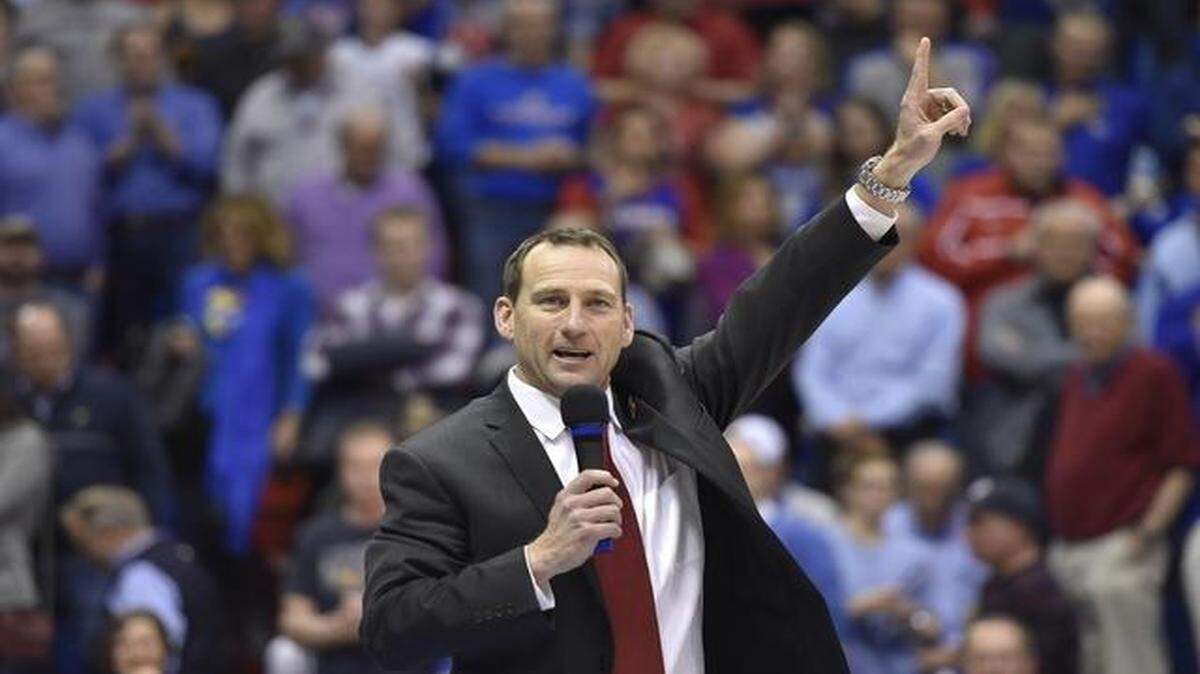
In the minutes after the first spring practice, a cold and rain-soaked affair on an early spring afternoon, David Beaty had two numbers stuck in his head.
Ninety-four and 44.
It was March 24, and Beaty, in his first year as Kansas’ head football coach, had retreated to the warmth and relative quiet of the Anderson Family Football Complex. For the next few hours, Beaty and his staff would review film from the Jayhawks’ practice. Finally, Beaty thought, a chance to evaluate a new roster and start making fair judgments on the program and team he had inherited.
But for the time being, Beaty was mostly concerned with two numbers. The Jayhawks had run 94 plays during the 44 minutes of practice dedicated to offensive reps. The quality was not always good, Beaty conceded. But for a head coach attempting to turn up the tempo of Kansas football, it was a start.
“For the first day,” Beaty said, “It ain’t bad.
Welcome to Kansas football in the Beaty era, where every rep is counted, the music blares all practice, and a souped-up tempo is a way of life. Welcome to Kansas football in the Air Raid era.
“The quality will come,” Beaty said. “We just want to continue to get reps, reps, reps, reps, reps, reps, reps.”
When you take over a college football program that has won 12 games over the last six seasons, there are plenty of places to begin the cleanup. Beaty is starting with the tempo, meaning everything from the pace of practice to the pace of a new offensive system. Back in December, in the weeks after he was hired, Beaty sought to put together a coaching staff that would be full of youthful energy. It was the only way, he though, to create the environment he desired. But he also needed an offensive mind to run a version of the Air Raid offense, an up-tempo spread attack popularized in recent years by Kevin Sumlin at Texas A&M, Art Briles at Baylor and Dana Holgorsen at West Virginia.
Beaty found Rob Likens, an offensive assistant who had worked in an Air Raid-influenced system at Cal under head coach Sonny Dykes. Likens, who will serve as Kansas’ offensive coordinator, says the scheme is simple enough to learn in days, and the Jayhawks have spent most of spring practice installing the offense in three-day cycles. But one focus, Likens says, is getting the players to understand how fast they need to play. And then getting them in the shape to do it.
“They literally can’t do what I want them to do unless their bodies are in that position where they can do it,” Likens says.
In 2014, Cal averaged 38.2 points and 81.3 plays per game, a high-volume of both scoring and snaps. The numbers can serve as a rough blueprint for what Beaty and Likens are trying to accomplish at Kansas. But there is, of course the reality that you need a solid quarterback and plenty of depth at the skill positions — especially at receiver — to run the system effectively. For now, the Kansas quarterback battle remains wide open. Beaty and Likens are still trying to learn what each quarterback can do. But the receiver position presents another question.
Likens said Cal would generally use anywhere from eight to 10 receivers per game. The Jayhawks, meanwhile, are moving forward with a rebuilt receiving corps that features zero players that had more than 20 receptions last year. Tight end Kent Taylor, a Florida transfer, could provide a reliable target, while returning tight end Ben Johnson will be in the fold as well. Likens is also optimistic about being able to find receivers to fill the holes.
“It’s not talent,” Likens said. “It’s (finding) guys that are going to be in the right spot, at the right time. You know exactly when they’re going to be there. The system is going to get guys open.”
It’s no secret, of course, that Kansas could use an offensive lift after years of low-scoring units. Last year, the Jayhawks ranked 115th nationally in both total offense (324 yards per game) and scoring offense (17.8 points per game.) According to advanced metrics at FootballOutsiders.com, the Jayhawks also ranked 119th nationally in a stat that measured drives that averaged 10 yards per play.
For Likens, the answer is simple. Play faster.
In some ways, the Air Raid offense can feel like organized chaos at a breakneck pace. During one drill at practice, the Jayhawks line up five quarterbacks across the field and sling five balls across the field at once, all in different direction. To fully embrace the scheme, Likens says, you have to take some chances. There are some coaches, for instance, who may not be comfortable throwing the ball around 50 or 60 times per game.
“If there’s anything that I want our kids to embrace, it’s that mentality,” Likens says. “Don’t be afraid to fail.”
Amidst the chaos, Beaty looks for signs of progress. During practice, he can be found checking in with longtime equipment manager Jeff Himes, who charts plays and reps during practice. For now, the quality could be better. Even Beaty recognizes that. But on a recent afternoon, Beaty checked the numbers again. The Jayhawks had run more than 90 plays in 42 minutes. Not quite fast enough. But definitely a start.
“You set a standard, and you set a certain amount of time for it to get done,” Beaty says. “And if it’s not getting done, than that’s my fault. We’re not pressing it enough.”
Reach Rustin Dodd at rdodd@wichitaeagle.com. Follow him on Twitter: @rustindodd.
This story was originally published April 4, 2015 at 8:56 PM with the headline "Kansas football picks up the tempo for new coach David Beaty."