
Why are DJ Giddens and the Kansas State Wildcats suddenly struggling to run the ball?
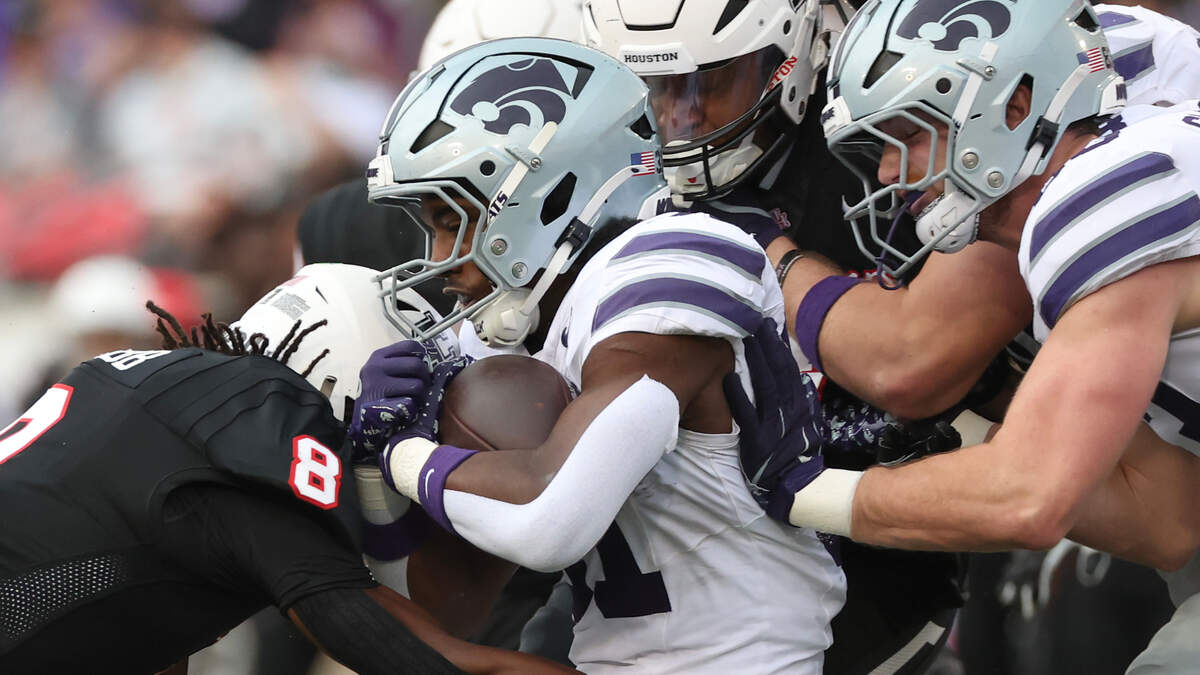
It didn’t take long for Chris Klieman to pinpoint the most frustrating thing about Kansas State’s recent loss against Houston.
He was upset about how the Wildcats ran the ball in that game.
More precisely, he thought they did a miserable job on the ground against the Cougars as the Wildcats rushed for just 89 yards on 34 attempts. K-State averaged 2.6 yards per run in that game. Worst of all, Klieman could see a performance like that coming. K-State wasn’t much better in wins over Kansas and West Virginia.
“We have talked about it for a little while now,” Klieman said. “We’re not playing with good enough fundamentals and techniques. That has really been (the case) over the last couple weeks. We’ve been able to overcome it a little bit with an explosive play here and there. But it’s the same thing we talked about on Monday after we won the (KU) game. We’re not good enough at identifying blocks, sustaining blocks, finishing blocks, and when we do we still have got to maybe run through an arm tackle. And we’re not doing that well right now at all.”
That is an alarming development for a team that was expected to have one of the most explosive rushing attacks in all of college football this season.
K-State lived up to expectations early on this season. Starting running back DJ Giddens averaged 7.3 yards per rush in his first six games, and he looked like one of the best players in the Big 12 as he piled up yards and touchdowns.
But things have changed drastically since then.
Take away a 54-yard sprint against Kansas and opposing teams have held Giddens to 2.9 yards per carry over his past three games.
Dylan Edwards was a nice change of pace option against KU and in early games, but the Colorado transfer was held to 31 yards on eight carries at Houston.
Then there is quarterback Avery Johnson, who was averaging 7.3 yards per carry as a dual-threat player. Then he suffered an injury against Colorado and that part of his game faded away. The Maize product has only totaled 70 rushing yards on 29 attempts over the past four games for an average of 2.4 yards per run.
To be fair, Johnson did run for 67 yards and a touchdown against Kansas. But he looked like he was running to get out of bounds rather than running to gain yards against Houston. And he didn’t attempt a single run against West Virginia.
Perhaps offensive coordinator Conor Riley needs to develop a more consistent strategy on how and when to run Johnson.
K-State still ranks second in the Big 12 with an average rush of 5.8 yards, but its success rate has recently plummeted.
Why?
Some credit has to be given to opposing defenses. Teams like Oklahoma State and Colorado are dreadful against the run. But West Virginia, Kansas and Houston focused all their attention up front.
They didn’t want to let Giddens beat them, and they succeeded.
“People are doing some stunts and some pressures against us,” Klieman said. “We are struggling to identify it and get it blocked up. When you do that you’re not running the football.”
It will be interesting to see how K-State responds. The Wildcats are off this week before they return to action on Nov. 16 against Arizona State.
Riley is a former offensive lineman who loves nothing more than rushing the ball up the middle. Fans can expect a few changes up front that could allow Giddens, Edwards and Johnson to find some more running room.
That feels like top priority for an offense that has lost its identity.