
How K-State’s top three running backs are bringing a new look to a retro formation
Kansas State football coach Bill Snyder wasn’t trying to be funny when he said the modified wishbone formation K-State used during a 31-12 victory over Oklahoma State last week has been in the team’s playbook for 30 years.
Few, if any, of his offensive coordinators have chosen to utilize it in games. But it is most certainly not new.
“It has always been in the playbook,” K-State running back Alex Barnes said, “just kinda in the old-school section where nobody really looks.”
Until now. K-State offensive coordinator Andre Coleman gave that section a nice long look on Saturday and used the retro formation five different times against Oklahoma State.
Everyone in attendance took notice. The formation, which uses three running backs, was impossible to miss. Skylar Thompson lined up to take a shotgun snap with Alex Barnes to his right, Justin Silmon to his left and Dalvin Warmack to his rear.
Coming into the season, many wondered how K-State coaches would rotate their top three running backs. That’s not an issue in this formation. They are all out there.
“Every time they call that personnel we all start getting a little antsy and hyped,” Warmack said, “because it is unique having all three of us in the game at once. It is just something we love.”
Over the years, people have stopped using the word “wishbone” in association with the play and started calling it a diamond formation or a three-running back set when it has been used at Oklahoma State, Oregon and other schools.
At K-State, they simply call it Bone. In time, perhaps it can develop a clever nickname like Catbone or Snyderbone. But, for now, the Wildcats are just starting to tap into the formation’s potential.
“It’s pretty cool having all three of us back there at the same time,” Barnes said. “We have a lot of different stuff we can run out of it, too. We have a bunch of stuff that we haven’t shown.”
K-State showed five plays out of it on Saturday.
Warmack took a handoff from Thompson on three of them and plowed forward for gains of 3, 4 and 8 yards with Barnes and Silmon acting as both decoys and lead blockers. Thompson looked to pass on K-State’s two other Bone plays, finding Isaiah Zuber for a loss of 3 on a busted screen and later drawing a defensive holding penalty.
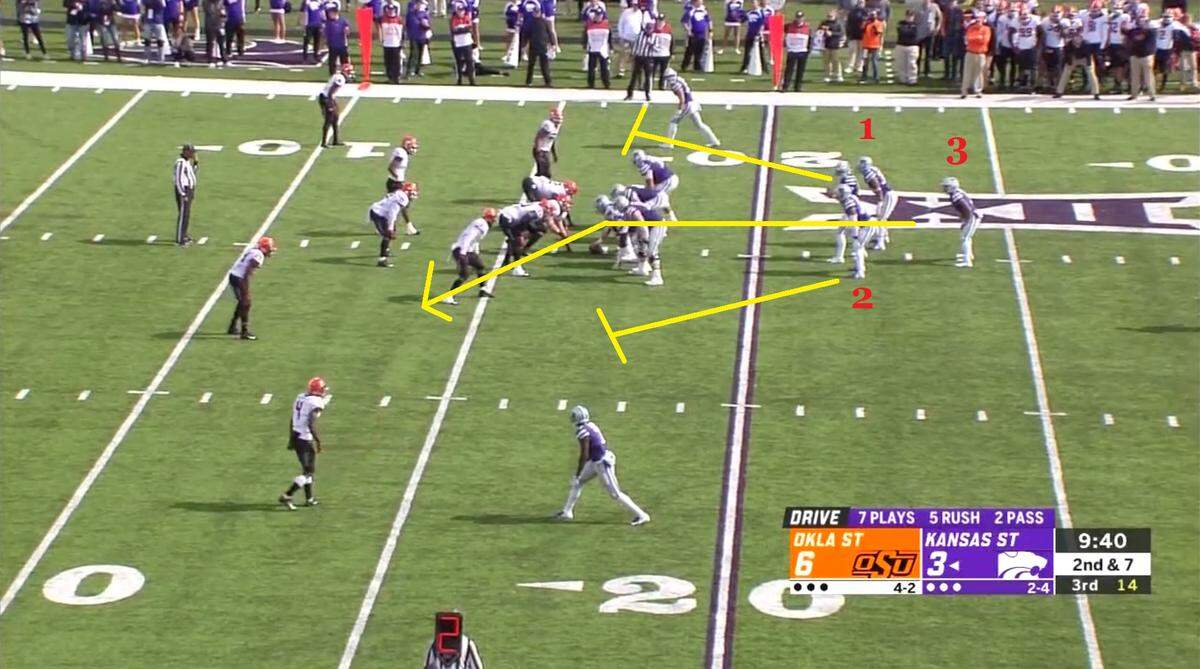
K-State’s first play out of the formation, on second-and-7 in the third quarter, was the most successful. Barnes took off to the right, Silmon went left and Warmack burst straight ahead for a gain of 8 and a first down.
Later, Coleman used the formation on back-to-back plays. Warmack gained 4 yards on the first, but Zuber lost yardage on the second.
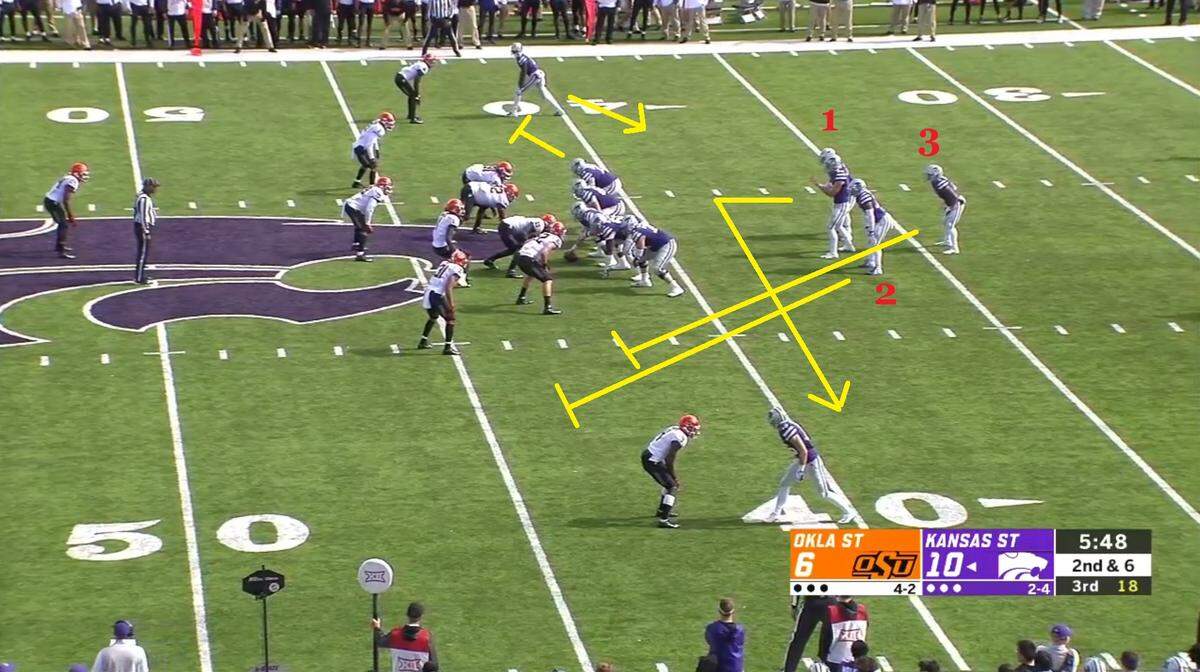
Still, K-State got creative on the pass. Barnes went in motion to his left before the snap and Silmon and Warmack both ran that way after the play began. Thompson then sent a short pass to Zuber on the right, but Oklahoma State defenders sniffed out the play and got past lead blocker Dalton Risner for an easy tackle.
Barnes said the Wildcats have practiced the formation at various times going back to the spring, but they upped the repetitions last week.
Now he hopes they stick with it. Even though the formation didn’t produce eye-popping statistics in its debut, Barnes was proud of Coleman for deploying it.
“He is definitely being a lot looser with the playbook,” Barnes said. “There is a lot of stuff that we have never really shown. He actually, with a couple plays, was on the sideline drawing them up in the dirt.”
For the first time, it felt like Coleman was coming into his own as a play-caller. All it took was some help from the old-school section of Snyder’s playbook.
This story was originally published October 17, 2018 at 2:56 PM.