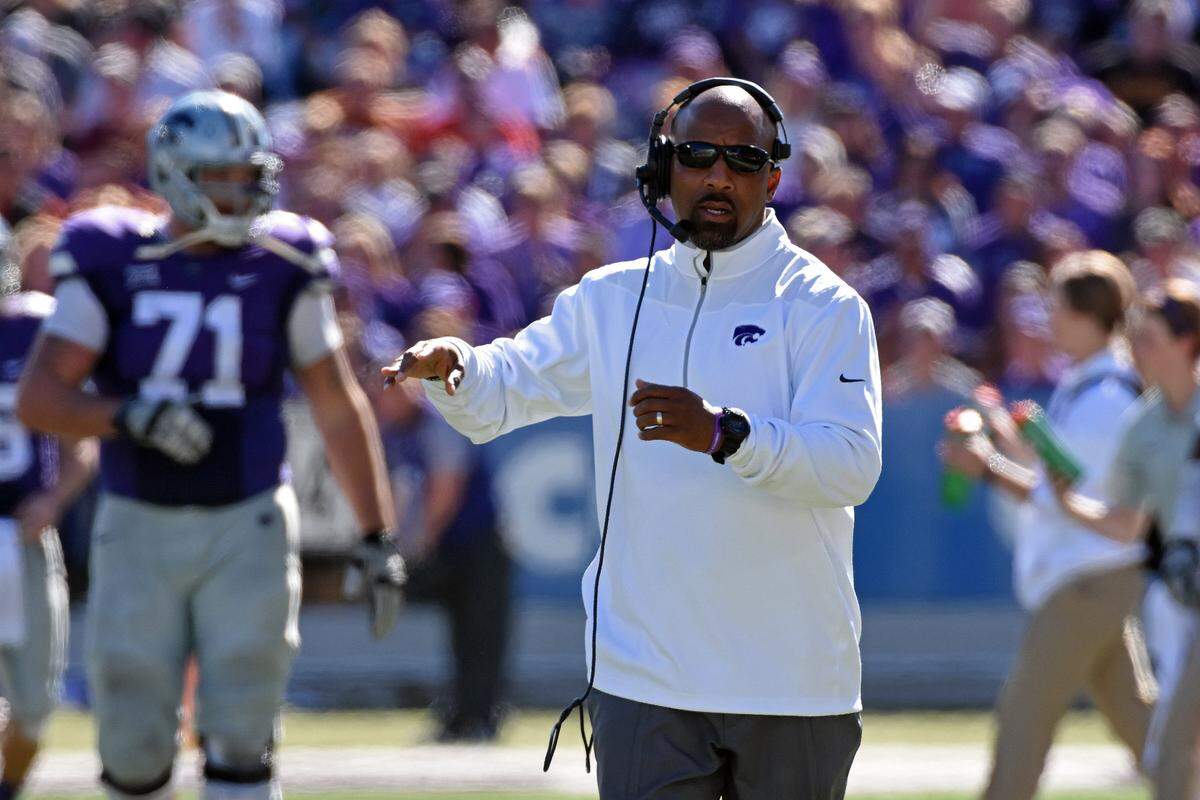
Andre Coleman is a demanding coach, but that's what K-State players like about him
None of you are very good. I have coached much better players than everyone in this room. I don’t need any of you.
Those are the first words Kansas State receivers remember hearing from Andre Coleman when Bill Snyder hired him away from Youngstown State to be their position coach five years ago.
That came as quite a shock for a talented receiving corps that featured the top statistical wide out in K-State history (Tyler Lockett), a 1,000-yard slot man (Curry Sexton), an all-conference selection (Tramaine Thompson) and a future pro (Deante Burton). But they certainly made an impression.
“I remember thinking, who the hell is this guy?” said Burton, now with the Atlanta Falcons. “He just came from a small school where there’s no way he had more talent than we did, and he’s telling Tyler Lockett that he isn’t any good. He was setting the standard that first day.”
“A few months later, I missed a block at our first practice and he went nuts,” Sexton said. “He runs in and tells me, ‘You’re going to lose your job.’ In that moment, I thought this guy is crazy. How could anyone live up to his expectations?”
They didn’t realize it then, but Coleman was exactly what that group of receivers needed. Each player was good under previous coach Michael Smith before he left to join Bret Bielema’s staff at Arkansas, but Coleman's demanding approach made them better.
That much was evident in their first year together when K-State receivers recorded the most receptions and yards by a Snyder-coached team. Then they shattered both marks in 2014. With Lockett and Sexton getting open at will, the Wildcats threw for a school record 3,736 yards.
Coleman has taken on a larger role within the offense ever since. First, Bill Snyder promoted him from receivers coach to passing game coordinator. Then Snyder elevated him to offensive coordinator this offseason when Dana Dimel became head coach at Texas-El Paso. Five years after he arrived in Manhattan with a coaching style that made players uneasy, Coleman is ready to call plays.
And his former players couldn’t be happier for him.
“Nobody deserves it more,” Sexton said. “He had some big shoes to fill when he came in. Coach Smith was a huge player favorite with significant weight behind his name as a former K-State player. Coach Coleman could have tried to become pals with us, but he wasn’t there to be our friend. He was there to be our coach. He made his presence known, pushed us every day and helped us grow as players. Looking back, it was really impressive.”
Copper Bowl hero
That is nothing new for Coleman. It seems like he has found success at every turn as a member of K-State’s football team, first as a player and now as a coach.
Coleman arrived in Manhattan in 1990. Back then, he was a promising receiver from Hermitage, Pa, hoping to help Snyder turn around one of the most moribund programs in college football. It wasn’t easy and the wins came slowly, but they turned a corner when Coleman was a senior. The Wildcats went 9-2-1 and won the 1993 Copper Bowl, their first postseason victory, with Coleman shining as MVP.
He did a little bit of everything that historic night, catching eight passes for 144 yards and a touchdown on top of a 68-yard punt return for a score.
Before long, he was off to the NFL. But his presence lingered in the K-State locker room.
“He played with so much tenacity that it felt like we couldn’t lose when he was on the field,” former K-State receiver Kevin Lockett said. “He set the tone for our entire receiver corps. Here was this smaller receiver with a huge chip on his shoulder, tired of the way other teams looked down at us. He instilled confidence on the whole offense.
“Players like Andre are a big part of why the turnaround happened. His win-at-all-cost mentality kind of caught fire and got passed down to each recruiting class. I only played with him as a redshirt freshman, but he was still helping me as a senior. He was also a great influence on my son, Tyler.”
Coleman finished his college career with 1,556 yards as a receiver and 1,458 yards as a return man. He was a member of Snyder’s first bowl team and he helped start a streak of 11 straight postseason trips.
It’s fair to wonder if he was a better player or coach.
“I wouldn’t make that distinction. He was so good at both,” Snyder said. “Andre was a guy who was an excellent return guy. He was able to stay in the NFL with the capabilities he had and he is doing a very nice job with the coaching side. He is valuable to us in both aspects of it, truly.”
Super recruiter
Here’s a trivia question: Who was the first K-State football alum to score a touchdown in the Super Bowl?
The answer: Coleman.
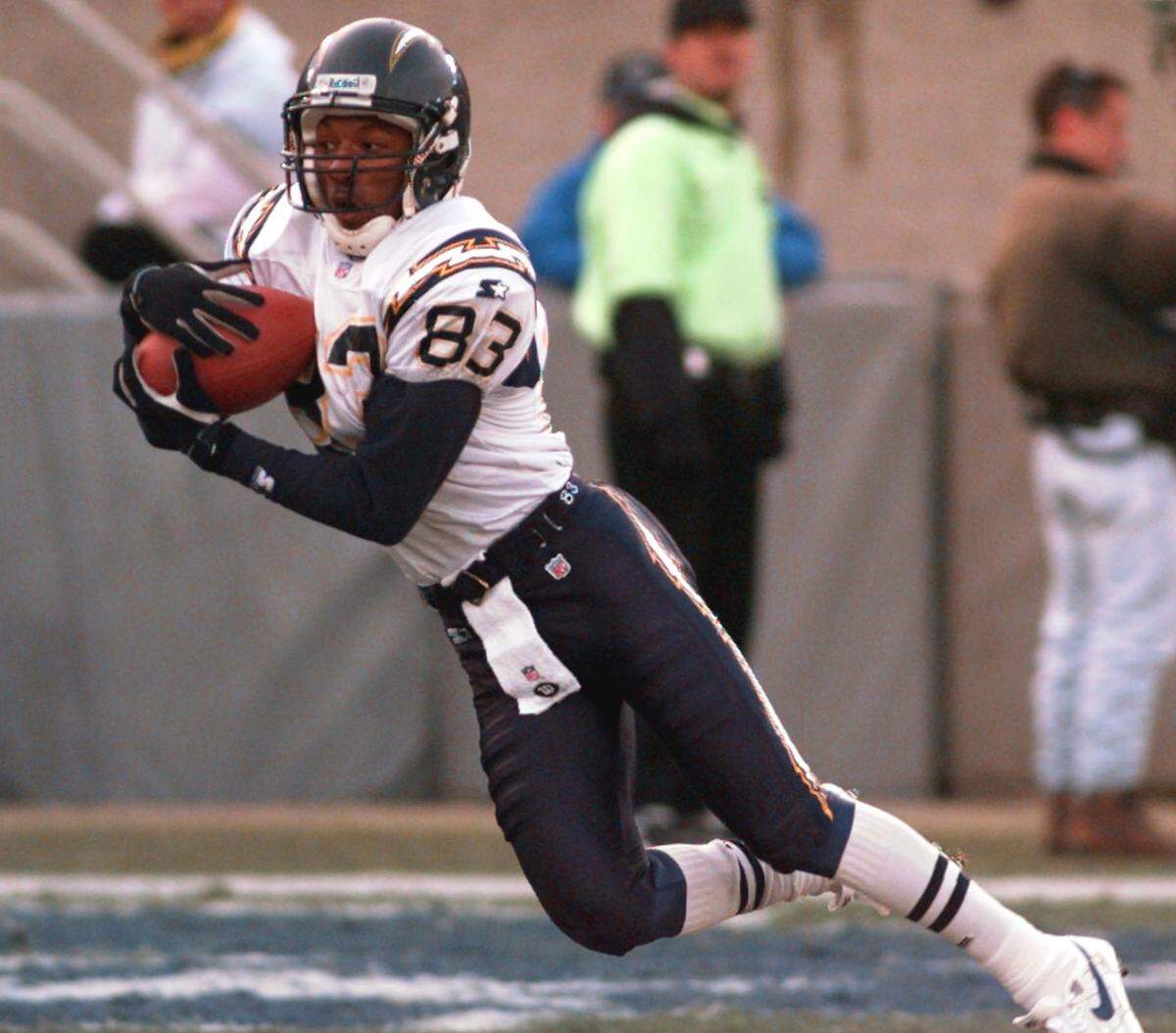
Log on to YouTube and you can watch the play — a 98-yard kickoff return — at any time. Coleman was just a rookie for the San Diego Chargers, but he looked like a veteran weaving through would-be tacklers and outrunning everyone to the end zone.
Coleman lasted five years in the NFL, also playing for the Seattle Seahawks and Pittsburgh Steelers.
That gives him instant credibility with players.
“We did our research on him and realized pretty quickly he is legit,” Burton said. “He’s not a fraud, telling us things he knows nothing about. With me being in the NFL now, I call him all the time and ask questions. The best thing you can do is seek advice from people who have been there before.”
Eric Wolford agrees. A former K-State teammate and now the offensive line coach at South Carolina, he thought Coleman could become a coaching star.
He had all the tools — reputation, passion, football IQ — to recruit and develop players. Wolford just needed to convince him to give coaching a try.
There is a gap in Coleman’s football resume between his final NFL game in 1998 and his first day coaching for Youngstown State in 2010. K-State did not make Coleman available for this story, but friends say he was involved with several business ventures during that time, including sports apparel and night clubs.
When Wolford, then the head coach at FCS Youngstown State, reached out to Coleman in 2010 about an opening on his staff, he said Coleman was living in Atlanta “doing several jobs and not thinking about football.” But he talked him into moving to Youngstown, Pa. and coaching tight ends.
“Coaching is the next best thing to playing,” Wolford remembers telling Coleman. “I talked to him about what the opportunities were going to be five years from now. I thought he could be at a big-time program somewhere, and now he is. He was an instant success.”
Coleman spent one season coaching tight ends and then shifted to receivers over the next two seasons. He was a hit with players and coaches alike.
But he was even more popular with recruits, a trend that continues today. His deep ties to Georgia and Pennsylvania have helped K-State sign dozens of talented players located outside their usual recruiting net.
There are many reasons for that, but it helps when you’re the answer to a trivia question.
“When Andre Coleman walks into a room he has a presence,” Wolford said. “He played in the NFL and has instant credibility with recruits. These days, kids Google you when you reach out to them. And a lot of good stuff pops up when they search Andre Coleman.”
High expectations
Curry Sexton wants to get something off his chest before he says anything more about Coleman.
“Why is he such a LeBron James hater?” Sexton asked.
Burton wonders the same thing.
“He’s a Michael Jordan guy. I get that. But he can be completely irrational,” Burton said. “He downplays LeBron so much, won’t even give him credit if he’s got 30 and a triple-double.”
Take a look at Coleman’s Twitter account during the NBA Playoffs and there’s a good chance he is debating MJ vs. LeBron with at least one former K-State player.
If he channels that same passion into play-calling, K-State’s offense will be in good hands next season.
It will be fascinating to see what changes Coleman brings. Snyder has said he expects Coleman to operate under the same umbrella as Dimel, but it’s silly to expect a carbon copy.
“He will simplify the offense,” Sexton said. “Coach Dimel’s offense was successful, but it was so complex and kind of hard for young kids to grasp. I think you will see a lot more all-purpose play-calling that gets more weapons on the field and gives them room to work.”
Though Coleman has never called a game before, he helped Youngstown State create plays and scripted every spring game. He has served as K-State’s passing game coordinator and suggested plays at various times.
It won’t feel completely new.
“You will probably see a nice mixture of things that we did at Youngstown State, what has been successful for him at Kansas State and what he did best in the NFL,” Wolford said. “He has his own ideas and will incorporate them next season.”
That’s an exciting thought.
“What Andre has been really good at is finding creative ways to get the ball to playmakers,” Kevin Lockett said. “I see Isaiah Zuber as a guy we are going to want to get the ball to this year. I bet they use him on jet sweeps and bubble screens. They will push the ball down field with multiple running backs. Andre will take our core offense and add his own twist. I can't wait to see it.”
One thing is for sure: His expectations for the offense will be every bit as high as they were for his first batch of receivers five years ago.