
Wichita State plane crash survivor takes on a mission of remembrance
The first time Rick Stephens descended Mount Trelease, near Silver Plume, Colorado, he faded in and out of consciousness. Three construction workers he’d never seen before carried him on a pair of coveralls, no other stretcher being available. They stopped to rest, moments after they started; Stephens looked at the broken, burning airplane behind them just as it blew up in a fireball.
He knew teammates and friends, members of the Wichita State football team, were still inside.
He faded out of consciousness again.
“That’s something that burns into your memory,” Stephens recalled.
Mission of remembrance
It’s been half a century since Oct. 2, 1970. Rick Stephens is 72 now. The lower half of his right leg, where it broke, still shows signs of injury. In March he added a broken femur and a new artificial hip to his list of wounds. He walks with a heavy limp.
“Tough,” his friends describe him.
“Stubborn,” his daughter Sarah Stephens Selmon says.
Fifty years and a day after that tragedy, tough and stubborn Rick Stephens, along with lifelong friends Paul and Kelly Harrison, drove to a Wichita State University parking lot to set off on a 500-mile mission of remembrance.
They unloaded bicycles off carrying racks, said farewell to family and friends. Kansas Lt. Gov. Lynn Rogers was there to see them off. Just before pedaling away, the three men huddled in prayer at the university’s crash memorial.
“Bless this adventure,” Paul Harrison said, holding back tears. This trip was personal for the Harrison brothers, too. Their cousin, Martin Harrison was the Wichita State football team’s equipment manager in 1970 and one of 31 who died.
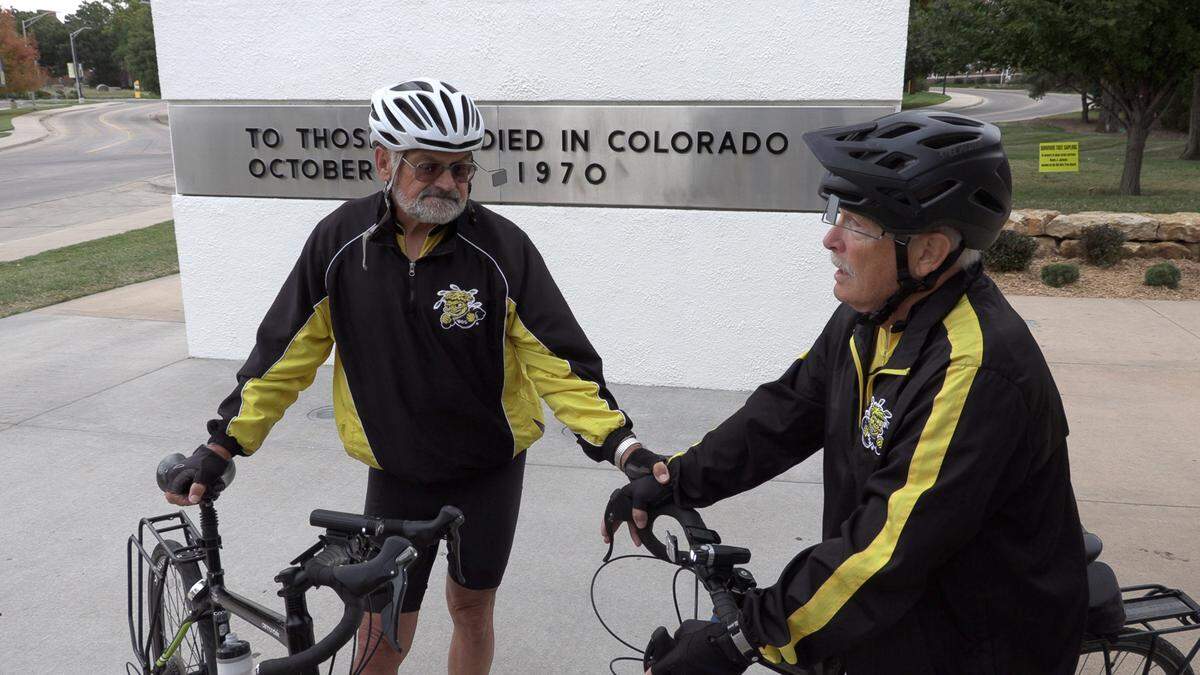
“To keep the memory alive,” Stephens said. “There was a great deal of pain, not just for those on the plane who survived, but for the families of the others.”
The ride would also raise money for a scholarship fund benefiting children and grandchildren of crash victims.
The trio mounted bicycles, age and broken bones be damned. With Rick leading, they waved one last time before turning north onto Hillside, 500 miles in front of them.
‘We can’t make it’
In that plane on Oct. 2, 1970, Rick Stephens knew something wasn’t right.
Two Martin 4-0-4 airplanes carrying the Wichita State football team had just left Denver’s Stapleton Airport after refueling. They were bound for Logan, Utah for a game against Utah State. Stephens played guard in the team’s varsity offensive line. He and the rest of the team’s starters, along with coaches, administrators and boosters, were flying in the plane dubbed “Gold,” while second-team players and assistant coaches rode the “Black” plane.
The planes diverged after leaving Denver. The Gold pilots decided to take a scenic route through the Rocky Mountains west of Denver, toward Loveland Pass. The “Black” plane flew north toward Wyoming, where it could gain altitude before crossing the Rockies.
Stephens sat in the middle of the Gold plane, over the left wing. Teammate and close friend Jack Vetter sat next to him.
As the plane flew west along I-70, Stephens looked out the window. He didn’t like what he saw. “We were not gaining much altitude.”
Curious, Stephens walked up to the cockpit, a common act during chartered team flights. He noticed Jack Vetter dozing off.
Stephens poked his head into the cockpit. The pilots “were in a state of not absolute panic, but extreme concern,” he recalled. “One pilot asked the other ‘How far? How high is it over there?’ The other pointed to the map and said ‘It’s 14,000 feet. We can’t make it.’”
Stephens turned back toward his seat. Almost immediately, the plane banked hard to the right.
“I remember the trees being clipped,” he said. “There was a sudden impact and next thing I know, I was out of the airplane. On the ground. I’d been thrown out, ejected in front of the airplane. How I got there, I have no idea.”
Everyone seated where Rick Stephens had sat, including Jack Vetter, were killed. Only seven other players, all seated in the rear, survived. One of the two pilots survived.
“Move on as we must, not as we wish,” Rick Stephens likes to say.
He moved on as best he could after the crash. Fourteen teammates died, along with 17 others – coaches, administrators, boosters.
After college, he briefly worked as a prison guard, a fitting job for a 6-2, 230-pound former football player. But not so fitting for a guy left wondering why he was spared when friends died.
Prison, he decided, “wasn’t where I was best suited to be.”
So he found a calling he liked more: “I went into social work and eventually became a teacher, coach and administrator. Working with young people.”
He saw it as a fitting way to honor those who died. “I’ve tried to live my life in a manner that reflects some obligation to their memory.”
Daughter Sarah says that’s what he has done.
“At lot of people will say ‘I wouldn’t have graduated if it wasn’t for your dad,’” she said. “He tried to make them understand the impact of their actions and that they can climb out of whatever the wreckage is of their own lives and do something positive.”
‘Move on as we must’
A bike ride that lasts five days, crosses two states and gains nearly 5,000 feet of elevation gives a person time to spend inside his head.
Most of the thinking occurs in the subconscious, Stephens said. In his conscious mind he kept his mind on the road. “You listen to what’s behind you and what’s on the road, but it is certainly an opportunity to reflect.”
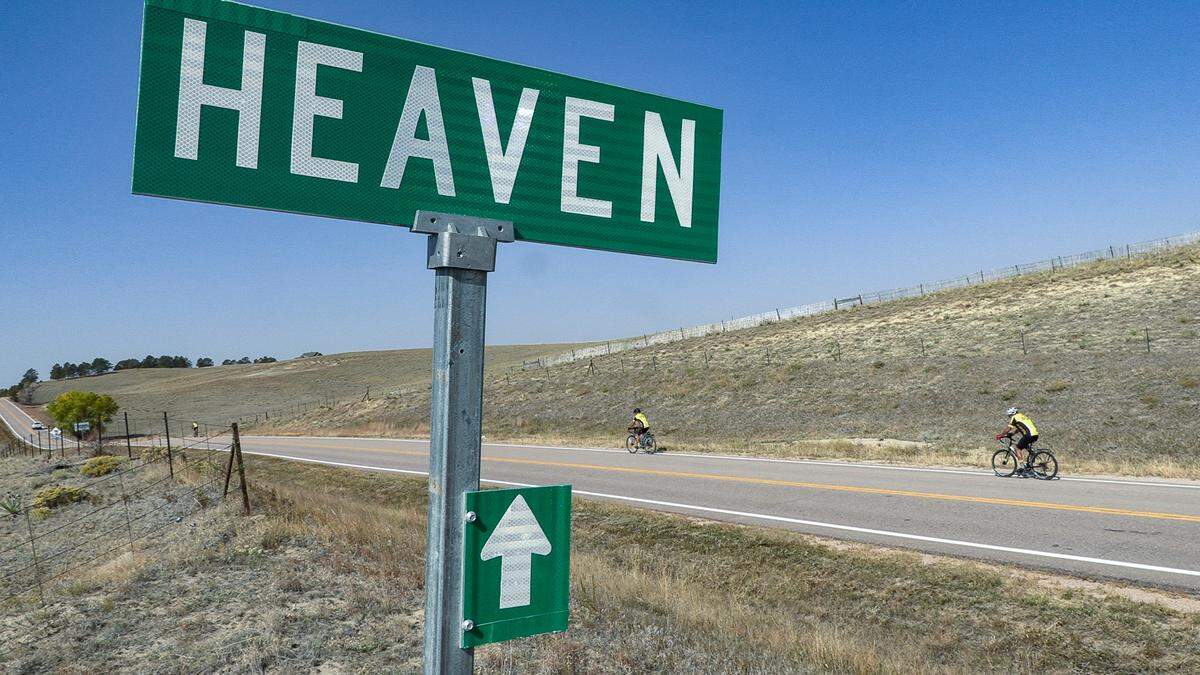
Five hundred miles, past combines harvesting corn in roadside fields in western Kansas. Through rolling and punishing foothills of Colorado’s front range. He thought a lot about Terry Carthrae.
Terry had been a Wichita State classmate of Stephens’, before the crash. In 1970, living in Colorado, she visited Rick while he lay in a Denver hospital two days after the crash and doctors worked to save his leg. Terry’s act-of-kindness visit was written up by a reporter from the Denver Post.
“I knew just about everybody on that plane,” she told a Post reporter.
Five years later, Terry was back living in Wichita. While out walking her dog, she ran into Rick Stephens. They had no idea they lived blocks from each other in Riverside.
Terry Carthrae fell in love with Rick, and became Terry Stephens in 1976. Like Rick, she helped others. In her law practice she helped people with adoptions, living wills and end-of-life planning. She was by Rick’s side for events related to the 1970 crash, and returned to the crash site with him twice.
But on July 22, 2016, Terry went in for a routine medical procedure, a heart catheterization. She was supposed to be home that evening, according to their daughter. But a mistake was made; an artery tore near Terry’s heart. They could not save her.
“It was out of the blue, just like the plane crash,” Stephens said.
On the night before Stephens left on his ride to Colorado, on the 50th anniversary of the first great tragedy of Rick Stephens’ life, and four years after the second, the Stephens family drove to Terry’s grave in Barber County to pay a visit.
“Move on as we must, not as we wish.”
‘Like a guardian angel’
Stephens and the Harrison brothers, Paul and Kelly, stood at the foot of the mountain, on a bright, warm Rocky Mountain Saturday, wearing matching black and gold Wichita State bicycling jerseys.
They had ridden almost 500 miles, through wind and heat, dismounting at last in Castle Rock, Colorado. Rick was tired, 72, and his bum leg made him limp. They stood together, a steep and unforgiving mountain rising in their path.
Kelly, 61, took his place on Rick’s right. Paul, 70, stood at his left. They each took an arm.
Paul Harrison would have it no other way.
His daughter Bridget died in Houston two years ago after a long battle with anorexia and depression. Paul and his wife, Carolyn, flew to Houston immediately. The next morning there was a knock on their hotel room door and there stood Rick. He’d driven all night. Paul had no idea he was coming.
“Like a guardian angel,” he said.
As the three men stepped up the mountain, one slow step after another, Paul sang an old Hollies tune, a world-wide hit in 1969 – the year before the crash.
“The road is long
With many a winding turn
That leads us to who knows where
But I’m strong
Strong enough to carry him
He ain’t heavy, he’s my brother”
The three men, with Stephens’ family and friends trailing behind, stepped slowly to a clearing beyond a growth of new pine trees.
Before them were twisted pieces of wreckage: mangled aluminum, rusted steel. Even the landing gear struts remain.
Rick paused. Kelly put his hands on his knees and began to cry. “Marty’s up here somewhere,” he said, of his cousin.
Even after 50 years of harsh winters and hot summers, much wreckage of the “Gold” plane still remains. They placed small pennants, bearing the name of every victim, in the field of wreckage. They included one for Rick’s teammate, Randy Jackson, a crash survivor who died of pancreatic cancer in 2010.
“You think of the kids. All of the folks, really. But especially the ones that didn’t have a chance to live their lives,” Rick said.
“A lot of mistakes that were made,” Sarah Stephens Selmon said, standing not far from her dad. “People die as a result of mistakes and it kind of changes who you are. It weighs on you that mistakes have consequences.”
The National Transportation Safety Board said pilot error caused the crash. They flew an over-loaded plane into a box canyon and couldn’t clear the top. Sarah at that moment isn’t talking only about the crash, but the mistake that killed her mother.
Rick Stephens isn’t bitter; doesn’t dwell on mistakes.
“You might not like what people do, but to hate them, you’re just wasting energy,” Kelly said. “Of all the things that have happened to him, and to not be bitter, it tells you something about the character of the person.”
A full life lived
After an hour on the mountain, Rick Stephens descended Mount Trelease, this time not with strangers carrying him on a makeshift stretcher, but surrounded by the living legacies of a full life lived — lifelong friends, grandchildren, his son Michael and two of his former North High students. They took turns holding an arm or a belt loop while Rick limped down the steep slope. Even other hikers stopped to watch, with reverence.
“I have seen you in some YouTube videos,” hiker Scott McClarrinon said as Rick passed him. “Can I have a picture with you?” Rick obliged.
When Stephens reached the road at the base of the mountain, everyone applauded.
“It’s a tremendous feeling of support,” Stephens said. “But you can’t help but think of all the families that never happened.”
Well-wishers patted him on the back and hugged him.
Carolyn, Paul’s wife and one of Terry’s best friends, stood 3 feet from him. Carolyn has always liked butterflies and always thought that if one of them visits you, it’s a message, from someone who loves you.
She pointed suddenly.
“There’s a butterfly on your shoulder.”
And there was.
This story was originally published October 13, 2020 at 5:01 AM.