
$3 gasoline makes a comeback in Wichita | Opinion
Well, that didn’t take long.
I just bought what will probably be my last reasonably priced fill-up for a while. It happens every time we start a war in the Middle East.
I topped off the old 2002 Kia Sportage at the Conoco station Monday morning, putting in a little over five gallons at $2.619 a gallon.
It wasn’t a price to write home about.
It certainly wasn’t the “below $2.30 a gallon in most states” that President Donald Trump lied about in his State of the Union speech last week (Oklahoma had the nation’s lowest average price at the time, about $2.34 a gallon, “most” states were considerably higher).
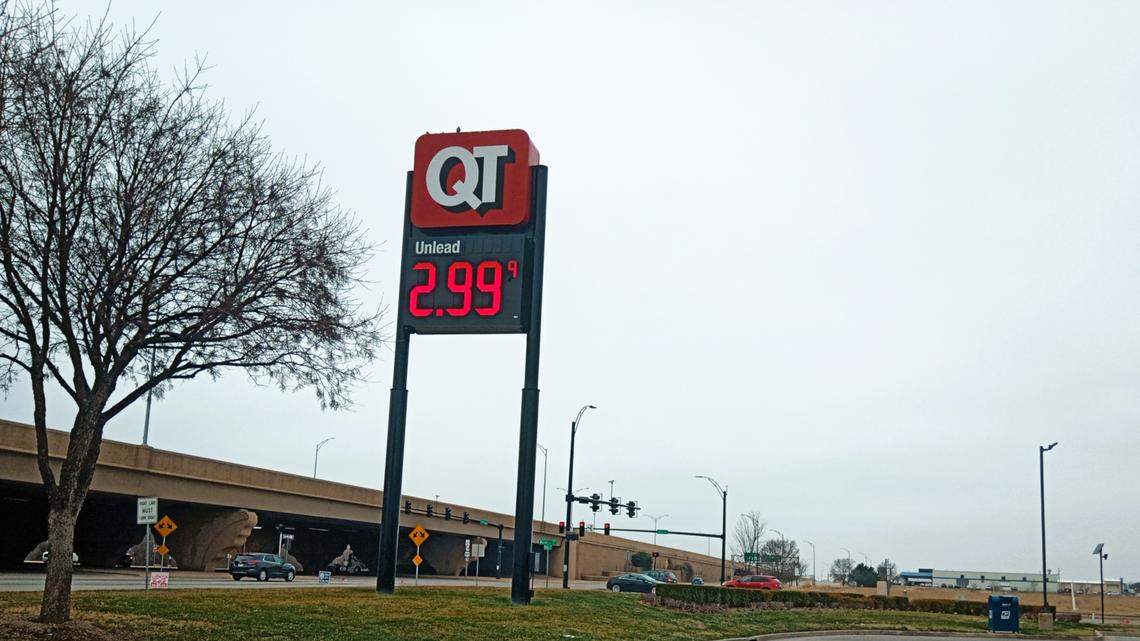
But on Monday, I did save about $2, because right around the corner, the price at my local QuikTrip changed overnight from somewhere around what I paid to $2.999.
I’m calling that $3. For the record, I’ve always been annoyed that gas stations tack 9/10 of a cent on the price of every gallon of gas they sell — a sneaky marketing ploy to make customers think their gas is a penny cheaper than it really is.
The obvious cause of the sudden spike in prices is of course our latest adventure in regime change, courtesy of self-declared President of Peace Trump and his recently renamed Department of War.
The U.S. and Israel shot a bunch of missiles at Iran, killing Supreme Leader Ali Khamenei and several of his henchmen. Iran retaliated against Israel, along with U.S. bases and oil infrastructure in neighboring countries, and warned tankers to stay out of Strait of Hormuz, the strategic choke point in the flow of oil from rich Persian Gulf states to the rest of the world.
As of Monday afternoon, Shawn Steward, manager of public and governmental affairs for the AAA Auto Club of Kansas, Oklahoma and South Dakota, which monitors gas prices, said he’s been seeing about an 8% increase in the price of crude oil in West Texas and Brent North Sea oil markets since the attacks started.
“The good thing from the U.S. perspective, I guess, is that we don’t import oil from Iran, but other parts of the world do,” he said. “And so with the crude oil market, that’s pretty much global. If there’s concerns in a region, even if we’re not consumers of that oil, the rising tide, I guess you will, floats all boats with regard to crude oil prices. And so if crude oil prices go up, naturally, the price of gasoline is going to go up. And so that’s sort of where we are.”
By the end of the business day Monday, AAA listed 11 out of 27 stations surveyed in Wichita that had bumped the price to $2.999.
Six were QuikTrips and four were Dillons.
Those stations move a lot of gasoline and are generally the first to react to international turmoil by raising prices. Other chains and independent stations are usually not far behind, Steward said.
There’s no way to know how long the higher prices will last.
It’s early and what constitutes a victory in our new war in Iran has not yet been defined by the administration. The war could remain confined to air strikes and missiles, or could become a full-blown boots-on-the-ground occupation.
It could take weeks, it could take months, it could take years.
On the (relatively) bright side, no matter how much the price of gasoline rises, us Kansans will probably remain at or near our current position of having the third-cheapest gas in the nation, behind Oklahoma and Mississippi. So we can at least gloat about that to our friends and relatives on the coasts.
About the only thing I can practically guarantee is when it ends, gas prices will come down a lot slower than they went up. They always do.
So if you run across one of those laggard stations still selling gas in the $2.60 range, I’d suggest you pull in and fill up.
It will probably be a while before you see those numbers again.
This story was originally published March 2, 2026 at 5:30 PM.
