Kansas governor candidate’s debate applause line got Reagan wrong | Opinion
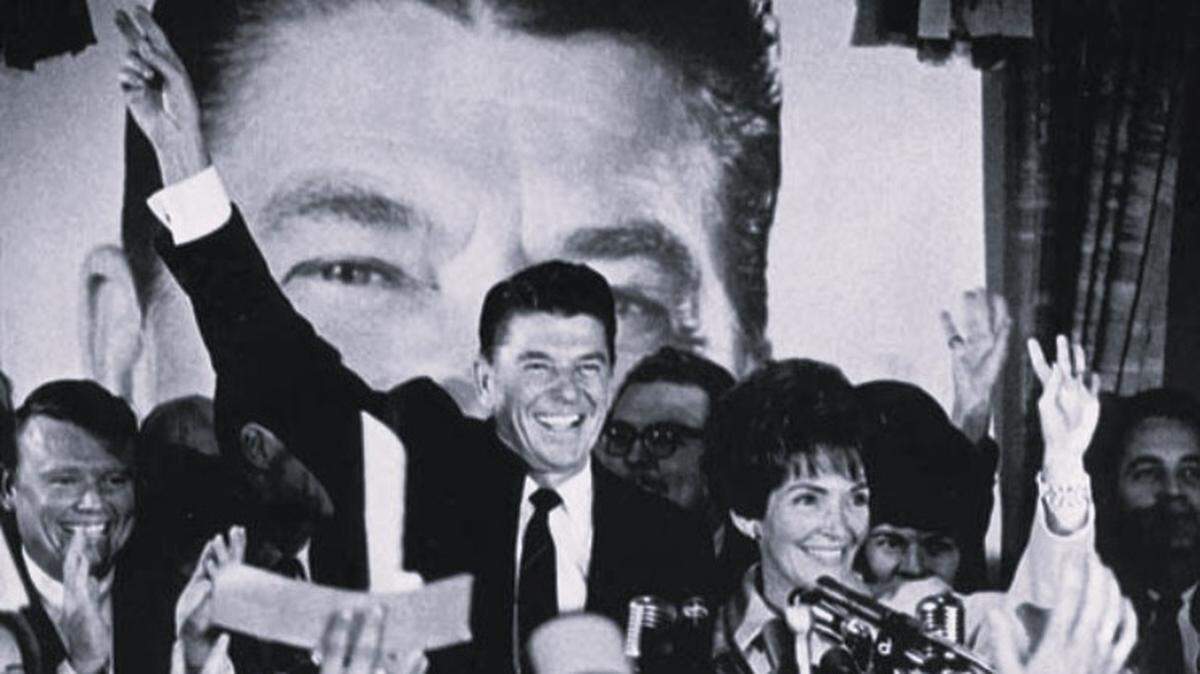
Friday’s gubernatorial debate at the Wichita Marriott wasn’t much to write home about.
Basically, it consisted of six conservative candidates, giving nearly identical conservative answers to the conservative moderator’s questions, and being cheered on by the conservative crowd at the GOP’s winter convention.
But there was one moment of the debate that triggered a memory of a story I did more than 35 years ago, when I was a much younger journalist covering the suburbs west of Los Angeles.
Seeking to burnish his credentials as a political outsider, candidate Philip Sarnecki, a Johnson County businessman, said this: “I would also like to remind everybody — I heard Ronald Reagan mentioned earlier — Ronald Reagan had never run for political office when he ran for governor of California.”
It got a nice round of applause, but it’s not actually true.
Reagan had been elected once before. It didn’t end well, and the story has been virtually lost to history.
Whenever I write a story like this, I feel like Ishmael in “Moby Dick,” that I alone have lived to tell thee all.
Reagan’s elusive first election
In the late 1980s and early 1990s, I was a reporter and editor in the Simi Valley bureau of the Los Angeles Daily News. My tenure there coincided with the development of the Ronald Reagan Presidential Library & Museum at the western edge of Simi Valley.
In the buildup to the library opening, I recalled that someone at a previous job had once told me that Reagan’s first elected office was a seat on the board of directors of the nearby Topanga-Las Virgenes Resource Conservation District (since renamed the Resource Conservation District of the Santa Monica Mountains).
I thought it might make a nice little feature about how Reagan’s storied political career had begun on this local backwoods board, which primarily existed to plant trees to keep the hills north of Malibu from sliding into the Pacific Ocean.
So I called the National Archives, custodian of the library’s documents, and asked what they had on Reagan’s service on the conservation board. (That’s how reporters acquired information back before the Internet).
I was surprised by the answer: “We don’t have anything on that.”
Me: “Wasn’t that his first elected office?”
Archive guy (in a very snippy tone): “That’s not a part of his career we’re focusing on.”
That set my reporter instincts on red-flag alert, so I decided to dig deeper. I tracked down a retiree who had been the longtime secretary of the board, and she gave me the scoop.
Reagan was elected to the district’s founding board of directors in 1961. Shortly thereafter, the CBS show he hosted, “General Electric Theater,” was canceled and Reagan was busy looking for work.
He missed three board meetings in a row, was deemed to have abandoned his office, and was formally removed from the board in 1962.
New information surfaces
As it turns out, the National Archives did have at least some information on this.
Now that we have an Internet, I’ve just now found a letter from the conservation district to the Reagan White House, circa January 1981.
The letter was addressed to James Brady, then Reagan’s press secretary. It included a resolution congratulating the president on his election, and inquired if Reagan’s service on the conservation board would be included in his official biography as his first elected office.
Sometime during Reagan’s rise to prominence, the board had apparently named him an “honorary director” of the agency, whatever that was.
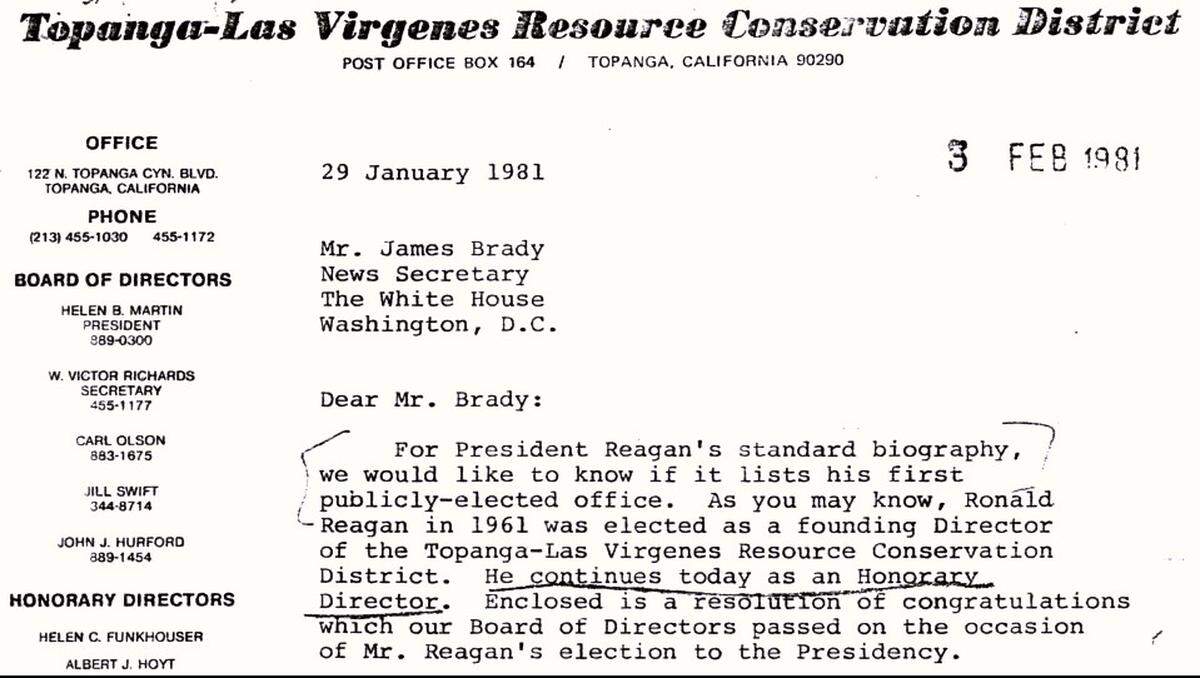
The letter touched off a flurry of memos between perplexed presidential aides, like this one from Dianna Holland of the White House Counsel’s Office to Reagan’s personal secretary, Helene Von Damm: “Have you ever heard of this group and does the president continue as an honorary director?”
On March 25, 1981, White House Director of Presidential Personnel Mary Lawton gave Holland the final answer:
“I suggest Mr. Brady thank them for the resolution of congratulations but suggest that it may no longer be appropriate to list the President as an honorary director: ‘As President of all the people of the United States he should not be publicly identified as having a particular responsibility to a single geographic area.’ Some statement along this line should be included in the response.”
The paper trail ends there.
Five days after Lawton’s memo, Reagan was shot in the ribs and Brady in the head in an assassination attempt by John Warnock Hinkley Jr., a mentally ill man who was obsessed with “Taxi Driver” actress Jodi Foster and believed shooting the president would get her attention.
Brady suffered permanent partial paralysis and slurred speech from the shooting, becoming a living national symbol of the need for gun control. He and his wife, Sarah, formed Brady: United Against Gun Violence.
Their advocacy led to the 1994 passage of the landmark Brady Handgun Violence Prevention Act, which mandates background checks for gun buyers and bans possession of firearms by criminals, individuals with certain mental conditions, drug users and others.
James Brady died in 2014 and Sarah Brady died in 2015, but the organization they created continues as one of the nation’s leading gun-control advocacy groups to this day.
So now you know the story of Ronald Reagan’s first elected office.
To gubernatorial candidate Sarnecki, I’m sorry, but you probably should revise your stump speech.
This story was originally published January 31, 2026 at 10:11 AM.