
Chase M. Billingham: Park won’t pull people downtown
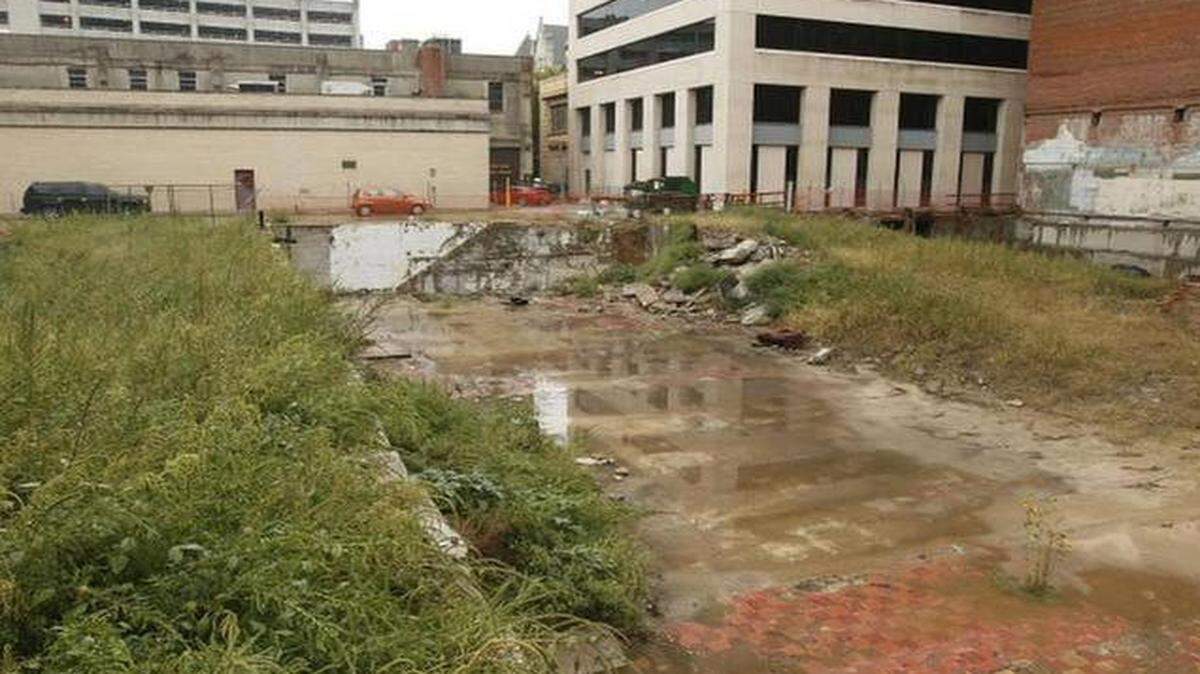
The Wichita Downtown Development Corp. announced last week that it had received a $146,025 grant from the Knight Foundation to develop a pop-up park on Douglas between Main and Market, at the site often bitterly derided as “the pit.”
The pit has sat unfilled for more than half a decade, as efforts to construct a substantial downtown building there have repeatedly fallen through. It is an urban scar covering some of the most valuable land in the city, and its continued presence serves as an abrupt physical reminder of the sluggishness characterizing revitalization efforts in downtown Wichita.
The new park – which will include tables, seats and room for food trucks – will patch the hole temporarily until a permanent occupant can be found for the space. In the meantime, the park’s designers hope, the park will attract people back into a moribund downtown and invigorate development activity in the city’s core.
It is unlikely, though, that the introduction of this new park will revitalize or repopulate the dead space downtown. This area already has ample public space. Indeed, within just one block of the planned pop-up park sit three small city parks – Finlay Ross Park, Chester I. Lewis Reflection Square Park and Heritage Square Park. A. Price Woodard Park is just a little farther west, while Naftzger Park is just a few blocks east.
On most days, these existing spaces are nearly devoid of activity. While filling the pit is certainly an admirable goal, there is no strong reason to believe that the pop-up park will not become just another in a long string of dead spaces downtown.
The development of Naftzger Park provides an informative historical parallel. As part of its effort to spark development in the burgeoning Old Town district, the Wichita Urban Renewal Agency acquired and demolished in 1976 several stigmatized “skid row” establishments at Douglas and St. Francis to make room for a new city park. Getting rid of “skid row” and replacing it with an attractive downtown space, the planners suggested, would re-energize a district that many residents avoided, generating a new middle-class respectability downtown.
It didn’t work. Within a few years, as former Eagle reporter Gordon Henry explained in a 1983 article, the park had turned into a “picturesque playground for penniless people in tattered clothes.” Struggles over Naftzger Park and many other public spaces downtown have continued for decades, but never has a park served as a major catalyst for downtown rejuvenation.
In suggesting that an exciting new park will pull people back downtown, these developers and designers have their logic backward. Parks thrive on activity; they do not create it.
The city, developers and the WDDC have succeeded in recent years in modestly increasing the downtown housing stock. But far more housing of all types, in all price ranges, is still needed to create more activity downtown. Moreover, the city government, the Wichita Metro Chamber of Commerce and the WDDC must work harder to bring business downtown, encouraging firms to move to Douglas and discouraging the low-density commercial development that sprawls across the outskirts of the city.
Despite its unseemliness, “the pit” does serve one useful function. It is an unrelenting reminder that developers, businesses and municipal leaders have focused too heavily in the past on low-density construction at the urban edge, and have neglected what was once a thriving city core.
Covering the pit with a temporary park may remove an eyesore, but it is no substitute for the construction of new residential and commercial structures that would return true vitality to the area. Even when it is filled in, the pit will remain an unnecessary gap in the downtown skyline.
Chase M. Billingham is an assistant professor of sociology at Wichita State University.
This story was originally published November 30, 2014 at 6:04 PM with the headline "Chase M. Billingham: Park won’t pull people downtown."