Update: How you can help Wichita doctor buy medical supplies for his return to Ukraine
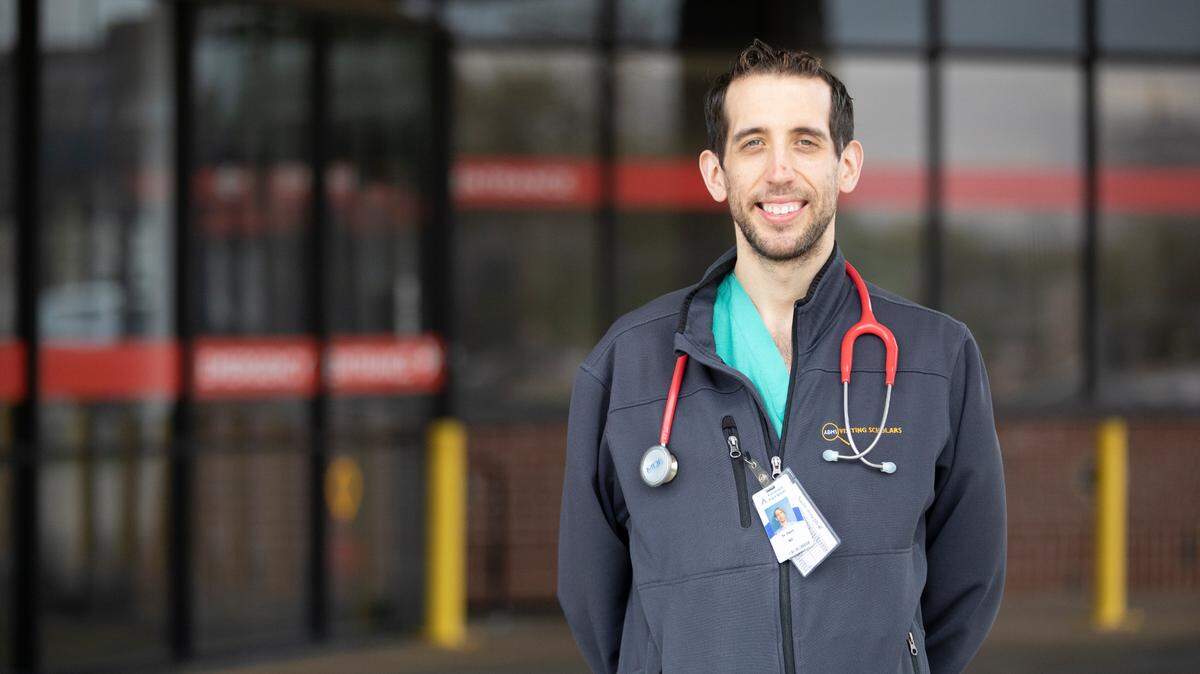
Update: When this column originally published, Dr. Davis was in the process of setting up a GoFundMe account to buy supplies for his return trip to Ukraine. That account is now active and you can donate here or go to www.gofundme.com and search for “Supplies for Ukraine, Joshua Davis.”
— Dion Lefler
We’ve all seen and been moved by the scenes of widespread human suffering that Russia’s invasion of the Ukraine has caused — and is causing.
But how many of us would fly halfway around the world, alone, to a country being shelled and bombed on a daily basis, where we didn’t speak a word of the language, just to help out however we could?
Most of us don’t do that. But then, most of us aren’t Dr. Josh Davis, an emergency room physician at Ascension Via Christi St. Francis Hospital in Wichita.
Davis returned Thursday from Ukraine where he transported supplies and patients, treated children and freed up Ukrainian doctors who are pressed beyond their capacity to keep up with thousands of soldiers and civilians wounded by gunfire and explosions, in a war of national survival entering its third month of fighting.
It was Davis’ first trip overseas.
“When I got on the plane, I actually did not know what I was going to do or where I was going to go,” he said. “I knew I would bring in supplies, I was confident that I would figure out something. There’s lots of people there who need lots of help and that was my plan.”
So why did he get on that plane?
“I can’t sit and watch that TV, like what we see on the news every day,” he said. “I just felt like I was being helpless and I needed to do something to help.”
When he boarded his flight in Wichita on April 14, Davis carried his clothes and travel kit in a backpack and, as they say on the airlines, a small carry-on item.
He checked two oversize suitcases packed with suture supplies, gauze, bandages, rubber gloves, splints and Ace bandages, much of it donated.
Most precious of all, his cargo included two pacemaker kits. The Ukrainians aren’t implanting pacemakers these days, but the scalpels, clamps and sterile supplies in the kits can be easily repurposed for whatever surgery is needed, Davis said.
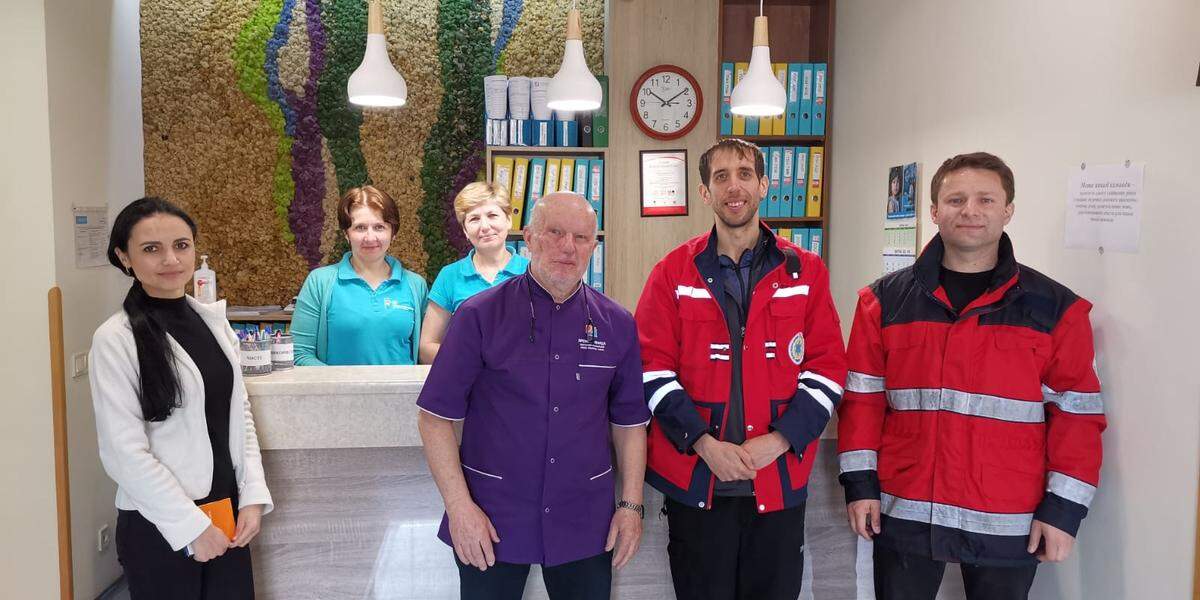
There are no civilian flights into Ukraine, so he flew into Poland and crossed the border with a local doctor from Lviv who doubles as a long-distance ambulance driver.
Lviv, a city of 700,000, is in the western part of the country and has largely been spared, but not completely.
“We were driving overnight to Tuesday morning to Lviv and on that Monday night, the Russians attacked an automobile and tire shop, in addition to a couple of military targets,” he said. “They attacked that civilian target and basically completely destroyed it. There were a couple of young male employees there, ready to go to work that morning and they were like sitting in the break room when that happened.”
Middle-age Ukrainian men are not usually allowed to leave the country, but Davis’ doctor friend has a special pass to come and go.
“He and his wife are physicians,” Davis said. “They actually run a children’s outpatient center right next to the children’s hospital in Lviv. They’ve basically taken their ambulances and turned them into this kind of transport that brings supplies in and transports patients out.”
His friend’s pass got them through the border checkpoint with minimal delays.
“There’s a very long line at the border, actually on both sides; a long line to get into Ukraine and much longer to get out of Ukraine,” Davis said.
Most of those waiting to enter the country are aid workers with all the supplies they can carry — “cars that were full of boxes and bags and stuff in the back of the vehicle,” he said.
The entire medical system of Ukraine has become like a cross-country relay race, transporting patients west from the eastern and southern areas of the country where the fighting is heaviest.
The patient load is a mix of soldiers and civilians wounded in the fighting and people with ordinary but serious medical problems that eastern Ukraine has neither the time nor capability to treat now.
Doctors in the east stabilize patients as best they can and send them by ambulance to Lviv, about 1,200 miles, a distance comparable to driving from Wichita to Cleveland.
Doctors in Lviv take over and do what they can, and ship the worst-off patients to hospitals in Poland, Germany, Austria and other western countries.
Davis arranged such a transport for one seriously ill individual and rode with him most of the way.
In Wichita, if he needed to send a patient to Houston for advanced treatment, he could pick up the phone and it would happen.
In Ukraine, he couldn’t transport the patient until he’d rounded up all the scarce medical supplies, food and water that the man would need to survive a 12-hour ride to Germany.
It gave him a new appreciation for the resources he has at St. Francis, where when he needs something to treat an emergency patient, he either gets it out of the supply closet or asks someone to go get it for him.
While COVID-19 caused shortages in some types of medical supplies here, it never got anywhere near what Ukraine is facing.
Davis said one of the things that impressed him most was the courage and stoicism of the people of Lviv. Although they’re not on the front lines, they are under constant threat of missile attacks and air raids.
He passed by the city’s TV station, destroyed by Russian missile fire early in the conflict.
“That’s something that they live with every single day,” Davis said. “One of the doctors I was staying with, in his flat in Lviv, he showed me where to go for the bombs and stuff. He was like, ‘If the alarms go off, don’t wake me up.’”
The alarms were frequent: “like having multiple fire drills multiple times a night, every night. My perception of war was really altered by seeing how they responded to it.”
The biggest lesson he learned about war is that the suffering is so widespread that it can’t be alleviated by a few, no matter how skilled they may be. It takes millions of small acts by millions of people.
“My perception was I was going to go there and there were going to be hundreds of thousands of people who needed medical care and I was going to see 1,000 patients in the week that I was there,” he said. “But there really was more of like an ‘every little bit helps’ kind of thing. So the one patient that I can get out of there unloads that hospital by one patient and helps that eastern kind of hospital free up, to get another trauma patient and stabilize and manage them with the resources they have.”
The Poles could simply close their borders, but they don’t. No strangers to war themselves, they’ve absorbed 2.8 million refugees and counting.
There are buses at the border and as masses of women, children and the elderly cross, they are immediately taken to emergency shelters and host families, Davis said. They’re taken to the safety that their own country can no longer offer them.
“One household can take in one Ukrainian family as a refugee,” Davis said. “That’s only one family that they’re helping, but if everybody in Poland that has the availability to do that one little bit, it adds up . . . every little bit that every little person does is what adds up to making this be successful.”
So what can we do, besides viewing with alarm from a distance and firing off some strongly worded tweets?
Quite a bit actually.
We can donate.
Davis said he saw relief workers from World Central Kitchen, CORE Response and Samaritan’s Purse, so he can attest they’re on the ground and doing good works.
On Thursday, President Joe Biden announced a program to streamline entry to this country for 100,000 Ukrainian refugees, who will need sponsors. “If that’s something you’re willing to do, I think that would be an excellent thing,” Davis said.
Although he went to Ukraine by himself, he was never alone.
He’s kind of our avatar, going places and doing things that we wish we could, but can’t.
And he wasn’t back 36 hours before he started planning his next trip for a couple of months from now.
He’s filed for a GoFundMe account to purchase another batch of medical supplies. He’s waiting for account approval to accept donations there and I’ll get that information out to you as soon as possible.
Dr. Davis deserves our support.
He represents Wichita. He represents Kansas. He represents the United States of America.
And he does it well.
This story was originally published April 22, 2022 at 6:06 PM.