
ICE cruelty is weighing on crucial Midwest immigrants’ mental health | Opinion
Over the past five years, I’ve produced more than 700 podcast episodes listening to first- and second-generation immigrants across the country tell their stories. I’m Pakistani-American. I know what it means to carry two worlds. And lately, I’ve been hearing from people in the Midwest in Missouri, Kansas, around Kansas City — and they’re describing the same quiet pattern.
A pattern that immigration enforcement data and legal aid statistics can’t capture.
It has nothing to do with paperwork or legal status. It has everything to do with what happens inside people when the climate tightens.
I call it “identity editing.” It’s the quiet, automatic way people shrink themselves based on how they think the world sees them. The Mexican father in Wyandotte County who switches to English the moment his boss enters the room. The Somali teenager in Kansas City who edits her accent because the comments wear down faster than her confidence. The Indian professional in Johnson County who drops her first name on applications because her full name gets fewer callbacks. The immigrant resettled here a decade ago through KC’s refugee network who still calculates whether it’s easier to nod along about Christmas than to explain she doesn’t celebrate.
These are not hate crimes. They don’t show up in data. But they accumulate. Over time, they reshape how people understand themselves. You perform belonging so fluently you forget what you sound like without the act.
What I kept hearing, conversation after conversation across 700-plus episodes, was the same unmet need: There is nowhere to do the daily work of figuring out who you are when the country keeps shifting the terms of your welcome.
That’s when the climate was relatively stable. Now, at this moment, in Missouri and Kansas specifically, everything is accelerating.
ICE arrests, flights out of KCI Airport
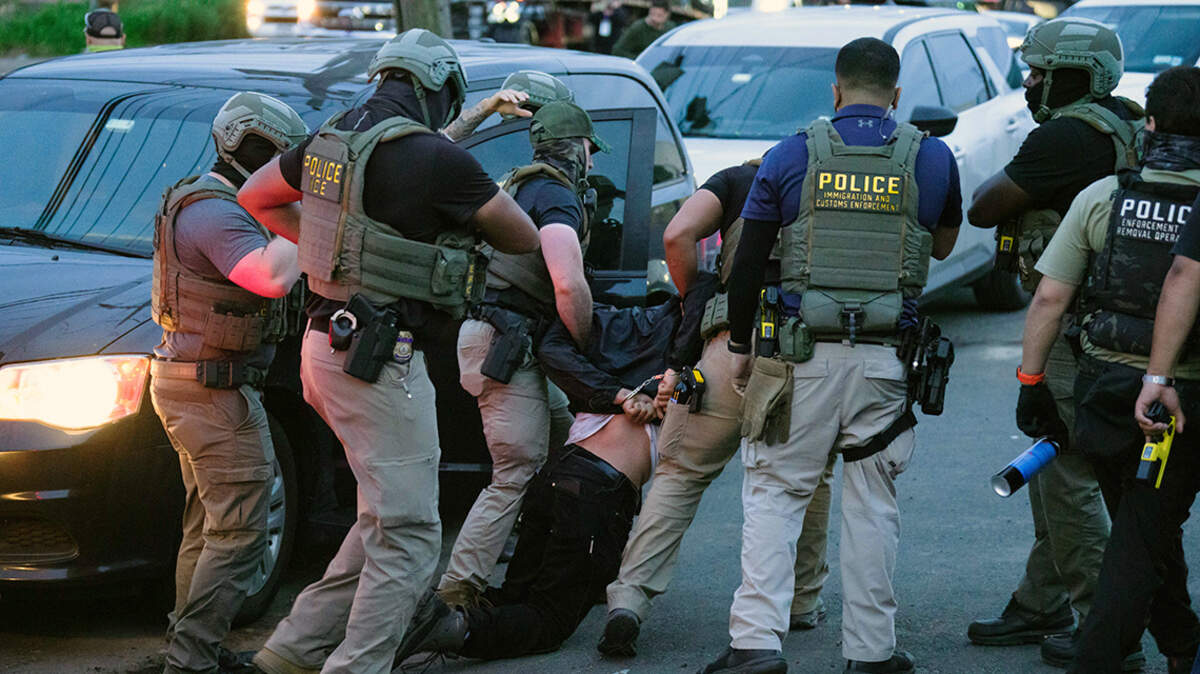
Kansas just became one of the first states to deputize state law officers to enforce federal immigration laws. In the Kansas City metropolitan area, Immigration and Customs Enforcement arrests nearly tripled in Kansas, and surged 76% in Missouri between January and October 2025, roughly 1 in 3 arrests in the entire region occurring here. ICE flights are operating out of Kansas City International Airport regularly.
The message is unmistakable. This isn’t theoretical anymore. It’s happening in the neighborhoods where people are trying to live.
The region is home to nearly 309,000 immigrants in Missouri and 232,000 in Kansas — roughly 540,000 people across the two states whose lives are being shaped by what’s happening right now. More than 60% of Missouri’s population growth this decade has come from international migration. This region was built by people arriving. And now those people are being told, through policy and enforcement, that their presence is provisional.
The psychological research is clear. Current immigration policies intensify psychological distress in immigrant communities, leading to chronic fear of deportation, family separations and barriers to health care. Roughly 1 in 12 U.S. children risks losing a loved one to deportation. Universities are calling it a public health crisis.
But all of that research focuses on the acute end: detention, deportation, family separation. What about the hundreds of thousands of immigrants across Missouri and Kansas who aren’t facing deportation but are witnessing the reshaping of this climate every day? The ones whose paperwork is in order, whose status isn’t in question, but who are still shrinking, editing, performing a version of themselves that feels safer?
That’s the population nobody is building for. That’s the gap I saw in my interviews. That’s why I built a smartphone app to create a space for the daily work of identity that happens between legal battles.
Resettlement agencies cutting staff
But one app is not infrastructure. What we need is for the people and organizations doing immigration work in Missouri and Kansas to recognize that the psychological dimension is not secondary. For hundreds of thousands of people in this region, the identity crisis is the most immediate thing happening to them right now. It shapes how they parent, how they show up at work, how they participate in civic life and whether they feel safe being visible at all.
Our refugee resettlement agencies — Della Lamb, KC for Refugees, Asylum Clinic KC — do extraordinary work reconnecting families. But they are stretched. They recently cut staff and turned to the public for help. The existing mental health system assumes a single cultural context. Traditional therapy can’t process the disorientation of existing between two or three cultures, carrying your parents’ sacrifices as emotional weight, while navigating a country that invited you in and now treats your presence as provisional.
In many of our communities — Mexican, Somali, South Asian, Central American — psychological struggle is private. The idea that you need structured support for an identity crisis, not a legal one, barely registers as a category.
I’ve listened to this region for five years. I know what our immigrants are carrying. I’ve lived it. And I know what we’re not building for.
The way I see it, Missouri and Kansas have spent decades opening their doors to immigrants and refugees — Kansas City especially has become a beacon for resettlement. But right now, as the climate tightens, we are building nothing for what’s happening inside them.
We deserve real support — real infrastructure for the work of staying whole when the country is telling you to disappear.
That’s what I’m calling for.
Saadia Khan is a Pakistani-American immigrant, human rights activist and founder of Immigrantly Media. She holds a master’s in human rights from Columbia University and previously worked with UN Women on civil society advocacy. She is creator of the Belong on Your Own Terms app.
This story was originally published June 14, 2026 at 5:10 AM with the headline "ICE cruelty is weighing on crucial Midwest immigrants’ mental health | Opinion."