
Some old acquaintances from Kansas politics 2025 that should be forgot | Opinion
Should old acquaintance be forgot?
It’s a New Year’s question etched in dichotomous reflection as we find ourselves thinking back and looking ahead at the same time. It’s a conundrum summed up in the 1989 film “When Harry Met Sally,” when Harry Burns (Billy Crystal) asked: “Does that mean that we should forget old acquaintances? Or does it mean that if we happened to forget them, we should remember them, which is not possible because we already forgot ‘em?”
Got it?
As we reflect on Kansas political affairs circa 2025, these four notable “acquaintances” caught my eye as maybe something we should have forgotten:
Property tax cuts (cough)
The Kansas Legislature leadership had made property tax cuts the first, second, and third priority of the 2025 session. By the end of the session, they had saved a $200,000 homeowner $35 in property taxes and passed the largest income tax cut since Gov. Sam Brownback. Furthermore, any future budget savings are dedicated to lowering income taxes until it hits 4%. Gov. Laura Kelly proclaimed this switcheroo the “kiss of death for the Kansas budget.”
Meanwhile, a November legislative post audit found substantial underfunding for mandated state services such as elections, law enforcement and motor vehicle registration, which counties primarily funded with — you guessed it — property taxes.
Gerrymander fever
Was there a more undemocratic contagion threatening the sovereignty of states than the presidentially-induced redistricting for partisan control of the U.S. House? Kansas Statehouse legislative leaders — Senate President Ty Masterson and House Speaker Dan Hawkins — caught the fever, boldly proclaiming their desire to gerrymander Kansas’ only Democratic congressional representative, Sharice Davids, out of existence in a special session.
The fever was broken by a handful of inoculated GOP House members, who were then only to be petulantly banished by Hawkins to the political equivalent of Siberia. But Masterson, a GOP candidate for governor, has vowed to rally a veto-proof supermajority in 2026. Gov. Kelly says it’s unpopular with Kansans.
Roger Marshall’s town hall flex
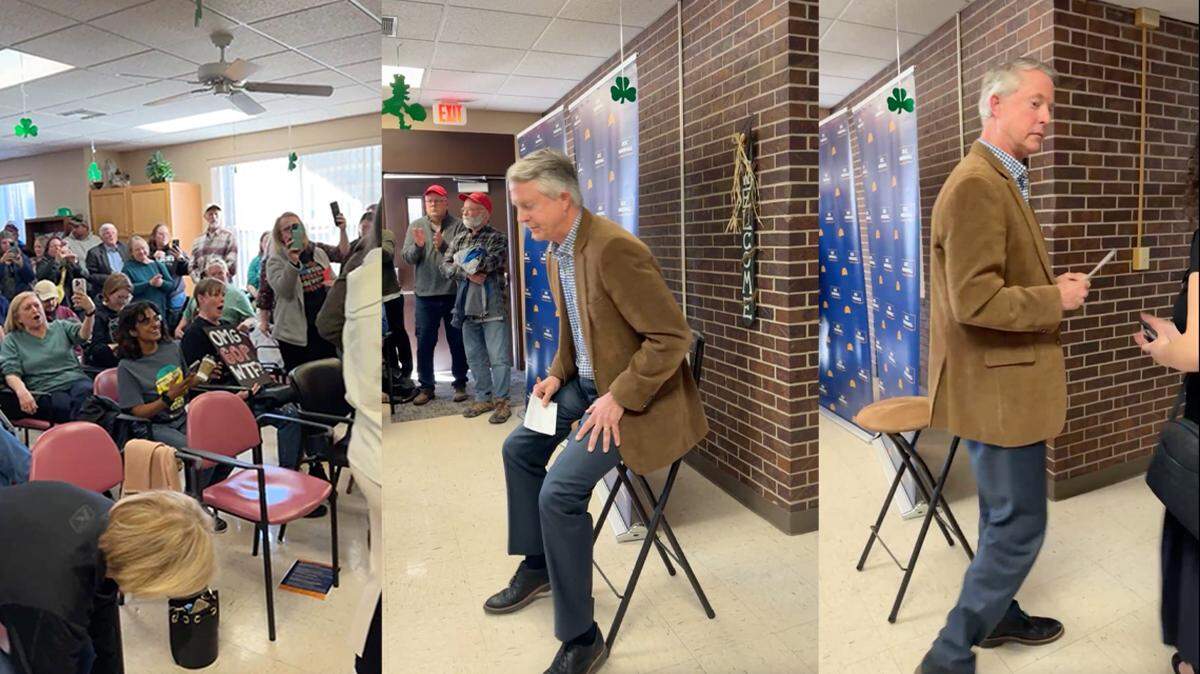
The federal government wasn’t the only thing shut down in 2025. In March, videos surfaced of U.S. Sen. Roger Marshall ending his own town hall early in Oakley after calling the crowd “one of the rudest audiences I’ve ever had” and being pressed on health care for veterans in light of massive DOGE cuts. Sen. Marshall didn’t answer. He walked out.
Town halls are not political rallies. It’s one of the few chances our elected officials in Washington get to face the people they serve. Listening is their job.
Contrast this with Kelly’s People’s Budget listening tour, which drew mockery from Speaker Hawkins.
Marshall is up for reelection in 2026. Hawkins is running for insurance commissioner.
Farm blues
It’s been a rough 2025 for the Kansas farmer. First, DOGE put the U.S. Agency for International Development and Food for Peace through the woodchipper, decimating wheat farmer exports without warning. Thanks to Sen. Moran, Food for Peace was reappropriated $1.2 billion in 2026. Secondly, farmers became entangled in President Donald Trump’s tariff-trade wars. China finally resumed soybean and sorghum commitments late this fall, which is important to Kansas as the leading sorghum-producing state, at $1.1 billion in exports.
A $12 billion federal bridge payment for farmers softened these self-inflicted “market disruptions,” but stands as a conspicuous indictment of federal ag policies and the first of more bailouts.
Let’s raise a cup of kindness to these “acquaintances” and in the words of Sally Albright (Meg Ryan), “remember that we forgot them.”
Or would like to.
— Bill Fiander is a lecturer at Washburn University in Topeka, specializing in public administration, urban planning, and state and local government.
This story was originally published January 2, 2026 at 11:28 AM.