
Kansas senators’ decision to oppose tariff repeal leaves state economy vulnerable | Opinion
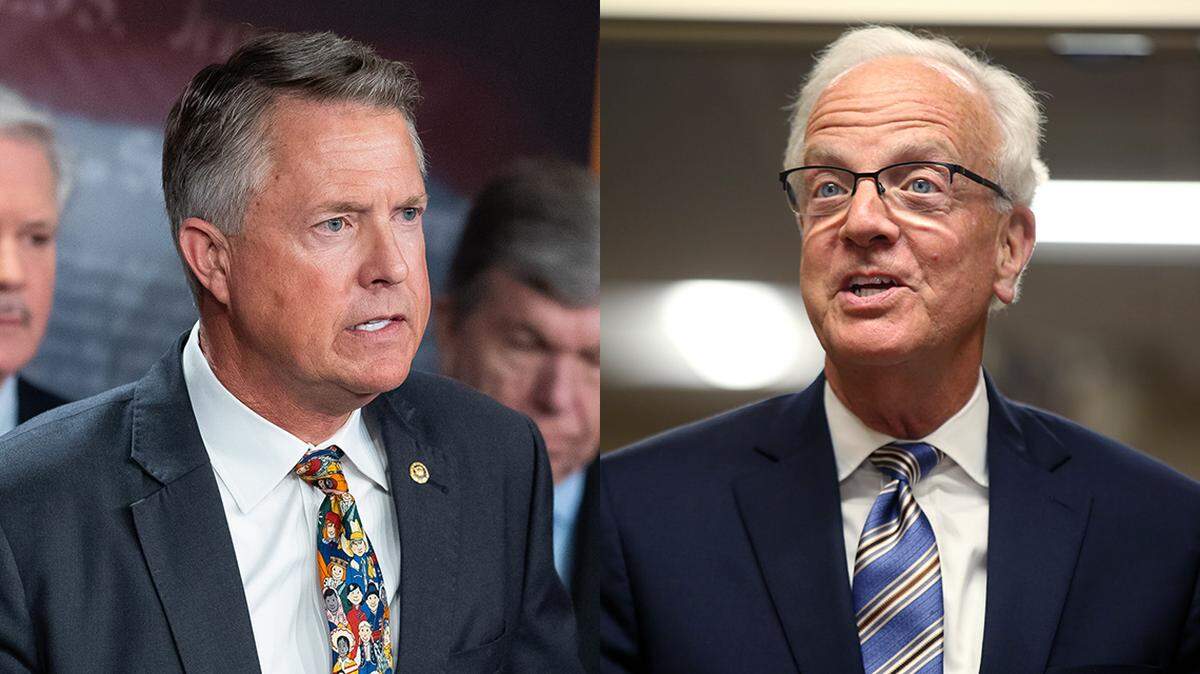
If President Donald Trump’s massive new “Liberation Day” tariffs punish your wallet, crush Kansas farmers and push America into recession — which seems likely — you should remember this: You have Jerry Moran and Roger Marshall to blame.
The state’s two U.S. senators could have helped avert this mess.
They didn’t.
Neither Republican voted Wednesday for a Senate resolution that would have effectively repealed the president’s tariffs on Canada. The vote wouldn’t have blocked Wednesday’s tariff announcement that sent stocks tumbling on Thursday morning, but the measure serves at least as a sign of discontent with Trump’s wildly misguided economic policies.
Marshall was absent from the vote — his office didn’t respond to my emails asking why — but he spent the week cheering on the tariffs and criticizing Democrats for trying to end them.
Moran, meanwhile, knows that tariffs are lousy for Kansas farmers and voted against the resolution anyway.
So they both bear some responsibility.
Fentanyl from Canada not a threat
In the days leading up to the vote, Marshall made clear that he’s willing to see Kansas and the country endure economic harm for entirely made-up reasons.
Trump “took decisive action to combat the flow of lethal fentanyl from Canada with his national emergency declaration at the northern border,” he posted Tuesday on X. The vote to repeal the Canada tariffs, he said, is “jeopardizing our national security.”
Nonsense.
Fentanyl is a problem in the United States. There’s just no real evidence that Canada is the source of the problem. Federal agents seized about 19 kilograms of the drug at the northern border last year. Compared to the 9,600 kilograms intercepted coming from Mexico, that’s practically zero.
It’s certainly not worth hurting the economy. Still, Marshall is committed to supporting Trump.
“America’s farmers and ranchers are tired of being taken advantage of,” he wrote on X, again on Tuesday. The president “will use tariffs to negotiate stronger trade agreements and put our farmers and ranchers first.”
On Thursday morning, this was the lead headline at Successful Farming, not exactly a liberal media outlet: “‘This Trade War Will Force Farms to Close’ and More Reactions From Ag Industry on Latest Tariffs.”
So Marshall might be wrong.
Moran: Tariffs are bad, but …
Moran couldn’t be any clearer: Tariffs are bad for Kansas farmers.
“Tariffs in Kansas often are very harmful to agricultural producers, farmers and ranchers,” he told Politico in a Monday article. “And we’re often the retaliatory target by those we impose tariffs against.”
“Our farmers are stretched,” he added. “This is one of the worst, certainly maybe the worst time I’ve seen, in agriculture. … We need every market.”
Wednesday night, though, he voted against repealing the Canada tariffs.
Other Republicans — Sens. Lisa Murkowski of Alaska, Susan Collins of Maine, Mitch McConnell of Kentucky and Rand Paul of Kentucky — crossed the aisle to join Democrats for the vote. So we know it can be done.
Moran, Politico said, is “planning to push for exclusions to Trump’s tariffs to limit the fallout on his home state.” And maybe there will be another taxpayer-funded bailout of farmers — just like the $23 billion aid that Trump had to deliver when China retaliated for tariffs in 2018.
But wouldn’t it be easier simply to vote to stop tariffs in the first place?
Pain spread far and wide
Of course, bailouts are no sure thing. Farmers overwhelmingly supported Trump, some folks argue. Why save them from the consequences of their choice?
“Farmers do not deserve special treatment,” David Frum wrote this week in The Atlantic, “and should not get it.”
Maybe. But agriculture and ag-related industries comprise three of the four biggest economic sectors in Kansas. Wipe them out, and you will spread a lot of pain to workers, communities and tax revenues across the state.
It’s not just Trump-loving farmers who will suffer. Nobody is getting out of this without some hurt. If you have a 401(k), it’s almost certainly taking a beating right now.
That may be just the beginning of the damage.
“These policies, if sustained, would likely push the U.S. and global economy into recession this year,” J.P. Morgan analysts said after Trump’s tariffs announcement on Wednesday.
We can’t say we weren’t warned. It’s too late to vote for a different president, but it would be nice if our senators would do something about it.
This story was originally published April 3, 2025 at 11:45 AM with the headline "Kansas senators’ decision to oppose tariff repeal leaves state economy vulnerable | Opinion."