
Tiahrt: Lax rules allow foreign bad actors to abuse courts, steal US trade secrets | Opinion
There is no shortage of national security threats facing the United States. From growing concerns about cyberattacks to the ever-present threat of terrorism, our leaders must work, day in and day out to stay one step ahead of those who would like to do our country harm.
This multitude of threats means that new dangers can emerge, sometimes with little warning. One such potential threat involves foreign interests using American courtrooms for industrial espionage. This is a cause for concern, given that innovation is one of the most important strategic assets that the United States possesses and the industries that could be most affected are key contributors to the Kansas economy.
In recent years, third-party funding of mass tort lawsuits and patent infringement claims has increased significantly. Attracted by investment opportunities that can be very profitable and are not subject to the risks of up-and-down markets, hedge funds, and other asset management companies have poured money into such efforts. The amount of outside funding more than doubled from 2017 to 2021 and now totals as much as $5 billion annually.
However, there is growing concern that foreign entities — both private sector and governmental — are now getting involved in third-party funding as well, and that they could be motivated by much more than just a financial return on investment. Foreign funders could use their involvement in such lawsuits to gain insider knowledge that could give them an unfair advantage in business deals, or in theory use the various legal tools associated with patent litigation to hinder the production of key technologies and products.
The Chamber of Commerce Institute for Legal Reform even found in a recent study that although the U.S. government actively works to limit foreign access to technologies in defense and other highly sensitive sectors, essentially nothing is being done to prevent foreign governments or foreign companies acting on their behalf from gaining access to those technologies via investments they make in tort cases.
Given the fact that the aerospace and defense industry is a key economic driver in Kansas that is responsible for nearly 20% of the state’s total exports, this is cause for concern on multiple levels.
What makes this all the more concerning is that foreign actors can undertake such activities legally and without being discovered because there are no adequate rules requiring the disclosure of third-party litigation funders. As a result, foreign investments could be pouring into civil litigation funding already, as foreign governments attempt to advance their strategic interests against those of the United States.
To correct this problem, reforms should be enacted to require full disclosure of third-party litigation funding agreements and the identities of any significant foreign investors. In addition, litigation funders that accept money from foreign governments should report that information to a relevant U.S. government agency. And any agents of foreign governments who invest in litigation against American companies should be required to disclose their association with that foreign government.
Some interpretations of the Foreign Agents Registration Act (FARA) already find that the law is written broadly enough that it could potentially require registration even for some routine business activities of law firms, and foreign funding of legal actions that could jeopardize national security is far from routine.
With evidence in hand and thoughtful reforms to consider, it’s now up to our federal and state lawmakers to do what they can to put a stop to such abuses of the legal system.
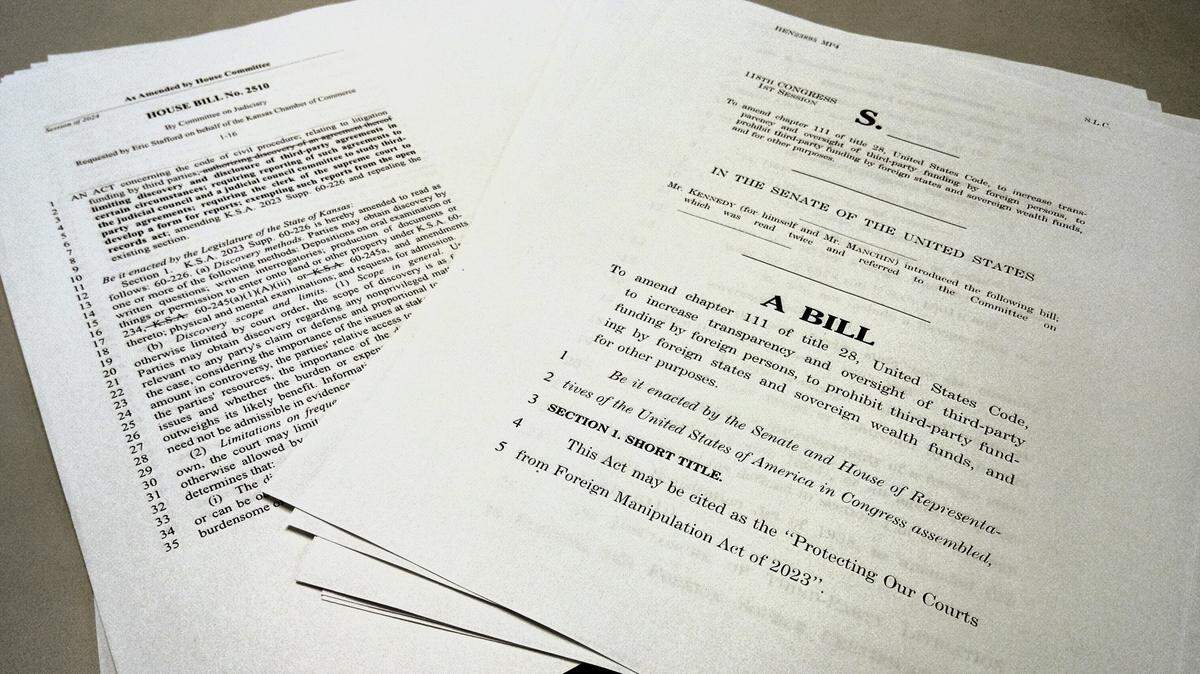
Fortunately, leaders in the Kansas Legislature have introduced a bill to address the issue, and a bipartisan bill before Congress would put necessary safeguards in place to prevent foreign meddling in our justice system. Both are important pieces of legislation that must be passed.
Putting the regulations and legal reforms in place that will make the actions of third-party funders visible for all to see should be one of the top priorities of our legal system and elected lawmakers.
This will give all parties involved in tort cases the information they need to adjudicate the cases fairly and impartially and make sure that neither national security nor the competitiveness of American companies is put at risk.