
Eagle endorsement: Wichita business pioneer JP Weigand said it best on school bonds | Opinion
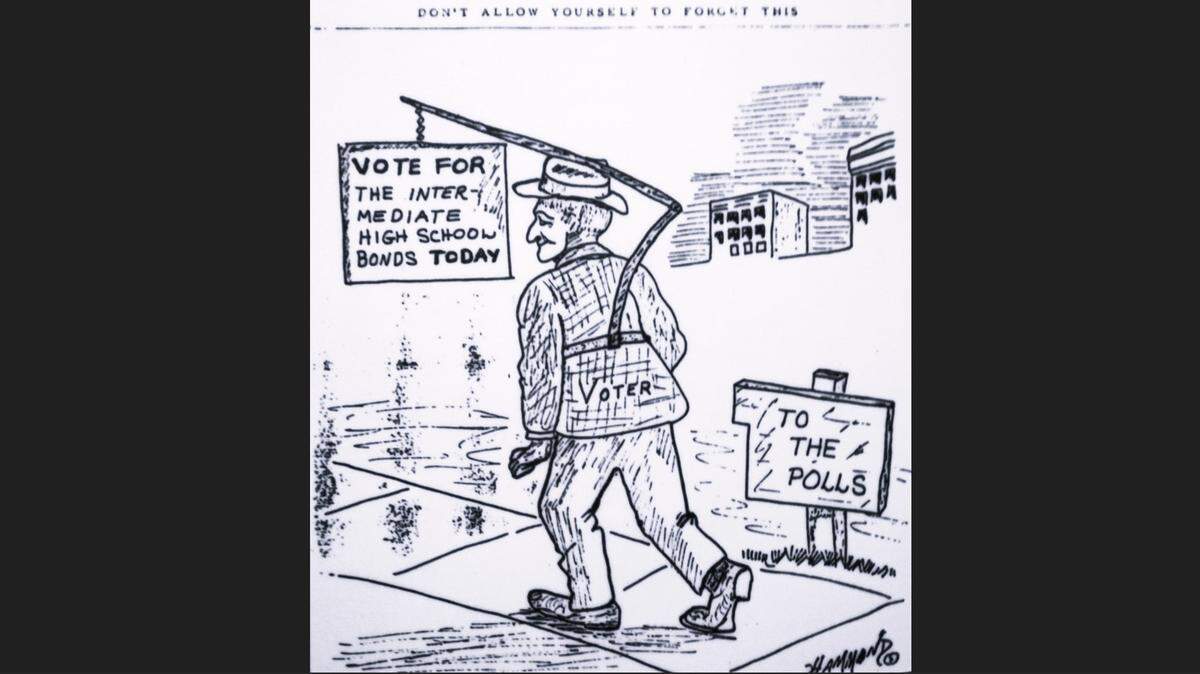
“We can’t have a town without schools. It is a public matter which every citizen should support and support decently. I have no use for the spirit of stinginess that animates some people of large property interests and big incomes when it comes to a matter of schools. We ought to have a school everywhere we need one and whenever we put one up we should make it a good one, up-to-date in every particular. It is one of the departments of government that we cannot afford to be miserly about.”
— John “JP” Weigand, Wichita Beacon, July 28, 1916
The words of JP Weigand, Wichita business pioneer and founder of what is, to this day, one of the city’s most prominent real-estate firms, resonate as true now as they did when he said them 109 years ago.
We would do well to listen, as the voters of Wichita proceed to the polls Tuesday to decide whether to pass another school bond and build an educational system for the future, or let the system we have slide into decay and irrelevance.
The arguments for and against the 1916 bond would be familiar to those who have watched the bond campaign of 2024-2025 — primarily the societal need for better schools versus the individual desire for lower property taxes.
The story in which Weigand was quoted dealt with divisions within a local group called “The Tax League.”
“Some of them are for it and some of them are against it,” the story noted. “They are arguing and counter-arguing. There seems to be a tightwad faction and a “Greater Wichita” faction among them.”
Fortunately for us all, the foresight of Weigand and other “Greater Wichita” leaders of his day prevailed, laying the cornerstone for the modern — and educated — city that we enjoy today.
Now, it’s our generation’s turn.
The $450 million bond issue will essentially extend the most recent Wichita bond issue, passed in 2008, and keep the school bond property tax rate the same as it is now for another 20 years. At present, the rate generates about $172 in tax on a $200,000 home.
A “Vote No” campaign has been activated, lavishly funded by anonymous donors, no doubt the 2025 version of the “people of large property interests and big incomes,” that Weigand warned about in 1916.
The “No” campaign argues that the bond is a tax increase. Granted, the amount of tax in actual dollars will rise somewhat as property values increase over time. It’s the natural course of inflation.
As any real estate agent will tell you, property values are higher in communities with good schools, because people want to live there. See Goddard, Maize and Andover for reference. So while you may pay slightly higher taxes on your home in the now, your actual wealth is increasing a lot more over time.
The “No” side also argues that student test scores have not kept pace with bond spending, a spurious argument punctured by Chase Billingham, an associate professor of sociology at Wichita State University.
Billingham’s research shows that test scores did go up after the 2008 bond, dipped practically everywhere during the COVID-19 pandemic when schools were closed and instruction moved online, and they’re now rising again.
We could cost-benefit analyze this question to death. But there’s not much point to that.
The only real question in 2025 is “Do you support public education, or don’t you?”
The bond vote comes as public schools are very much under attack.
The Legislature in Topeka has just voted (again) not to fully fund special education and the energy at the Statehouse is behind expanding what is essentially a voucher program for private schools. A little-known but ironic fact is that private schools can enroll special-education students and collect their tuition, while the local public school district remains responsible for providing their special-education services.
In Washington, President Donald Trump and multi-billionaire Elon Musk are working to at least gut and probably shutter the U.S. Department of Education. That would be devastating for rural and urban Kansas districts with large percentages of impoverished students that receive federal funding under Title 1 of the Elementary and Secondary Education Act.
If you want to send a message that “That ain’t right,” you probably won’t get a better chance than going to the polls on Tuesday and voting “Yes” on the USD 259 bond issue.