
Urban and rural farmers can come together to feed Kansas City smartly | Opinion
We are going to run out of food if big changes in our food habits aren’t made — like today.
As a graduate student attending classes in K-State Olathe’s Urban Food System program, I regularly hear that we will have 2 billion more people on Earth during most of our lifetimes. The universe isn’t making any more land or natural resources — so we need to make changes now to work with what we have been given.
There are signs all over that show we aren’t properly managing our current food system. Copious numbers of food pantries prove that there is an imbalance between areas of excess and areas of nutritional need. Grass-covered (and, sadly, totally exposed) landfills are bulging, while few people engage in composting kitchen waste. The small number of existing compost enthusiasts encounters obstacles in homeowners associations and archaic zoning regulations. Composting is just a part of the challenge.
At the big-picture level, commodity farmers are being squeezed to their breaking points by crop and equipment tariffs, shortages and high prices for production inputs. To feed our growing population, “olive us” need to put on our Superman capes and “meat” the task of improving the food system for everyone. Too often, food producers in urban and rural areas are pitted against one another for the wrong reasons. The truth is, we have more in common than we realize, and we can’t live without each other.
In the past, rural food producers have accused city farmers of having their head in the clouds and not grounded in reality. Densely-populated neighborhoods have high land prices. Expensive property creates farms that are too small to reasonably feed all the residents of their neighborhoods. Urban agriculture can be perceived as a luxury — something only a select few can participate in.
Urban farmers are physically divided from their rural counterparts. Both parties have been at odds philosophically because city farmers see large-scale commodity producers as major polluters and killers of important pollinator species such as the monarch butterfly. Some view rural producers as sprayers of chemicals, destroyers of nature and ruiners of natural resources.
We need to shed these misconceptions like a bad habit. When you sit down with people who grow food, rural or urban, they will tell you that their food is for everyone, and they are not exclusive to any particular group.
Recognizing the linkages between the city and country is the first step in hatching a strategy to work together to solve our current and future food insecurity issues. We can build on what makes us stronger, and go from there. Think of all the trade schools near urban centers where young farmers can take welding classes and learn to repair their own tractors. On the flip side, our cities couldn’t function without the commodity crops grown in rural communities. No urban dweller could live on what they grow or forage. They need corn, soybeans and wheat.
Vertical integration to efficiency
To improve our chances of not starving in the near future, I have been interested in promoting urban growers using vertical integration. That is when you absorb more than one step of a production system. Large businesses such as Walmart use vertical integration by owning their own shipping companies. They don’t have to pay another company to move their products. Originally, this was to pass the savings on to the customer efficiently and keep prices low.
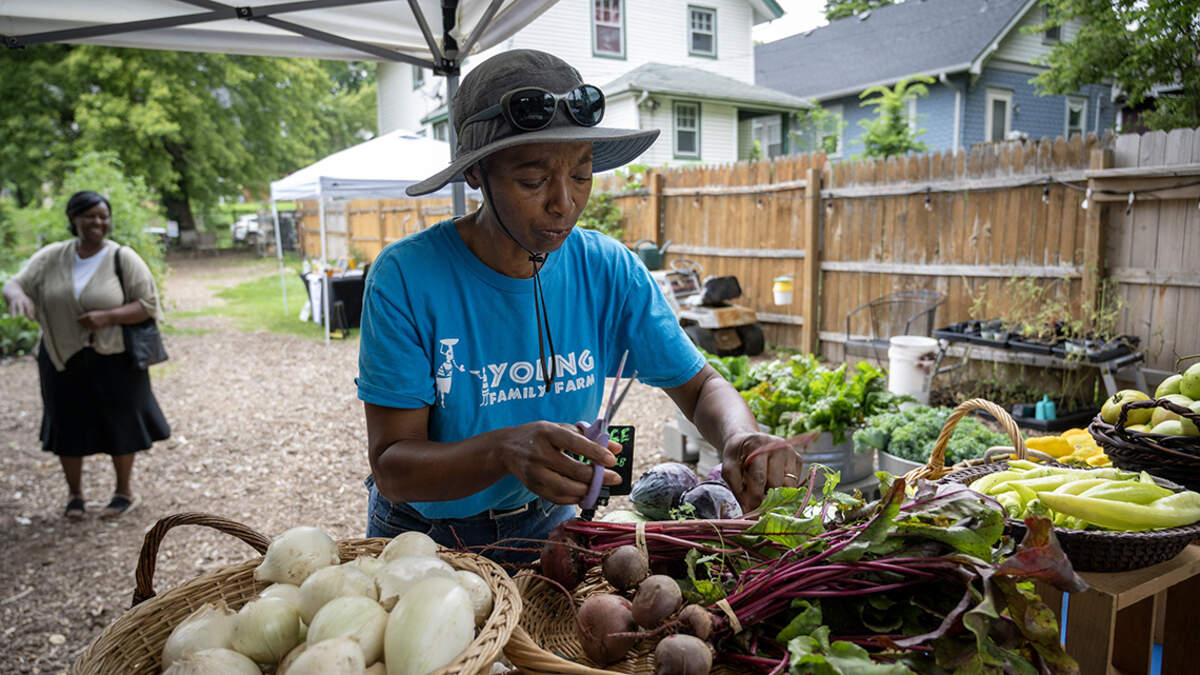
In the case of food systems, this is a farmer growing food and selling at the farmers market instead of to a produce wholesaler. Another example of vertical integration is when small producers have the equipment to preserve their crops. They can sell locally-made organic applesauce to an elementary school and keep any profits that would have been paid to a canning factory. With the extra income, urban farmers can reinvest in their local markets through job creation or purchasing from other area businesses.
If we make a commitment to celebrate the successes of the alliance between urban and rural farmers with creative vertical integration systems, we could save our own bacon. We need to support and appreciate rural commodity farmers. They don’t have much leeway in their business plans, and their margins are small.
Your biggest impact comes from being a champion of city farmers who can use creative methods to take up steps above and beyond food production.
Let’s all try to help urban farms at any level. Simple solutions are a great start. You can make a budget of what to spend at the farmers market this weekend. Choose local products if they are available at your supermarket. Google the nearest urban farmer who uses compost to decrease their fertilizer costs and keep food scraps out of landfills.
We can do this.
Tracy Flowers is an urban farmer and a student in Kansas State University’s Urban Food Systems master’s program.
This story was originally published July 6, 2026 at 5:05 AM with the headline "Urban and rural farmers can come together to feed Kansas City smartly | Opinion."