Wichita City Hall ignored warning signs on Ken-Mar project risk from the start | Opinion
This week’s City Council meeting was a test of integrity.
And the council passed with a grade of 71%.
That’s the percentage of the seven-member council that stood up to a proposal to forgive and forget $1.4 million in undeserved benefits for Old Town developer David Burk and Key Construction co-owner David Wells, who refuse to pay back a $1.8 million balance due on $2.5 million they borrowed from the city going back to 2009.
Seventy-one percent is a C-minus. But it’s better than I expected, given that the developers in question are prolific contributors to City Council campaigns and have been awarded tens of millions in city subsidies over the years, with mixed results (mixed for us, they seem to be doing just fine for themselves).
The current case deals with the Ken-Mar development at the northwest corner of 13th and Oliver.
What stings most in the sad story of Ken-Mar is that the city was warned — I remember, because my own reporting was part of that warning. That, and it’s another failed promise to bring neighborhood-elevating development to the economically challenged and historically Black community of northeast Wichita, which desperately needs it.
City Council ignored warning signs
The Ken-Mar project was approved at the Jan. 6, 2009, City Council meeting.
That was less than a month after the council was forced to put the brakes on a plan for $11 million in city subsidies to a proposed commercial/office/apartment project in Midtown called “Renaissance Square.”
Renaissance Square was halted after I, and former Eagle reporter Tim Potter, published an investigative report that the principal developer had been sued 35 times for bad debts and bounced checks; had previously run a hotel development venture that went bankrupt owing Wichita, Sedgwick County and state more than $450,000 in back taxes; and also had an outstanding warrant in Butler County for more than $12,000 in unpaid income tax.
Bob Weeks, the publisher of the Voice For Liberty blog, cited our report at the public hearing on Ken-Mar in a warning that now, 16 years later, has turned out to be chillingly accurate.
“Last month, it was certainly discovered that the procedures used to investigate the background of potential city business partners were lacking,” Weeks said. “It’s now recognized that the processes that were in place failed to give City Council members information that they needed in order to make fully informed decision about the desirability of partnering with a certain development firm. Today the council is facing a similar situation.”
Weeks pointed out that the city could have trouble collecting if the increase in property taxes from the Ken-Mar project wasn’t enough to cover what the city was lending the developers.
“The developers have been asked to agree to what the city calls a tax increment shortfall guarantee,” Weeks said. “It seems to me that this guarantee is only as good as the financial condition of the guarantor.”
Those words were prophetic.
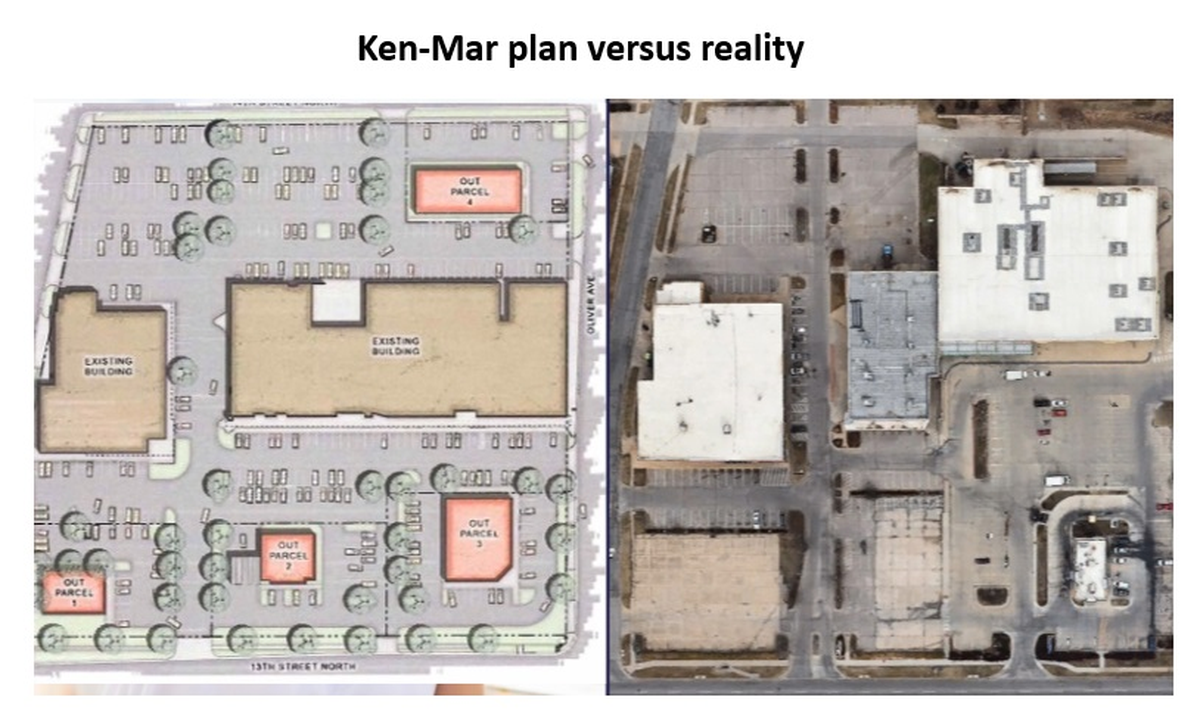
The Ken-Mar project has turned out to be a shadow of what the city was promised.
Burk and Wells split the property and sold off the pieces for a little over $3.7 million, pocketing the revenue and stranding most of the debt to the city in a limited liability company they created that now has no income, no assets, and no future prospects of ever obtaining either.
Burk and Wells paid back a little over $700,000 (the exact amount is in dispute). And then they decided they weren’t going to pay any more.
“Since 2013, our members had to individually contribute $717K to allow HH Holding to fund $765,194.73 in shortfall,” Wells wrote in an email to the city on March 8, 2022. “However, it is not financially feasible for us to continue to make these payments. We hope the City can acknowledge and appreciate the extent we have supported this original effort, but feel it is time to have the City take over the responsibility for the shortfall.”
The city has sued, seeking to enforce what City Manager Robert Layton says was a verbal promise from the developers to pay back the loan, a promise Burk and Wells deny making, according to court records.
Yes, it really is that messy.
Ken-Mar? Or Providence Square?
When the project was approved, the stated goal was to revitalize the neighborhood with multiple consumer-facing storefronts and stand-alone retail stores and restaurants.
It was hailed as a catalyst for improvements all around a depressed and depressing corner in one of the poorest areas of the city.
Burk and Wells teamed up with a respected local pastor, the Rev. Kevass Harding of Dellrose United Methodist Church, which is adjacent to the Ken-Mar site, and Spaghetti Works District/Naftzger Park developer Nick Esterline.
They formed a company called H.H. Holding, LLC. Between 2014 and 2015, Harding and Esterline vanished from H.H.’s annual reports, leaving Wells and Burk as the remaining owners.
The project was christened “Providence Square” back when it started. A faded sign still attests to that, but Providence has long since left the building.
As plans evolved, Burk and Wells sold off part of the site to Walmart for a Neighborhood Market, which opened in 2011 and closed in 2016. A mattress store moved into the spot, and then moved out.
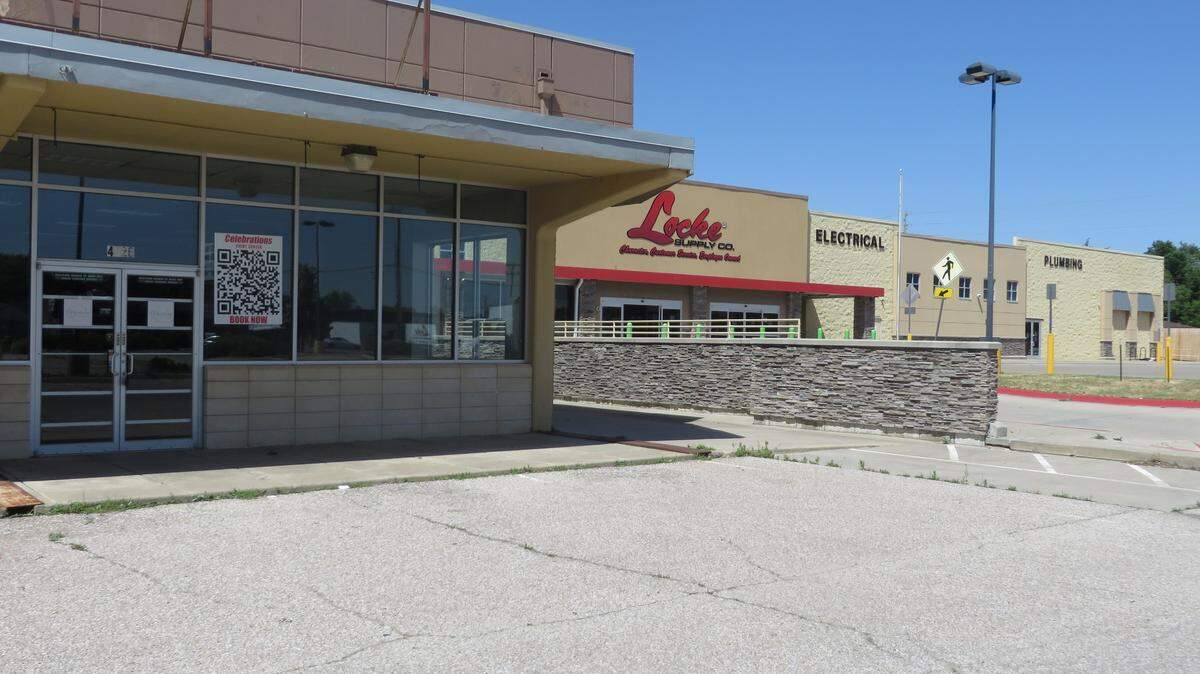
Today, the shopping center is anchored by Locke Supply Co., which primarily sells wholesale electrical, plumbing and HVAC equipment to commercial contractors. It’s a solid business, but not the kind that uplifts an economically challenged neighborhood in a food desert.
There’s a Church’s Chicken fast-food restaurant in the parking lot, the only one of four outparcels in the original development plan that was actually ever built upon. The center also holds a small clothing store, a smaller beauty supply shop and a tiny storefront church.
Three storefronts attached to the Locke building are vacant and run down. Over time, they’ve housed a bank that relocated nearby, a rent-to-own furniture joint, a flea market and a hair-braiding establishment
It’s far from the shining example of neighborhood revitalization that northeast Wichita was promised.
The surrounding area is still mostly the same mix of business you see in any poor neighborhood — a couple of dollar stores, a car-title loan outfit, a liquor store, etc.
Ken-Mar is the same old song for Wichita redevelopment: A handful of favorite-son developers walk away with millions in public money and the people — especially poor people — get bupkus.
We saw it with WaterWalk, which instead of the glitzy commercial zone and boat canals we were promised is now a collection of condos and apartments and the headquarters for King of Freight.
We saw it with the Advanced Learning Library, pushed off the Arkansas riverfront to make room for the privately owned but city-subsidized River Vista Apartment complex.
We saw it in City Hall undercharging commercial landlords for downtown parking for 25 years based on a handshake agreement, which is why you’ll soon have to dig out your credit card to park there yourself.
Burk and/or Wells had a hand in all those. But the money kept flowing from City Hall to their developments for years.
“From 2011 to 2021, David C. Burk and David E. Wells sought and obtained various City-provided incentives for seven other development projects in which they or their affiliated limited liability companies held financial interests,” the city’s lawsuit says. “Defendants apparently saw no need from and after March 8, 2022, to fulfill their verbal commitments to the City for the Tax Increment Shortfall payments because they had already secured the desired benefits for their other projects with the City.”
‘If we don’t pay, we get punished’
I applaud the council for its vote to stand up and say “enough” on Ken-Mar.
The two dissenting council members in the 5-2 vote, Brandon Johnson and J.V. Johnston, pointed out that a negotiated settlement of $400,000 is better than nothing, which is what the city risks if it takes the case to trial.
They’re right. But they’re not right enough.
The Ken-Mar discussion at Tuesday’s council meeting went on for an hour or so. But it was Lawanda DeShazer, a northeast Wichita community activist and City Council candidate, who really put it all in perspective.
She told a personal story about a time when she forgot to pay her water bill to City Hall.
“You know what happened? My water got turned off,” she said. “On top of that, I got (charged) a fee to get it restored. So not only did I have to pay what I owed, I had to pay more, because I didn’t pay what I originally was supposed to pay.
“Common everyday citizens are expected to pay the city what they owe the city, and if we don’t pay, we get punished. And so I expect the same thing to happen to these multi-million dollar investors.”
The best time to draw that red line would have been 16 years ago, when the city was warned it was flirting with financial danger at Ken-Mar.
So props to the current council for doing what the 2009 council didn’t have the nerve to do.
If nothing else, fighting to the end over Ken-Mar will send a message to Wichita’s development community that the time of special rules for special people needs to come to an end — and if the city subsidizes your project, you better be prepared to keep up your end of the deal.
Sending that message is worth risking $400,000, because it could save us millions down the line.