Venomous copperhead snakes are slithering around Kansas. Here’s where & how to stay safe
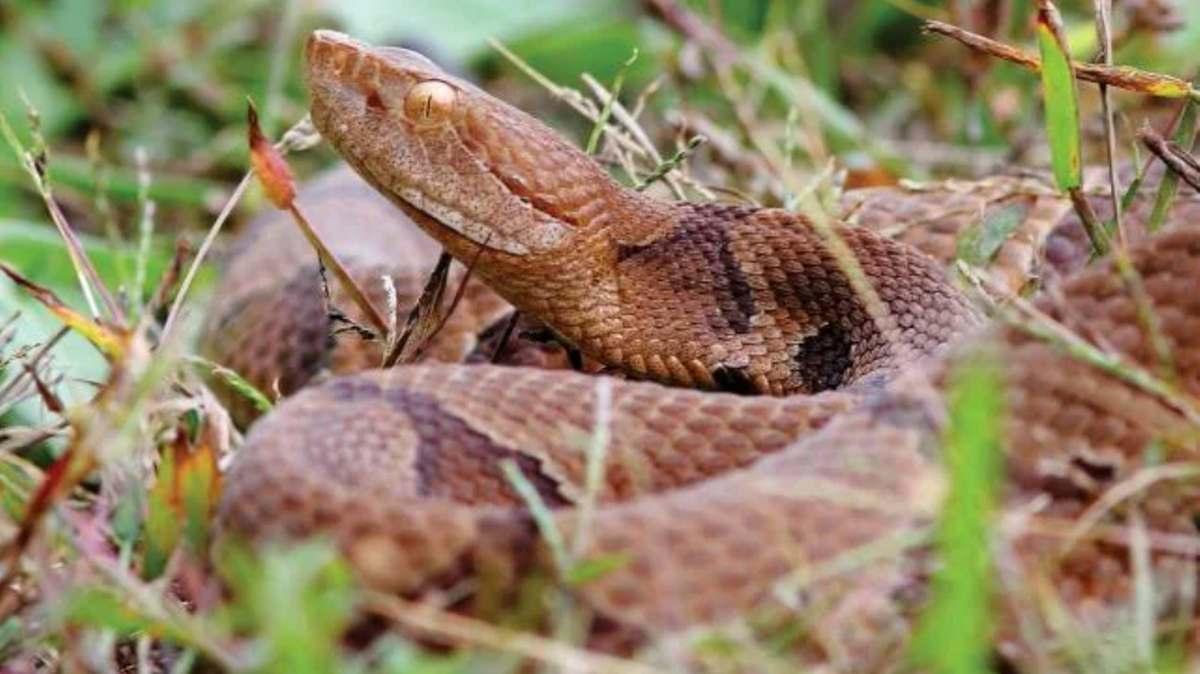
It’s almost baby copperhead season in Kansas.
Copperhead snakes usually mate in the spring, which makes mid- to late summer the prime time to find these venomous snake babies in yards.
For those living in Sedgwick County, however, you shouldn’t have to worry too much about coming across one of these venomous snakes close to home.
“The east of the Flint Hills are where they’re most abundant,” said Daren Riedle, wildlife diversity coordinator with the Kansas Department of Wildlife and Parks.
The closest these snakes come to Sedgwick County are southern Butler County and Cowley County, Riedle said.
There are two kinds of copperheads found in Kansas — the broad-banded copperhead and the eastern copperhead. Copperheads can be identified by their distinct bands on their body and the lack of a rattle on the tail.
How to distinguish a copperhead from other snakes
One common snake that is often mistaken for a copperhead is the northern water snake. Northern water snakes are widespread in Kansas and have bands that are very similar to copperhead snakes.
But you can tell the difference by looking at the shape of their heads, Riedle said.
Copperheads have a more chunky, triangular snapped head and elliptical pupils — very different than northern water snakes.
“If you harass a water snake, they will flatten their head out to make their head look bigger,” Riedle said. “But it’s going to be really flat, as opposed to more of a chunky head.”
A small snake called the dekay’s brownsnake is often pretty abundant in peoples’ yard. Riedle said he gets calls often where people confuse that snake with baby copperheads — but in reality, brownsnakes are completely harmless.
What to do if you come across a copperhead in Kansas
The best thing to do if you come across a copperhead in Kansas is to not bother it, Riedle said. The snake will go on its own way if you go on your own.
If you are hiking in an area that’s known to have copperheads, it’s important to keep an eye out.
“Just watch where you put your hands and your feet while you’re hiking, because they are very well camouflaged,” Riedle said. “They blend in with the leaf litter very, very well.”
Copperheads are most commonly found in woodland areas and rocky hillsides, but can venture beyond to farm buildings if there are food sources around.
Reidle said that copperheads are not usually aggressive snakes. Instead, most cases where bites occur happen by accident.
Riedle said the bites he knows of from the last couple years were from either people walking in sandals and stepping on a copperhead, or not paying attention and accidentally grabbing one.
What to do if you get bitten by a copperhead
If you believe you might have gotten bit by a copperhead, you should go to the nearest hospital right away, Riedle said, where they will most likely put you under observation in case there is a severe reaction.
Most common symptoms of a snake bite are, from the U.S. Centers for Disease Control and Prevention:
- Puncture marks
- Swelling around the bite area
- Nausea
- Vomiting
- Labored breathing
- Muscle twitching
- Irregular heartbeat
- Troubled vision