
28-ton boulder sacred to the Kaw Nation to move from Lawrence to tribal land
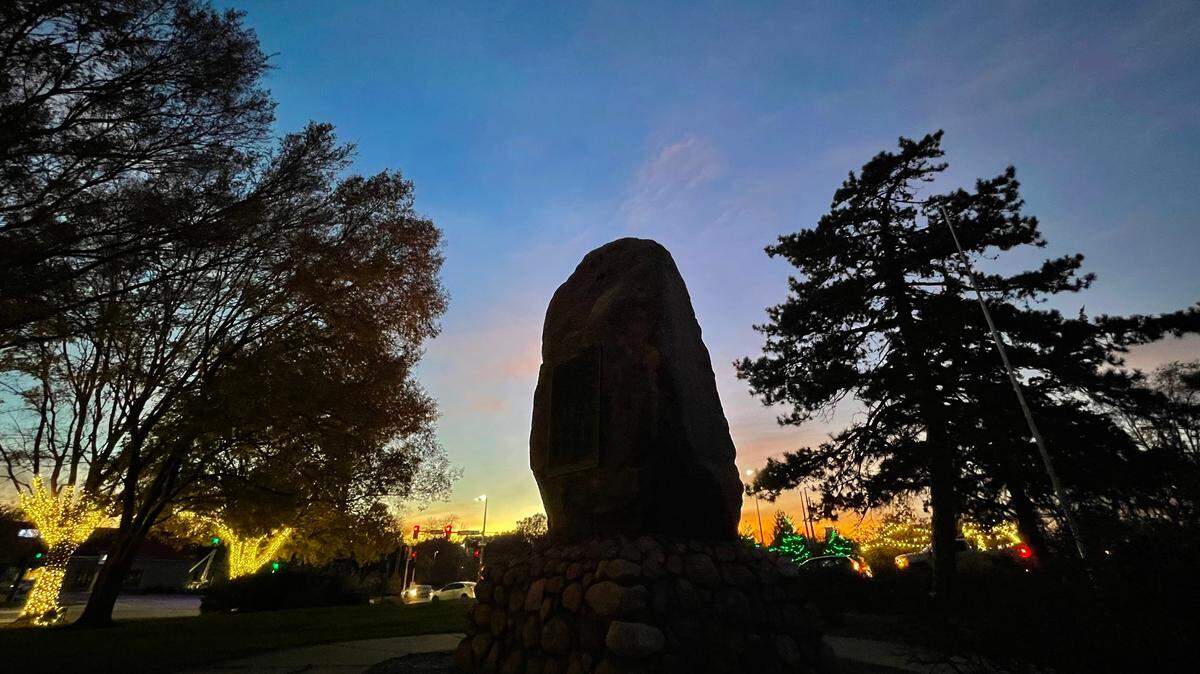
A national foundation announced this week that it is awarding a $5 million grant to the University of Kansas, allowing funding for the Kaw Nation to relocate a sacred 28-ton boulder from a park in Lawrence to the Allegawaho Memorial Heritage Park, near Council Grove.
Known as In‘zhúje ‘waxóbe — which is pronounced EE(n) ZHOO-jay wah-HO-bay and translated means the Sacred Red Rock — the Kaw, or Kanza, tribe hold it in holy reverence, said Jim Pepper Henry, the director and CEO of the First Americans Museum in Oklahoma City and vice chair of the Kaw Nation Tribal Council. The rock was originally deposited in Kansas at the confluence of Shunganunga Creek and the Kansas River close to Tecumseh, which is near Topeka, 300,000 years ago by a glacier.
For centuries, the red rock was as a symbol for the Kaw Nation, the tribe from whom the state of Kansas takes its name.
But in 1929, as Lawrence was celebrating the 75th anniversary of its founding, the rock was moved by rail to the north end of Massachusetts Street, south of the bridge over the Kansas River to Robinson Park. The park is named after Charles Robinson, the first governor of Kansas and former superintendent of Haskell Institute, now known as Haskell Indian Nations University.
A bronze plaque was then affixed to the rock honoring the town’s predominately white pioneers.
For 93 years, the rock has stood in Lawrence as a conflicting symbol.
In 2015, Kansas-based artist Dave Loewenstein began working with Pauline Eads Sharp, a member of the Kaw Nation Cultural Committee to recall the stories of the Sacred Red Rock in order to address the misuse of the rock by the city of Lawrence and Douglas County. That project led to growing awareness and a collaboration with the Mid-America Arts Alliance, Lawrence community members and the Kaw Nation.
Last year, the city of Lawrence and Douglas County formally apologized to the Kaw Nation for defacing the rock and agreed to the unconditional return to the Kaw Nation.
The Mellon Foundation’s grant will now relocate the rock, provide financial resource to develop an interpretive plan and infrastructure at Allegawaho Park as well as signs for visitors to learn about the Kaw people.
Lawrence Mayor Courtney Shipley said in a news release that “the City is excited by this grant … and the opportunity it affords us to continue the process of returning In‘zhúje ‘waxóbe.”
Moving the rock will take months
Moving the rock will be a months-long process and will be led by members of the Kaw Nation in collaboration with the city of Lawrence, University of Kansas, Spencer Museum of Art, Kanza Heritage Society and others. The project is expected to be completed by spring of 2023.
The process will include building a custom-made harness for the rock so it can once again be transported, and using a crane to lift the rock onto a flatbed truck.
A ground-penetrating radar examination of the rock has taken place to ensure the internal structure of the rock is sound and can withstand the moving process. Appropriate ceremonies and gatherings will be held to honor the sacredness of the places the rock has traveled.
Moving the rock and developing the infrastructure of Allegawaho Park near Council Grove is essential, Pepper Henry said, because the rock will then be back on Kaw land, owned by the tribe since 2002.
Currently, there is no water or electricity on the property.
“Our plan is to actually bring more attention to it,” Pepper Henry said. “We never thought in a million years we would get this kind of support to do something like this. The Mellon Foundation understands the importance of our position and that we are trying to have people acknowledge that we still exist and that we have a history that is important not only to Kansas but to our country.”
Allegawaho Park is on the final reservation lands of the Kaw Nation in Kansas before the tribe was forcibly removed and relocated to Indian Territory, now Oklahoma.
At one time, the Kaw claimed a territory that covered roughly two-fifths of modern Kansas and parts of Nebraska and Missouri.
Then, an 1825 peace treaty with the federal government reduced the Kanza lands from 20 million acres to 2 million acres just west of Topeka. With the passage of the Homestead Act in 1862, the land once owned by the Kaw became available for settlement.
Another treaty in 1946 then reduced the Kanza land from 2 million to 256,000 acres near Council Grove, where the Kaw Mission is the town’s oldest stone structure.
“This is a real opportunity for the Kaw people and the citizens of Kansas to — I don’t know if the right word is reconciliation, because we are a long way from having that happen — but it can be, I think, it can be the beginning or the continuation of a healing process,” Pepper Henry said.
“It’s happening several generations after the removal of the Kaw people, but I think people now are beginning to understand a little bit better of our history and the darker parts of history — the displacement, the ethnic cleansing that happened in our country, in Kansas and the removal of the original people.”
Two years ago, the Mellon Foundation began the Monuments Project initiative with a $250 million commitment to preserve the efforts of those whose stories are often denied historical recognition.
The $5 million grant by the foundation was among four announced this week. Others included grants to the Wideman Davis Dance Company to explore antebellum and black spaces through dance in Alabama and South Carolina; a Los Angeles memorial honoring the World War II Japanese Americans who were incarcerated; and in Virginia, a reconstruction of a home built by a black homeowner.
“We belong to it”
Efforts on the Sacred Red Rock project began more than 30 years ago to help create awareness of its sacredness to the Kaw people.
“I think people confuse this as something as an idol that we would pray to and that’s not the case,” Pepper Henry said. “This is a stone that we prayed at to God or to Wakonda – and I know that some of the elders describe the stone as almost like the flesh or embodiment of the physical manifestation of Wakonda – or at least the presence of Wakonda.
“We would gather there at the stone to pray to God, like almost a church. Generations of our people would gather at the stone and pray. I was told the stone has dozens if not over 100 songs associated with it.”
He made his first trip to the rock in the mid 1990s with his uncle, Luther Pepper Henry.
“You could describe it as a spiritual feeling, just being around it,” Pepper Henry said. “You could feel the presence of that and even the kind of weight of that and how important that was.
“I knew from that time on that the stone needed to be back in the stewardship of our people. In our way of thinking, we belong to it. It doesn’t belong to us.”
This story was originally published April 6, 2022 at 3:42 AM.
CORRECTION: The University of Kansas is the recipient of the Mellon Foundation’s grant. An earlier version of this story misstated who received it.