Why aren’t your plants thriving in Kansas? Location and climate change could be why
Randi Thimesch, a west-side Wichita gardener, has a deep passion for flowers. Her favorites are Sun Coleus and Johnny Jump Ups. For her, gardening is a way to get out of the house and clear her mind, while enjoying nature and soaking in vitamin D.
“It’s my happy place, and really, truly it is therapeutic,” Thimesch said.
As she works in her garden, people who are driving by regularly yell out their window as they pass that her garden is beautiful. She’s put a lot of effort into it and it’s a labor of love.
But Thimesch has begun changing the way she gardens to accommodate for the “erratic weather,” as she calls it.
As climate change warms the planet and causes more extreme weather, it has begun affecting where plants can grow throughout the nation, and Kansas gardeners, conservationists and botanical gardens are starting to see the effects.
Plant species can respond to warmer conditions by either moving north or changing the timing of their blooming and seeding seasons to cope, according to Dr. Theresa Crimmins, director of USA National Phenology Network and plant ecologist, who studies how plant species are responding to changing climate conditions.
Hardiness zones and plant zones are government classifications that help identify which plant species can survive in which areas. But climate change is causing these zones to move north.
This shift could affect plant growth and, according to the National Climate Assessment, could cause iconic species to disappear and alter some regions’ plant life so much that they “will become almost unrecognizable.”
Planting zones are shifting
In Kansas, the hardiness zones are between 5b in the north, where the average annual extreme minimum temperature is between minus 15 and minus 10 degrees Fahrenheit, and 6b in the south, where the minimum temperature is between minus 5 and zero.
In 2012, the zone was updated based on rising annual temperatures and showed that these zones had moved north across the nation.
Hardiness zones are based on the average extreme colds over a 30-year time period. How cold a region can get is actually one of the most important factors to consider when choosing which plants will survive, according to the National Oceanic and Atmospheric Administration.
“What they’re looking at is, will this plant tolerate a low of that level?” said Mary Knapp, a state climatologist. “The problem that can come in these are the average extremes and sometimes we have even more extreme extremes, like this year. Most of the states had low temperatures below zero and if you have a particularly sensitive plant, that’s going to be more than it can tolerate.”
NOAA developed a similar tool that distinguishes planting zones based on 30-year temperature normals.
When using the old 30-year normals, from 1971 to 2000, about two-thirds of Kansas was in region 6, with average annual minimum temperatures reaching between -10 and 0 degrees Fahrenheit. The state’s northern third was in region 5, where the minimum temperature fell between -20 and -10 degrees.
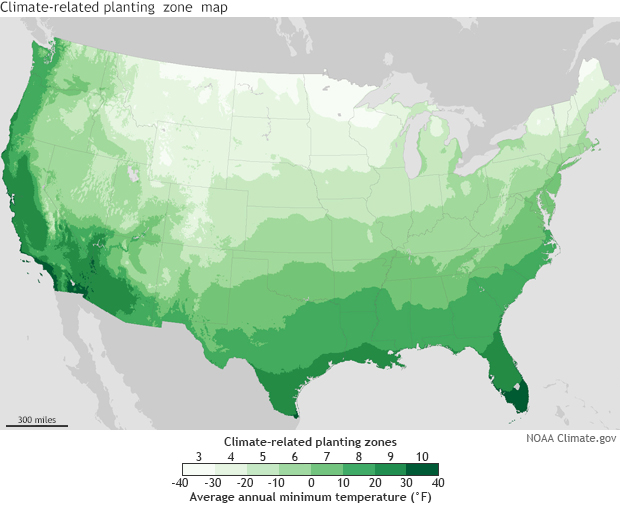
However, when the NOAA updated the map based on the 30-year normals from 1981 to 2010, the northern region of Kansas warmed and was left with a much smaller region 5.
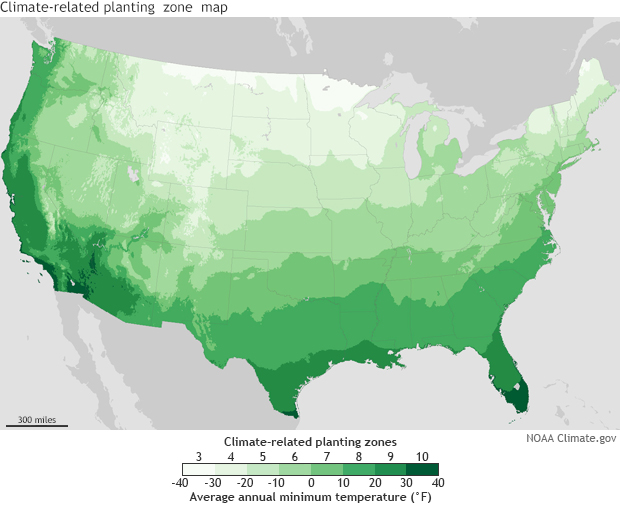
This shift was because of warming winter temperatures and warmer nights.
It’ll get worse
This trend will likely continue as climate change continues to heat the planet.
Earlier this month, NOAA released new climate normals that indicated that climate change has continued to heat the U.S. And with its update to the U.S. Climate Normals earlier this year, the USDA is considering an update to the Plant Hardiness Zones but has not yet done it, according to Kim Kaplan, a USDA communications officer.
If they updated the hardiness map, there would be a continued shift northward, according to Crimmins.
“You would see the same kind of shift again, for everything would just inch up northward,” Crimmins said. “Those minimum average temperatures are increasing pretty steadily in lots of the country.”
However, even as hardiness zones and plant regions have moved northward, this doesn’t mean gardeners, farmers or others should start worrying or ripping out their plants.
“It doesn’t mean that suddenly your plants are going to perish,” Crimmins said. “What it means, is that there’s this slow and steady underlying change. It’s hard to parse it on a day-to-day or even a year-to-year basis.”
Most plant species have the ability to tolerate a range of temperatures and weather conditions and still live, Crimmins said.
“But eventually, something will be beyond what they can handle and then they may not do so well,” Crimmins said. “They may not produce a lot of flowers and fruits anymore, might look sickly or just need more supplemental watering to not wilt completely. You’re not going to wake up one day and see them all dead.”
Planning for big changes
For the past 111 years, Bartlett Arboretum in Belle Plaine has been a trial ground to see which different types of plants and plant species could grow in Kansas, according to Robin Macy, the steward of Bartlett Arboretum.
“It’s a place to see what will and can survive and perhaps thrive on a very arid and very Kansas topography,” Macy said.
The arboretum has had plants that should be grown in zones that are warmer than Kansas, that have survived for decades.
That is, until last February when the state was hit with extreme cold.
“We have seen a big backlash from that event,” Macy said. “The creek froze solid. I’d never been able to skate on the creek. I ran out and bought ice skates and I was … ice skating on this lake with reckless abandon. I could see how deep it was frozen, never dreaming that these trees around me were screaming bloody murder.”
The Bartlett Arboretum has seen firsthand how floods and extreme weather can have a huge impact on the plants. In 2011 and 2012, it installed more water hydrants to combat the heavy drought it were seeing.
“We had 60 days over a hundred degrees in one of those years,” Macy said. “I just basically spent all my time on the end of a hose … I knew that when I was introducing new trees, if they really were not drought-tolerant, I would triple wrap soaker hoses, just wanting to make sure they get enough water.”
Crops and insects are already changing
The changes in plant species is driven primarily by increased temperature, moisture concerns and the intensification of extreme weather.
The average summer temperature in Topeka increased by 2.7 degrees Fahrenheit and by 1.3 degrees in Wichita since 1970, according to NOAA data analyzed by Climate Central, a nonprofit science news organization.
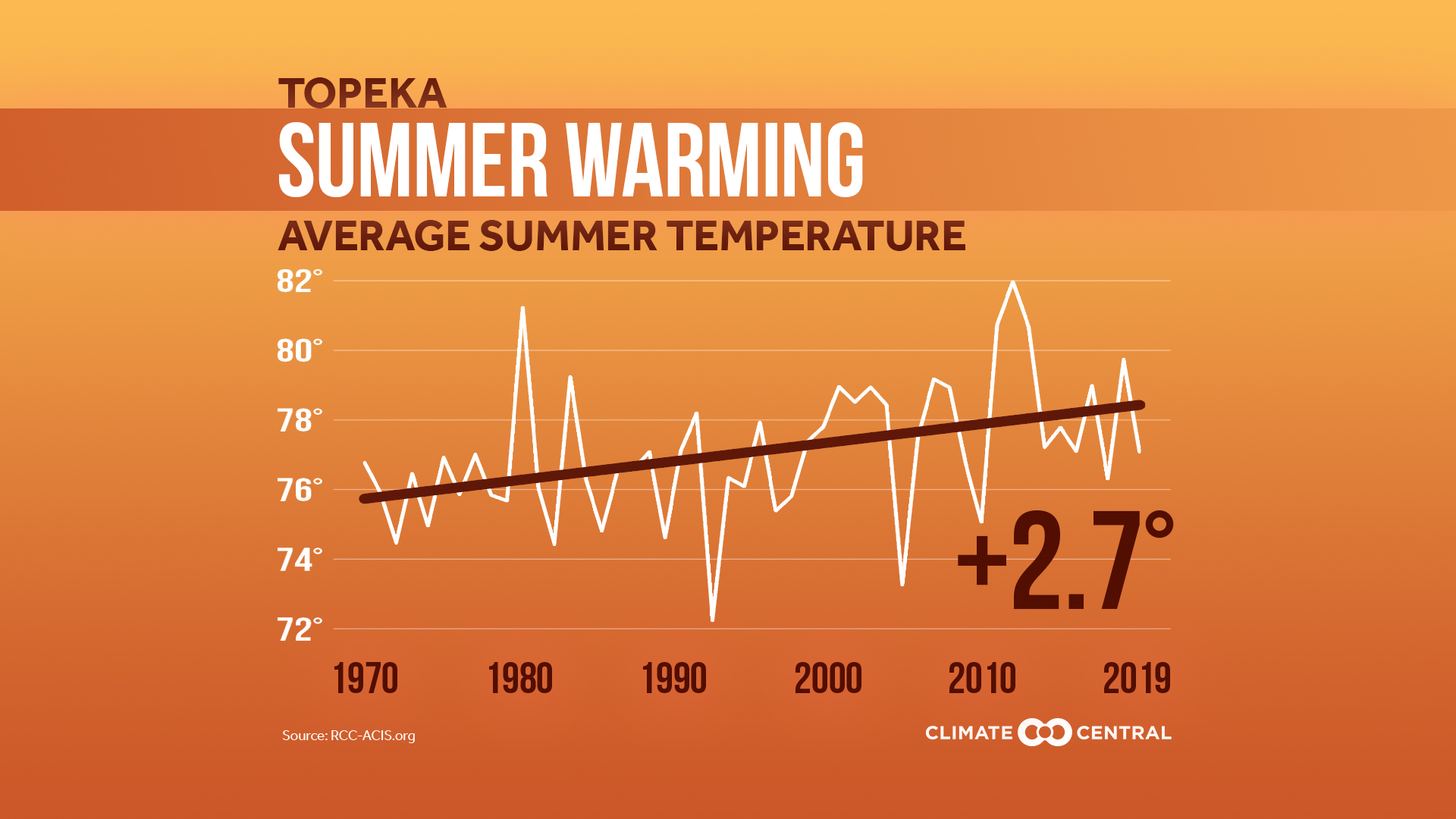

But it is the overnight low temperatures that are rising more quickly, according to the Environmental Protection Agency. The average overnight low temperature in Topeka has risen 3.4 degrees Fahrenheit, and 2.7 degrees in Wichita.
These rising overnight low temperatures can be more destructive to plants, and humans, as it gives organisms less time to cool off and recover from hot days, according to the EPA.
Warmer temperatures and warmer nights also mean more insects, like aphids, that bother plants.
“We’re already starting to see certain insects more, as they can undergo more generations within a season when it’s extra warm,” Crimmins said. “And those insects can carry diseases, too, so we’re starting to see the spread of disease for both wildlife, stock and humans as well.”
Climate change is causing longer summers, which can cause water stress and excessive heat. Warmer temperatures can dry out the soil, so even when rain does come, it can’t penetrate the ground as well, according to NOAA.
While plant zones and hardiness zones look exclusively at temperatures, in Kansas it is moisture that can make or break a plant’s tolerance, according to Knapp, the state climatologist. This has driven a shift in Kansas cropping practices because, even as there are recordings of summer temperatures beginning earlier each year and ending later, which expands the growing season, moisture is the limiting factor.
“There has been more of a shift from corn, which is a high water demand crop, to sorghum, which is more drought-tolerant, in the central and western parts of the state,” Knapp said. “You can use less irrigation and maybe not use any irrigation at all.”
The changes can negatively affect native species, which depend on reliable season changes.
This is of particular concern with prairie conservation and restoration efforts, according to Knapp. Conservationists can be torn between using native species and species that are similar but might have a better chance of surviving in the future.
“Do you go with the grass that was there or do you go with a slightly different species that may be representative of what the future is going to be like in the area?” Knapp said. “When working on conservation, you’re not looking at just the five years or 10 years. You’re looking at 50 to 100 years.”
Try to stay flexible
Those looking at working in their gardens or redoing landscaping might have similar concerns as people doing prairie conservation work as these plant zones drift north each year.
While annual plants might not be too much of a concern, as you have to replant them each year anyway, perennials might take more consideration.
“If I’m looking at a perennial, do I want to look for those that will tolerate the warmer temperatures or do I need to be more conservative and make sure that it’ll tolerate the occasional very cold temperatures?” Knapp said.
The biggest thing gardeners can do to protect their plants is to make sure their garden is resilient to Kansas extremes, Knapp said.
“Improve the soil condition, the drainage and the tolerance to the wide ranges of conditions that are inherent in Kansas,” Knapp said. “Losses often occur at the extremes, not at slight shifts in the average.”
Additionally, it’s important to be flexible.
“Gardening is imperfect,” Thimesch said. “And you really have to look at that to take joy in that imperfection. It’s okay that your plant dies. That’s just part of the deal and you could do better, or you can choose to do something else. It isn’t a big deal if there’s failures, because that’s how you learn.”
This story was originally published June 3, 2021 at 4:07 AM.