Six things the Evergy refund could mean for Kansas solar
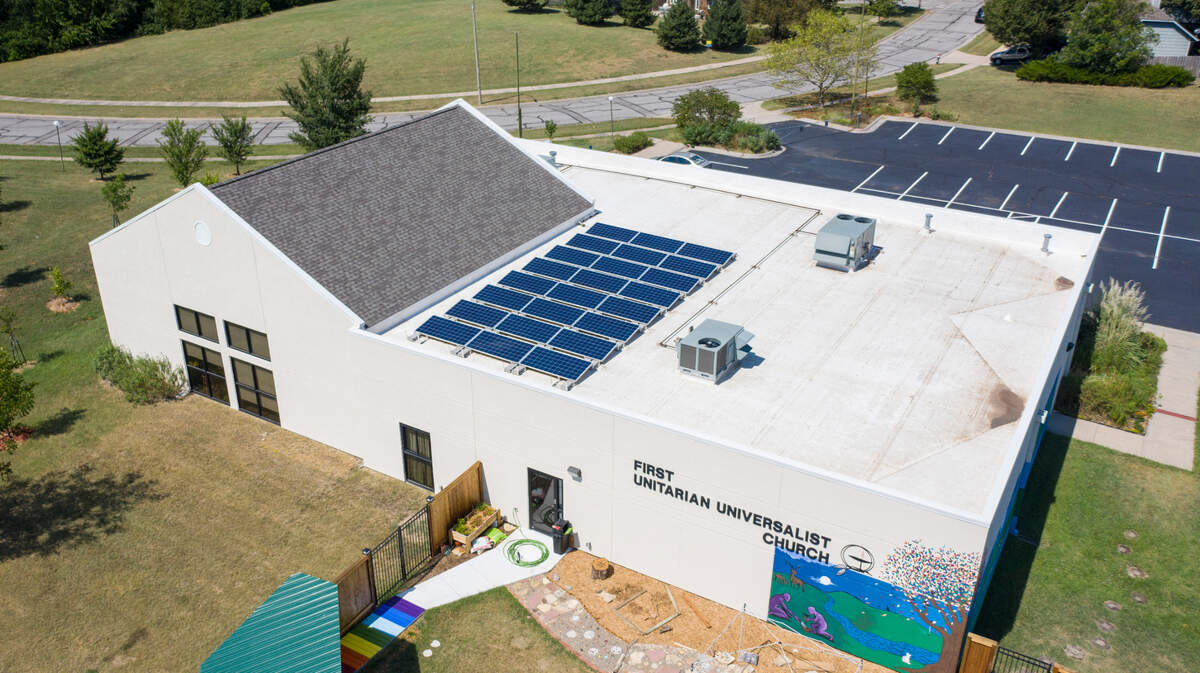
More than a year after the Kansas Supreme Court ruled that solar customers were being charged unfairly by Evergy, Kansas’ largest utility, some customers will be refunded the difference between what they paid and what they should have paid.
The Kansas Corporation Commission ruled earlier this year that solar customers would no longer be charged this fee but said that customers wouldn’t be refunded. After a request to reconsider from Vote Solar, the Climate & Energy Project and the Kansas Sierra Club, the KCC unanimously ordered the refunds earlier this month.
The commissioners also mentioned that they were interested in the stakeholders moving forward and working together on a plan during their meeting.
“That’s the other piece that’s encouraging to us because, as fun as this is, we don’t relish the idea of non-stop battles to protect solar,” said Dorothy Barnett, director of the Climate and Energy Project, a Kansas nonprofit. “We want to find a solution that can allow distributed generation to grow.”
Gina Penzig, communications for Evergy, echoed similar sentiments about working together and added that Evergy wants to find an alternative rate so that solar customers won’t be subsidized by non-solar. If this subsidy exists, it will be on Evergy to prove during the 2023 rate case and demonstrate that it is measurable and billable. Solar advocates are expected to continue their argument that there is no subsidy.
For now, solar advocates are celebrating the KCC’s recent decision, marking it as a monumental move and perhaps a sign of shifting attitudes toward solar in Kansas. Here’s what you need to know about the broader implications of this decision.
1. It could have a national impact
Perhaps most significantly, the decision to rule the fees illegal and order a refund to the customers will likely discourage other states from pursuing these demand charges, said one solar policy expert. Kansas was unique in allowing these charges and putting their solar customers in a separate rate class from other residential users.
“In fact, when in other states where utilities tried to get higher charges or separate charges put on solar customers, they often pointed to Kansas as an example of where this has already occurred,” said Rick Gilliam, a solar regulatory policy expert at Vote Solar, a national solar advocacy nonprofit. “I feel like we’ve put the final nail in the coffin — on-demand charges at least.”
While the Kansas Supreme Court decision ruling these fees illegal was based on a Kansas law, the state law was based on federal law, meaning the arguments could still be persuasive in other states.
2. The KCC may be regaining the trust of environmentalists
When the commission voted to refund solar customers and remove the fee, the unanimous move was encouraging for solar advocates. But the context was crucial, as, in an uncommon move, the commissioners’ recommendation was different from the KCC staff, who had asked for a $15 minimum bill for all Kansas residents.
“The commission is really showing that they recognize there is an energy transition happening and that they want to see Kansas prosper in this new energy economy,” Barnett said. “There’s an expectation for the utilities and for environmental organizations and solar companies to get together and figure it out.”
For Zack Pistora, lobbyist of the Kansas Sierra Club, this move shows that the KCC is starting to defend home solar users in Kansas and won’t just “rubber-stamp” the utility’s decisions.
“For a long time, whatever the utility said, goes in Kansas,” Pistora said. “It’s a new set of commissioners and really new circumstances where these commissioners care about how high rates have become in Kansas. They care about private opportunity and market dynamics, which favors investment of solar and clean energy in Kansas.”
Pistora also pointed to the commission’s expanded efforts to be more transparent, like opening the workshops of Evergy’s Sustainability Transformation Plan and live streaming and recording their meetings on YouTube.
3. Kansas could value solar beyond the economics
After the commissioners ordered the refund, Chair Andrew French added that he thought a value-of-solar study could help regulate solar users and determine how to charge them. Such a study is something solar advocates have pushed for in the past, saying that the benefits of solar go beyond the economics of saving money and backup energy for the grid and environmental benefits.
“I know other states have done value-of-solar studies, and I don’t think doing that study predisposes any particular outcome because the value of solar can be very different for different areas of the country,” French said during the KCC meeting. “I don’t know what it would say, but I would like us to take a more holistic and modern approach in this area.”
When more than 1,100 Kansans called, emailed and wrote to the KCC on behalf of solar customers in the state, many said that while they didn’t have solar, there were more benefits to having solar in the state than not.
“You gotta think that the commissioners heard that,” Pistora said. “I think we’re starting to see that a Kansas-based solar energy resource is powerful in a number of different ways, for the utility, for the resiliency of the grid, but also, for the economy of Kansas and the environment.”
4. Kansas City and rural solar customers will still pay the fees
Since the docket at the KCC that the decision was made in was originally a case of Westar, now Evergy central, the orders stopping the charges and the refund only apply to Evergy central customers, including Wichita.
Evergy customers in the Kansas City metro area will continue to pay the charge deemed illegal and discriminatory by the Kansas Supreme Court more than a year ago.
“We would hope that Evergy would voluntarily go in and change the tariff for Evergy metro,” said Barnett. “It’s something that we’re going to ask them to do. We hope that the directive from the commission was clear enough, that they’re going to recognize that was the right thing to do.”
Penzig said Evergy was still “evaluating next steps” about the Kansas City metro area.
Additionally, municipal utilities and co-ops that the KCC doesn’t regulate can still charge the extra rates.
“So the city utilities have these discriminatory rates, but because they’re not regulated by the KCC when do they get the day of justice?” Pistora said.
5. Solar businesses in Kansas still don’t have much stability
The years-long fight surrounding how solar customers will be charged unsettled the Kansas solar industry. Solar companies say that without any legislative certainty for how solar customers will be charged, their businesses have suffered.
“There is that caution we have to communicate with our customers that your rates could change, and there’s always the fear that if we get the wrong commissioners who are sympathetic to the utility like we’ve had in the past many years, could they make it read these changes retroactive?” said Scott White, research and project analyst at Cromwell Solar, Kansas’ oldest solar installer.
White said the onus is really on legislators to make legislative changes that the KCC can then interpret and enforce. Without it, there’s too much uncertainty, especially since the KCC only regulates a portion of the utilities that serve Kansas.
“We have a whole slew of rural electrics and small municipalities, and they all have different rules and rates, and for some of them, there’s no way at all to install solar,” said White. “We’ve had some small municipalities that have put in so many roadblocks that we just don’t deal with customers in those towns.”
While some Kansans have gone ahead with solar, despite the uncertainty, because they believe in it for environmental reasons or don’t want to be controlled by a utility, there is no question that solar could grow if the rules stopped changing, said Pistora.
“We need to put Kansas on an economic level playing field with our surrounding states,” Pistora said. “You talk with solar companies, and they’ll do more business in Missouri, Oklahoma and Nebraska than they are in Kansas because of these discriminatory charges.”
6. When will residential solar be resolved?
The issue is far from resolved and will likely remain unresolved until the next rate case in 2023, when Evergy is expected to unveil and defend a new plan for charging customers at the KCC.
“Evergy is going to have to be very creative in coming up with some alternative to just the straight, non-demand charge rate that all residential customers are on,” Gilliam said. “I don’t doubt that they will propose something that will increase costs for solar customers, but we’ll just have to wait and see.”
What the solution might look like, however, is a guessing game, although the debate over how to charge residential solar customers in California might give some indication of what Kansas could see in the future. Commissioner Susan Duffy said she would be watching what information California receives and its decision in the coming months.
“I do hope parties take this time to look at more modern ways to grapple with this issue,” Duffy said. “I’m hoping that a state like California and the work that they’re doing can help us in Kansas.”
Solar advocates will likely push back on a more permanent solution for solar rates until solar can penetrate the market in Kansas.
“The industry hasn’t even had a chance to really move forward and certainly not like our neighboring states, and so that’s what we should be promoting as a state,” Barnett said. “How do we create jobs? How do we allow people the opportunity to lower their bills? How do we make this an industry that meets the needs of the economy, the environment, and energy overall?”
But for now, solar advocates are celebrating their win and looking toward what the future might bring for Kansas solar.
“I think at some point, we’re going to get with the program, and we’re going to take advantage of a huge natural resource that’s becoming more popular, more affordable, and more urgent,” Pistora said. “It’s more significant for us to do because of our obligation to help the country and help the world address this problem of climate change. It’d be like if we’re sitting on the best dirt in the country but we decided not to grow any food for people. That’s how I feel where we’re at with solar.”
This story was originally published April 16, 2021 at 4:37 AM.