Bald eagles are no longer a rare sight in Kansas. Here’s why
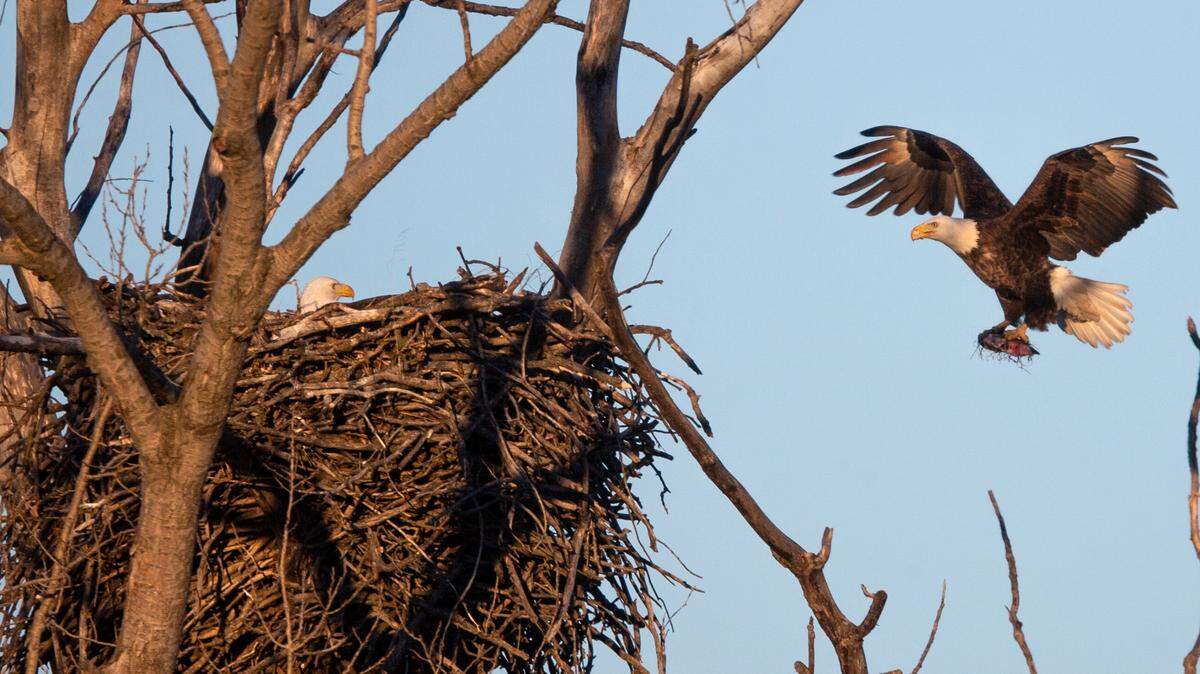
Today, there is a bald eagle nest along the Arkansas River approximately every five to nine miles from Wichita to the Oklahoma Border. But it wasn’t that long ago that there weren’t any in the state.
The birds’ rapid population growth has been studied and recorded by the Kansas Department of Wildlife, Parks and Tourism, an effort that, in the south-central region of Kansas, is led by Charles Cope, District Wildlife Biologist.
In 1990, there were two nesting pairs of bald eagles in Kansas, according to the U.S. Fish and Wildlife Service, but in 2020, there were a record-setting 175 active bald eagle nests in the state, about one-third of which were in south-central Kansas and the area surrounding Wichita, according to Cope.
And that number has already grown. In early March, a record 68 nests were found in 12 south-central Kansas counties, according to Cope. This added 12 sites and Harper County to their list.
When the bald eagle was chosen as the national symbol in 1782, there were as many as 100,000 nesting eagles, according to the U.S. Fish and Wildlife Service. Only 487 nesting pairs were left by by 1963 due to a decline in prey, loss of habitat and shooting, and use of DDT, which caused eggshells to thin and break before hatching.
“A lot of people care about bald eagles, but the real success story is what modern biology can do,” said Bob Gress, former director of the Great Plains Nature Center. “We can make a difference if we want to. That’s why the comeback of the bald eagle is so noteworthy because we cared and were able to do something about it, working with science and nature.”
A majority of the nests are on private land, which is information the state wildlife department does not release to the public. Additionally, bald eagles are still protected, even from someone disturbing their nests.
How conservation saved our national symbol
DDT was a major hurdle for bald eagles, Gress said.
Once bald eagles leave an area or their population is decimated, it can be difficult to get them to return, because male bald eagles usually return within 80 miles or so to the place they were born. So with no new eagles being born in Kansas, how and why did they return?
The Sutton Center in Bartlesville, Oklahoma, removed eggs from Florida to Oklahoma and then raised and released 275 bald eagles in eight years in the 1980s and 1990s.
These bald eagles, now believing this area to be their home, have been observed nesting in five other states, including Kansas.
“Kansas did not participate in the conservation efforts, but benefited from spillover bird sites,” Gress said.
Bald eagles have been federally protected since 1967, after their numbers reached critically low levels. They were delisted in 2007, but Kansas waited to remove them from the state’s endangered and threatened list until spring of 2009.
Wichita — Home of the Bald Eagles
None of the 68 nests are more than 100 miles from Wichita, which has the most unique nest in the state — one in a tree no less than 10 feet from a resident’s backyard. There haven’t been any babies from that nest yet, and they might not because it’s so close to human activity, Gress said.
“So that bird has adapted to people, and that’s true for all wildlife, but for eagles .. .it’s very interesting,” Cope said. “Whether these nests will be established remains to be seen. If we have a drought, we don’t know if they’ll leave.”
In the mid-1990s, Cope said the Great Plains Nature Center, which houses the Kansas Department of Wildlife, Parks and Tourism’s regional office, would receive a couple reports of bald eagle nests each year and because the areas along the Arkansas River in south-central Kansas were designated as critical habitat under the Endangered Species Act, each of these reports were investigated.
But there were never any eagles.
That is until 1999, when a report of a nest near the Ninnescah River by Viola, a small town a half-hour southwest of Wichita, led to the first record of a bald eagle nest built in Kansas in 10 years. Although the eagles never nested their eggs there, Cope remembers the call vividly.
Surveying the eagles
The survey began in 2009, around the same time Kansas decided to remove bald eagles from state protections. The Kaw Nation had paid to search for bald eagle nests along the Arkansas River in south-central Kansas, where they found eight active nests.
Since then, Cope and Gress, along with several other volunteers, have been on the ground, verifying these observations, recording the number and following up on reports of other nests.
Southcentral Kansas has the most accurate data in the state of all the regions because Cope and his group follow up on each report of a nest. The surveying efforts depend primarily on volunteers to report back their observations.
“We could not have accomplished it without help,” Cope said. “Bob (Gress) and I did it through 2014 and it would take 12-14 hour days, driving 400 miles.”
The survey starts in late February and its primary goal is to confirm incubation and the number of chicks, according to Gress. Sometimes this is as easy as driving around once and noting observations, but depending on the timing and how the eagles are acting, sometimes it takes re-checks.
“It all grinds to a halt with leaves out,” Gress said. “It’s incredibly difficult to see. The survey has an end date and that’s when there are too many leaves.”
Anyone observing bald eagles in south-central Kansas, particularly in Harper or Rice counties, is encouraged to call the Great Plains Nature Center at 316-683-5499.
“I’m always willing to talk to them because I’m curious about how many we’ve missed,” Cope said.
This story was originally published March 22, 2021 at 5:47 AM.