Kansas judge suspended for frequent F-bombs, sexism; called Black men ‘boy’ in court
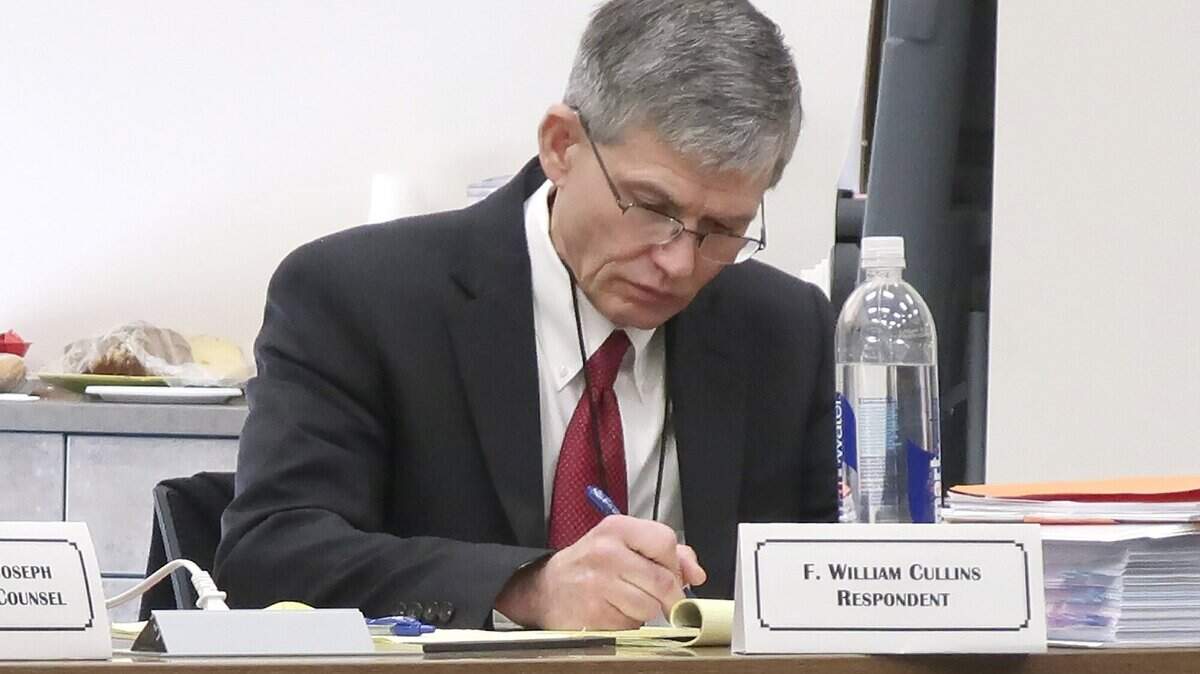
A Kansas judge has been suspended from his duties for a year, after court workers and defendants complained of multiple incidents of obscenity-laced harassment and use of derogatory terms for women and African Americans.
The Kansas Supreme Court took that action Friday against Montgomery County Judge F. William Cullins. Although the suspension is for a year, he could be back on the bench in 60 days if he enters a training and counseling program approved by the Office of Judicial Administration.
Evidence shows Cullins frequently and abusively dropped F-bombs in his conversations with court staff and others and referred to females by vulgarities. He also created a perception of race bias in his court in his handling of criminal charges against African-American student athletes, the Supreme Court ruled.
The court upheld the findings of a panel of the Commission on Judicial Qualifications, which took four days of testimony in the case in 2019.
The panel found that Cullins had improperly used profane, vulgar and harassing language against court staff.
It cited two cases in particular, a performance review for a male court clerk and a dispute with the female chief clerk over whether to put carpet in the courthouse elevator.
In one instance cited in the record, Cullins told Lance Carter, a court clerk, to “go sit down in that f---ing chair and don’t you say a f---ing word,” before commencing a obscenity-laced tirade.
Cullins had a similar exchange with the former chief clerk, Joni Pratt, during a 2016 courthouse renovation project. Pratt had asked the judge whether the carpet-layers should install leftover carpeting in the elevator.
“In response to Ms. Pratt’s question, Respondent (Cullins) became ‘very angry’ and told Ms. Pratt that ‘he didn’t give a f--- about the carpeting and that that wasn’t our f---ing building,’” according to court documents.
Later, Cullins told Pratt ‘If you think I’m going to f---ing apologize to you, I’m not,” court records said.
Two attorneys, including former Attorney General Curt Schneider, now a lawyer practicing in Coffeyville, testified to Cullins’ use of vulgar misogynist language.
Lawyer Tim Emert of Independence testified that when dealing with Cullins, obscenity was “just routine” and that he also had heard him use the demeaning terms for women.
The Supreme Court also found that Cullins fostered perceptions of racial bias against African-Americans who appeared before him as defendants, referring to two college athletes as “boy,” a common racist slur against African-American men.
The ruling quoted from transcripts of two bail hearings for Black student-athletes from Independence Community College.
In one instance, Cullins asked the defendant, “Can I assume you’re not even a Kansas boy?’”
When the student replied he was from North Carolina, Cullins proceeded with questions that appeared to assume that he had a criminal history there, although the defendant testified his record was clean.
In that and another hearing the same day, Cullins complained about the number of junior college athletes who came before his court and blasted the local college for giving scholarships to out-of-state athletes.
“We pay for this community college and they don’t even have Kansas boys play their football or their baseball,” Cullins said. “They invite these people from out of state.”
In the second hearing, Cullins assumed another student athlete was from out of state and told him: “It might be a little bit easier for me to stomach seeing these cases if I didn’t know the mill levy that that college imposes upon everybody in this area, and they use that money to invite athletes from—where are you from?”
“Topeka, Kansas,” the student replied.
The judge then said: “Oh, you’re from Kansas. I’ll take that different. At least you’re a Kansas fellow, anyway. It bothers me more if you are out of state and they invite you here to commit crimes.”
Although the Supreme Court accepted Cullin’s explanation that he hadn’t meant the word “boy” as a racial slur, the justices ruled his use of the term and assumptions that the defendants were from out of state and had criminal backgrounds had created the perception of racial bias, which judges are prohibited from doing.
“When taken altogether and in context, a reasonable perception of bias cannot be denied,” the court ruling said. “Even the prosecutor in these cases felt the need to reach out to one defendant’s father, assuring him with words along the lines of: “[D]on’t think that the use of that language is going to affect the administration of justice in your son’s case.”
Cullins, a former Montgomery County Attorney and Coffeyville city prosecutor, was appointed to the District Court bench in 2006 by then Gov. Kathleen Sebelius. He was elected unopposed in 2010, 2104 and 2018.