A return to the past may be the answer to a cleaner, more affordable burial process
For some of us, visiting a family member’s grave in a cemetery can be an almost mathematical process. Every memorial day, it’s two rows down, three over to find my grandfather and leave plastic flowers to memorialize his service in the U.S. Merchant Marines in World War II.
Imagine instead, a prairie field, filled with native grasses and trees, where men with binoculars sit on benches and watch birds. Children toddle after their parents on nearby hiking trails that wind in and out of the field, and small patches of wildflowers grow near stones that stand as decorated grave markers.
This is the future, or rather a possible return to the past that some, like Sarah Crews, imagine with a revolution called “green burials,” but it is actually a movement back to the more natural form of burials that have existed since humans first walked the earth.
Each year in our cemeteries, the U.S. buries 800,000 gallons of formaldehyde-based embalming fluid, 2.3 billion tons of concrete, 4 million acres of forest worth of wood and 115 million tons of steel.
Additionally, an estimated 360,000 metric tons of carbon dioxide are released into the air from cremations. These CO2 emissions, which contribute to climate change, could have been worsened this year as places like Los Angeles had to lift their cremation limits to deaths from the COVID-19 pandemic.
Sarah Crews, the founder, and director of Heart Land Prairie Cemetery in central Kansas, represents a movement that has reached across the nation as environmental concerns with climate change become more present in the national psyche.
“To think about how we want our bodies, whether we want our bodies to contribute to life on the planet after death or contribute to more pollution on the planet is a worthy consideration,” Crews said.
While more and more Kansas cemeteries offer the green burial option, interest has stagnated among Kansans. Cemetery directors note that it’s difficult for people to choose green burial when so many of their family members have been buried in the more traditional way.
Warren-McElwain Mortuary offers green burial services at Oak Hill Cemetery in Lawrence, Kansas, and most of the interest in green burials come from religious reasons or environmental concerns, according to Lisa Manley and Audrey Bell, both funeral directors and embalmers at Warren-McElwain.
“I think more people are interested and less people actually choose to move forward with it,” Manley said. “When you talk about the physical steps of placing the body into a biodegradable container directly into the ground with no outer burial vault covering, I think sometimes it’s hard for them to choose that in the last steps of the planning.”
Those who work with green burial sites stress the importance for people and families to take time with their decision and understand the process before making a decision.
What is a green burial?
While requirements vary, most green burials require a biodegradable container, such as a cardboard box, a casket made out of pine or banana leaves or a cloth shroud to encase the dead. According to the cemetery directors, the COVID-19 pandemic has not changed the way green burials are done, other than limiting the number of people who can attend the graveside service.
“I just think it’s better to be more natural, to allow our bodies to recycle as they will eventually and I personally don’t see any reason to try to slow that process down. It’s going to happen,” said Jon Shafer, a board member of the Funeral Consumer Alliance of Greater Kansas City. “It’s honoring the Earth as well as the people, and some people have strong environmental concerns. This is a way for them to be buried that is consistent with that.”
Green burials do not allow embalming, the process where blood is drained from the body and replaced with fluids that will slow decomposition, which is not required in Kansas, as long as the body is refrigerated, buried or cremated within 24 hours, according to Kansas law.
Green burial cemeteries or cemetery sections do not allow cut markers or monuments to mark the graves. Instead natural markers, such as rocks, trees or boulders, and native plants, flowers and grasses are often the only decorations allowed.
Unlike most traditional burials, families are often allowed to participate in the burial process, such as digging the grave or lowering the dead into the ground.
“Grief isn’t a stagnant thing. It needs expression, and I think that physical activity can really help move our grief through our bodies and be a comfort,” Crews said. “We invite family to shovel as much or as little as you like, and once people start moving, it’s like this visceral engagement that I think allows our grief to move through our bodies.”
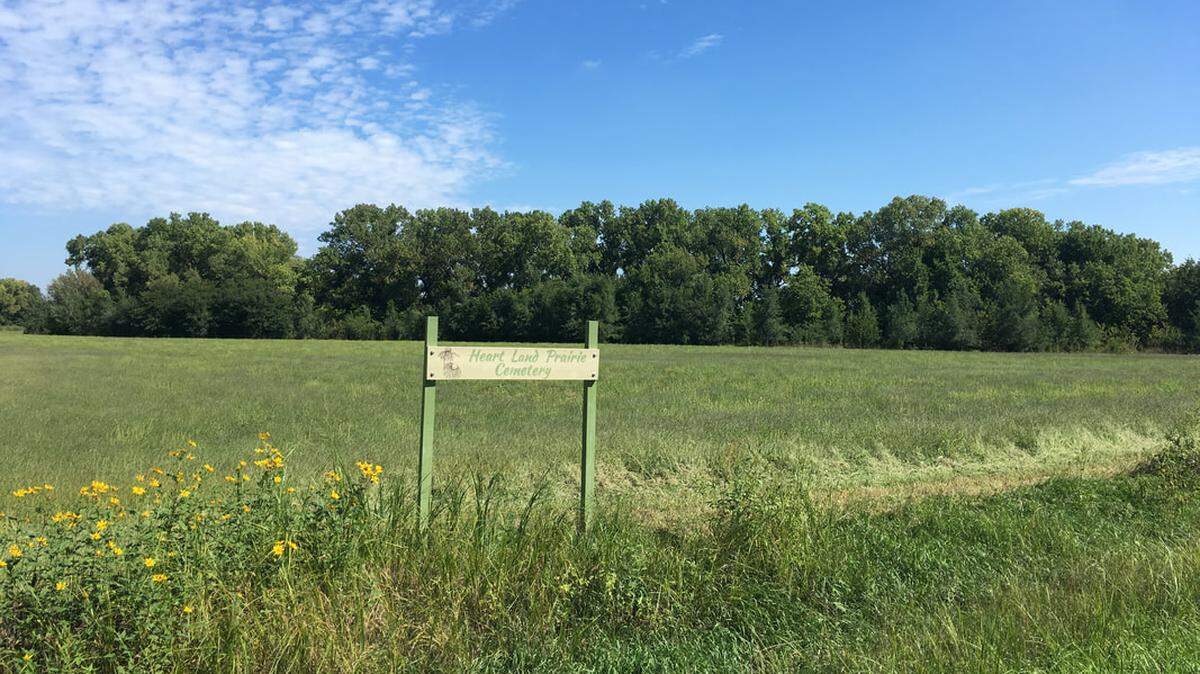
Heart Land Prairie Cemetery located near Niles, about 15 miles northeast of Salina, is the first and only Kansas cemetery entirely dedicated to green burial, Crews said.
As people are buried, the cemetery restores the land to native prairie, using only native species and small engraved metal markers and GPS coordinates to locate burial spaces. The cemetery has trails and benches for visitors, hikers and bird watchers to use.
The cemetery has woods on either side for a total 13.5 acres, and the burial meadow is being restored to native prairie, Crews said.
Crews worked in the end of life field for many years, starting as a musician who brought music to the bedside of dying people in nursing homes and hospice, before going back to school to learn more about end of life traditions.
“I just started noticing how out of balance our burial practices were and how we had become spectators at one of the most important transitions that we, as family members and communities, experience,” Crews said. “As soon as our person dies, we have their body removed from us. They are taken care of by strangers in a $20 billion a year industry. The people at the cemetery do all the burying, and we’ve kind of lost touch with rituals around caring for our dead.”
Now, she’s a death educator and a home funeral guide who teaches families how to care for their own loved ones at home after they’ve died.
Other cemeteries in Kansas offer green burial services, in addition to traditional services, such as Oak Hill Cemetery in Lawrence, Highland Cemetery of Prairie Village, and Mount Muncie in Lansing, Kansas.
“It’s laid out like a normal cemetery plot would be and it’s in a wooded area in the back part of the cemetery,” said Gene Kirby, the on-site manager of Mount Muncie Cemetery. “The point behind natural burials is to reduce your carbon footprint ... The rest of the cemetery gets mowed and trimmed every week. The green part gets mowed twice a year.”
In Wichita, the closest green burial site is Ascension Cemetery, a Catholic cemetery in Bel Aire open to all faiths, that offers 5 acres of green burial area that opened about six years ago.
“It’s very nice, quiet and peaceful, so, if someone’s looking for that environment, that’s one that we do provide,” Mark Miller said, the cemetery director. “We’ve got native grasses and native Kansas trees out there.”
Green Burial Cost
In 2019, the national median cost of an adult burial and funeral was more than $9,000 and a cremation and funeral was more than $5,000, according to the National Funeral Directors Association.
“For a lot of people, a $10,000 funeral is not something they can afford,” said Shafer of the Funeral Consumer Alliance of Greater Kansas City. “The green burial is a way for the body to be recycled more quickly ... The whole point is to minimize the barrier between the body and the soil so that the body can return to its natural state and it’s atoms and molecules can be reused and recycled.”
At Heart Land Cemetery, grave plots are $1,200 and opening and closing is $400. Cremated plots are $300 and opening and closing is $100. People also can choose to scatter cremated remains at no charge. At Ascension Cemetery near Wichita, a natural burial plot is $1,375.
Interest in green burials is increasing, Shafer said.
“You don’t have to go into debt or declare bankruptcy to honor your loved ones,” he said.
Families can save with green burials, by not having to buy a casket, burial wall, or expensive monument marker, according to Kirby of the Mount Muncie Cemetery.
“It’s burial at its very simplest form and there are savings to be made from it,” Kirby said. “There’s no doubt about that. But I think there’s an attitude of ‘Well, we’ve got to do all this other stuff,’ and the younger generation is kinda going ‘Why? Just because we’ve been burying people for hundreds of years, doing all this other stuff doesn’t mean we have to keep on doing it.’”
This story was originally published March 1, 2021 at 5:01 AM.