
Jean Schodorf, Kris Kobach spar over proof-of-citizenship law, more in TV debate
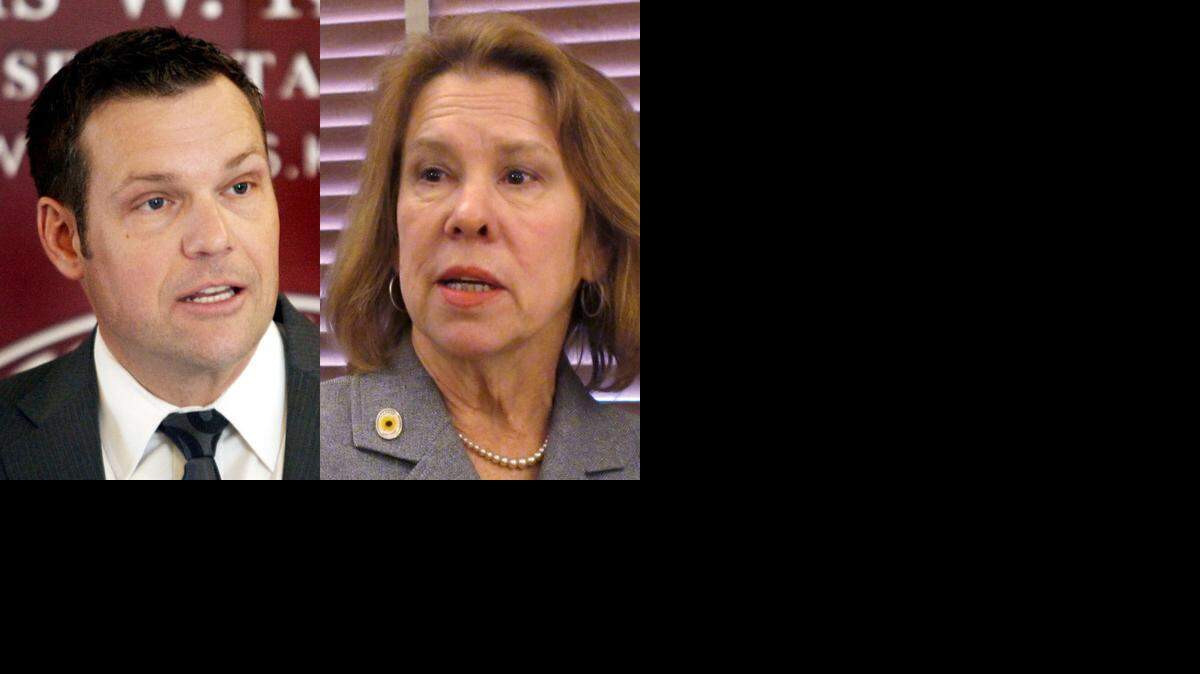
Democrat Jean Schodorf questioned Secretary of State Kris Kobach’s impartiality as the state’s chief election officer during their televised debate in Topeka on Wednesday night.
Schodorf attacked Kobach for having a political action committee and questioned his place on U.S. Sen. Pat Roberts’ campaign committee.
“An election officer for the state of Kansas is supposed to be above the fray,” she said at the debate hosted by KTWU public television at Washburn University.
Kobach pushed back and defended his decisions.
Kobach’s membership on Roberts’ campaign committee came under scrutiny when he ruled that Democrat Chad Taylor would remain on the ballot in the Senate race, a decision political onlookers said would help Roberts against independent Greg Orman.
Kobach said Taylor had failed to properly withdraw, but the Kansas Supreme Court rejected Kobach’s interpretation of the law and ruled that Taylor must come off of the ballot.
Kobach maintained that he had correctly enforced the law and instead attacked the court as partisan.
“The Kansas Supreme Court has made a lot of very bad decisions,” Kobach said. He referred to the court’s recent decision to overturn the death penalty of the Carr brothers, while upholding their convictions for five murders in Wichita in 2000.
“No matter what truth is presented, Mr. Kobach only believes his own version,” Schodorf said after the debate.
Kobach’s criticism of the court comes the same week that Gov. Sam Brownback’s re-election campaign has aired ads criticizing the court for the Carr decision.
Schodorf, a former Republican state senator from Wichita who switched parties, attacked Kobach’s appointee Tabitha Lehman, Sedgwick County election officer, for not allowing media to observe the counting of ballots during the primary election.
“They’re counting ballots in secret in Sedgwick County,” said Schodorf, a former Wichita school board member.
“I think this is rife for fraud. I’m not saying that it happens but it could happen,” Schodorf added after the debate. “What is going to happen election night in Sedgwick County? How can we trust the results?”
Kobach said every county election officer has the authority to set their own guidelines and defended Lehman’s decision to close ballot counting to the press. Lehman has previously said the media’s presence slows down the process.
The candidates also sparred over the state’s proof-of-citizenship requirement, a measure heavily pushed by Kobach.
Schodorf voted for the law as a member of the Senate, but now claims that Kobach misrepresented its impact when lobbying for it in 2011.
“She claims that she voted for this law because I did some sort of Jedi mind trick on the Legislature,” Kobach quipped during the debate. He accused Schodorf of shifting her position for political reasons. “Contrary to what my opponent says, if you’re a U.S. citizen it’s easy to register to vote in Kansas,” he said.
At one point Kobach handed Schodorf a copy of the proof-of-citizenship law and suggested she read it. “I’ve read it,” she replied.
More than 121,000 people have successfully registered since the law’s adoption, but another 23,000 potential voters have seen their registration status suspended because of this law as of this month.
“When you say ‘succeed’ that suggests that they tried,” said Kobach when asked why so many Kansans had not met the requirement.
“It’s very easy for any of those 23,000 to do it from their couch at home. You can use your phone to take a picture. You can use an ‘Obama phone’ to text it in,” Kobach said after the debate.
He said that the term “Obama phone” referred to a government-provided phone for welfare beneficiaries.
In reality, phone companies offer low-income people low-cost cellphone plans as part of a law that passed in 1996 that requires the FCC to pool money from phone bills to pay for the program, according to the fact-checking website Politifact.
Kobach also said that it was unknown what percentage of the 23,000 were actually citizens. He contended that non-citizens’ voting cancelled out the votes of citizens.
Schodorf compared the requirement to a poll tax, a term for laws meant to prevent African-Americans from voting during segregation. She said the law had been carried out inconsistently and that Kobach was out of touch with its impact on Kansans.
“I will straighten out the registration mess so we can restore the freedoms of more than 22,000 people,” Schodorf said in her closing statement.
Kobach called for the power of the Secretary of State’s Office to be expanded to allow it to prosecute cases of “double voting.”
He said that 23 such cases had been identified, but that only four had gone to trial because county attorney offices are too swamped. “And these cases are slam dunks,” he said.
Schodorf said she supported granting the attorney general the power to prosecute these cases as the state’s top law enforcement officer but not the secretary of state.
Schodorf pressed Kobach about his outside legal practice.
Kobach has served as an attorney in several high-profile immigration law cases, including a lawsuit by 10 ICE agents against the Obama administration. Kobach has said that his practice takes up about five hours a week and has compared it to playing a round of golf.
During the debate he said his income from the practice varies from year to year and ranges from $30,000 to $100,000.
His salary as secretary of state is $86,000.
“Frankly, when you have, now soon to be, a family of seven it’s helpful. Many Kansans do this, too. To make sure you have a second job so you can provide for your family,” Kobach said.
The debate was co-sponsored by the Kansas Sunshine Coalition for Open Government and the Kansas Press Association and moderated by Nick Haines of Kansas City Public Television.
Reach Bryan Lowry at 785-296-3006 or blowry@wichitaeagle.com. Follow him on Twitter: @BryanLowry3.
This story was originally published October 22, 2014 at 8:03 PM with the headline "Jean Schodorf, Kris Kobach spar over proof-of-citizenship law, more in TV debate."