Kansas amendment would overhaul Supreme Court justice selection. What’s at stake?
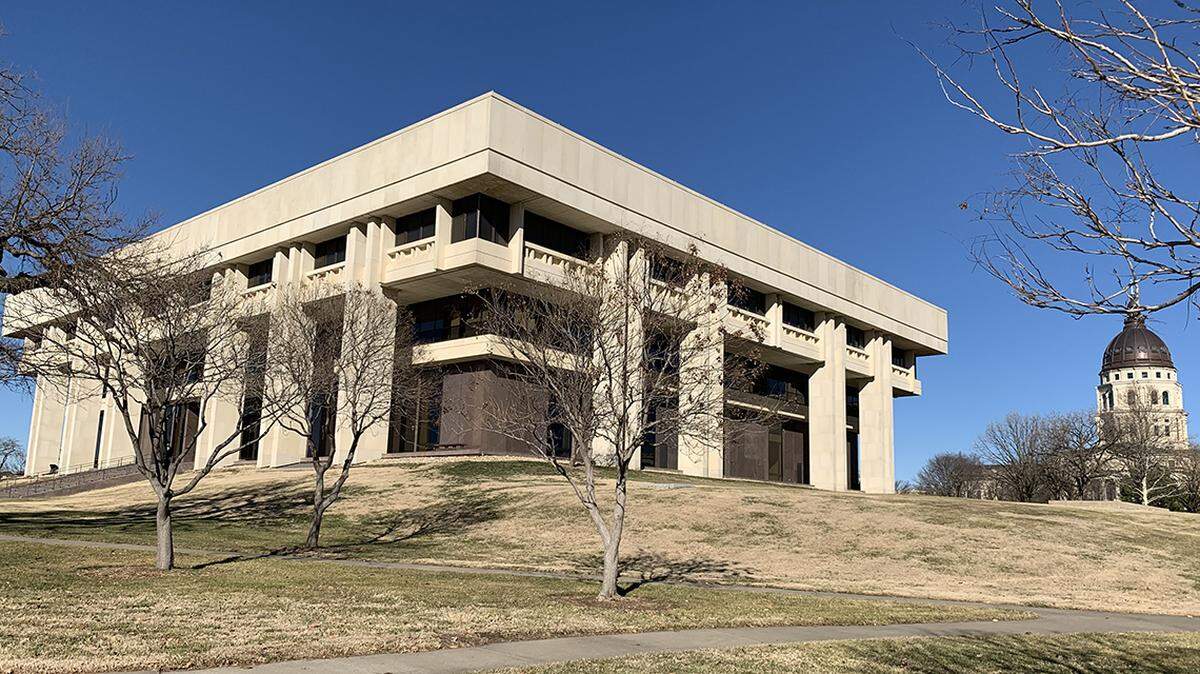
Three weeks out from the August primary, Kansas voters are being inundated with political messaging about a proposed seismic overhaul of the state Supreme Court.
The voices arguing for and against direct election of Kansas Supreme Court justices make their cases in stark terms. Both sides urge voters to choose wisely or risk letting special interest groups dictate the course of justice in the Sunflower State.
Critics of the proposed constitutional amendment put forward by Republican lawmakers frame it as a hostile takeover of the court that would inject millions of dollars from out of state into judicial elections, mirroring recent record-breaking state court races across the country.
“If this ballot measure passes, impartial judges will become politicians for sale. Billionaires will bankroll campaigns and then push whatever laws they want,” warns a recent commercial from Kansas United for Impartial Courts, one coalition of groups fighting to defeat the amendment.
Proponents of the ballot measure have branded it the “right to vote amendment,” seizing on the fact that in the nearly 70 years since Kansas switched to a nominating commission and appointment system, voters have never fired a justice in a retention election.
“Kansas is the only state in America where lawyers run the entire show. The system was designed to cut you out. And it worked… until now,” reads a mailer sent by Prairie Fire PAC, a political action committee run by Attorney General Kris Kobach, who has clashed repeatedly with the Supreme Court and previously outlined his vision for reshaping the bench in service of eventually abolishing the right to an abortion in Kansas.
Abortion subtext
In September 2022, the month after Kansas voters became the first in the nation to reject an effort to restrict state-level abortion following the reversal of Roe v. Wade, Kobach told supporters that he was calling on lawmakers to craft a direct election ballot measure that would allow conservatives to “slowly and quietly” assemble an anti-abortion majority on the court.
“It’s not just about abortion. It’s about this whole panoply of potential areas where plaintiffs can ask a state Supreme Court to create a new liberty interest that is far broader than anything created in the U.S. Constitution,” Kobach told the New York Times in a recent interview, where he argued that direct election would make justices more accountable to voters.
Emily Wales, the president and CEO of Planned Parenthood Great Plains Votes, told The Star that abortion opponents have “already said the quiet part out loud” about their quest to circumvent the will of Kansans, who voted to preserve abortion access by 18 percentage points.
“The anti-abortion legislature put on the ballot (in 2022) the provision that would have ended the constitutional protection for abortion in Kansas and they didn’t like the outcome,” Wales said. “So this (judicial amendment) is just a runaround to try to get to the same thing.”
Supreme Court justice selection
State Supreme Court seats are filled by a variety of methods across the country, from partisan or nominally nonpartisan elections to direct appointment by governors or lawmakers.
Kansas is one of 21 states that rely on governors selecting appointees from a pre-approved list of candidates screened by nominating commissions, a Star analysis found. Kansas governors appoint supreme court justices from a short list of three candidates vetted by a commission composed of members representing specific geographic areas of the state.
Practicing attorneys in each of Kansas’ four congressional districts elect a representative to serve on the nominating commission, and governors also appoint a member from each congressional district. Lawyers statewide choose the sole at-large member, making Kansas the only state where attorneys hold a majority of seats on the nominating commission — an eccentricity that Kobach and conservative lawmakers have emphasized.
Pro-amendment advertising minimizes the existence of regular retention elections, arguing that voters are “completely cut out” of the judicial selection process.
“For a hundred years, the citizens — people like you — voted for Kansas Supreme Court judges,” says a commercial from the pro-amendment group Kansans for Democracy. “It worked well. People did the research and voted. But the elites took over. Now they decide who’s on the Kansas Supreme Court. Behind closed doors. Trading favors. Rewarding friends.”
Supreme Court nomination commission candidate interviews are filmed, and livestreams of meetings are posted to the Kansas Judicial Branch’s YouTube channel.
Anti-amendment organizers describe the nominating commission system as merit-based and say it allows the court to serve as an independent check on the other overtly partisan branches of government.
“(The Kansas Supreme Court) kept government out of your private medical decisions, stopped unconstitutional cuts to our schools, and held Gov. Brownback and Gov. Kelly accountable,” says an ad by the Kansas Fair Courts Fund, an advocacy group fighting direct election.
The ballot measure includes few specifics about how elections would function in practice. With voter approval, the GOP-controlled Legislature would be granted broad authority to decide how elections would be administered and whether judicial nominees would be chosen statewide or by geographic district.
The Kansas Supreme Court is currently composed of five liberal justices and one conservative justice. On Monday, Democratic Gov. Laura Kelly named Johnson County District Court Judge K. Christopher Jayaram to fill a vacancy in what could be the last appointment to the state’s high court. It’s unclear how many of the court’s current justices would choose to run for election if voters approve the ballot measure next month.
Kansas ‘Triple Play’ scandal
Before the nominating commission and retention election system was approved by voters in 1958, the Kansas Supreme Court was filled by direct election of justices, who remained actively engaged in state party politics and defended their seats against opponents every six years.
The switch away from direct election followed a notorious scandal involving an outgoing Republican governor who conspired with the court’s chief justice and his own lieutenant governor to have himself appointed to the Supreme Court after losing a re-election bid.
The 1950s scandal was widely portrayed as an embarrassment by contemporary observers, who dubbed it the “Triple Play”. It prompted lawmakers to quickly propose the nominating commission model adopted by other states as a reform designed to depoliticize the courts.
Chief Justice William Smith had served on the Supreme Court for 26 years when he announced his impending retirement, citing health problems. That left the matter of filling the seat on the bench to Smith’s close political ally, Gov. Fred Hall, who was days away from leaving office after being ousted in the Republican primary months earlier.
“(Smith) had been on the Supreme Court, and as a politician, he had to remain a politician since he had to run for re-election every six years. And he was very close to Fred Hall,” said Virgil Dean, a history professor and the former longtime editor of “Kansas History: A Journal of the Central Plains.”
Although justices were directly elected, state law at the time allowed governors to unilaterally appoint a candidate of their choice to the Supreme Court when a vacancy occurred in the middle of a judicial term.
In a matter of minutes in January 1957, Hall abruptly resigned as governor, which automatically elevated his former running mate, John McCuish, to chief executive. In his only official act as governor, McCuish appointed Hall to the Kansas Supreme Court, sparking the backlash that led to the nominating commission system being adopted the following year.
Dean said that at the time, the switch away from direct elections was supported by a broad coalition of conservative and liberal interest groups. The fact that Kansas Bar Association members would occupy a majority of seats on the nominating commission didn’t compromise the reform’s popularity in the 1950s.
“The fact that half of the nominating commission is made up of lawyers is kind of a negative thing for people who think lawyers have too much influence. Well, who should have influence on the qualifications for a justice of the Supreme Court if not lawyers?” said Dean, whose front yard features a “Vote No” sign.
“We’re in an age where some people are very skeptical of professionals in whatever field — science, the law, education — I guess, you name it,” Dean said.
In a Star guest commentary, state Rep. Bob Lewis, a Garden City Republican and attorney, argued that rather than shielding the high court from politics, Kansas’ current selection system ensures lawyers will always play an outsized role in selecting justices.
“Kansans should reject a rigged system run by a small group of elite professionals and political insiders who pretend to be above politics, and in its stead adopt a transparent system that gives voters a voice in selecting those who are the final arbiters of the meaning and application of the laws by which they are government,” Lewis wrote.