
Wichita mayoral candidates Whipple and Wu debate baseball stadium, housing, trans rights
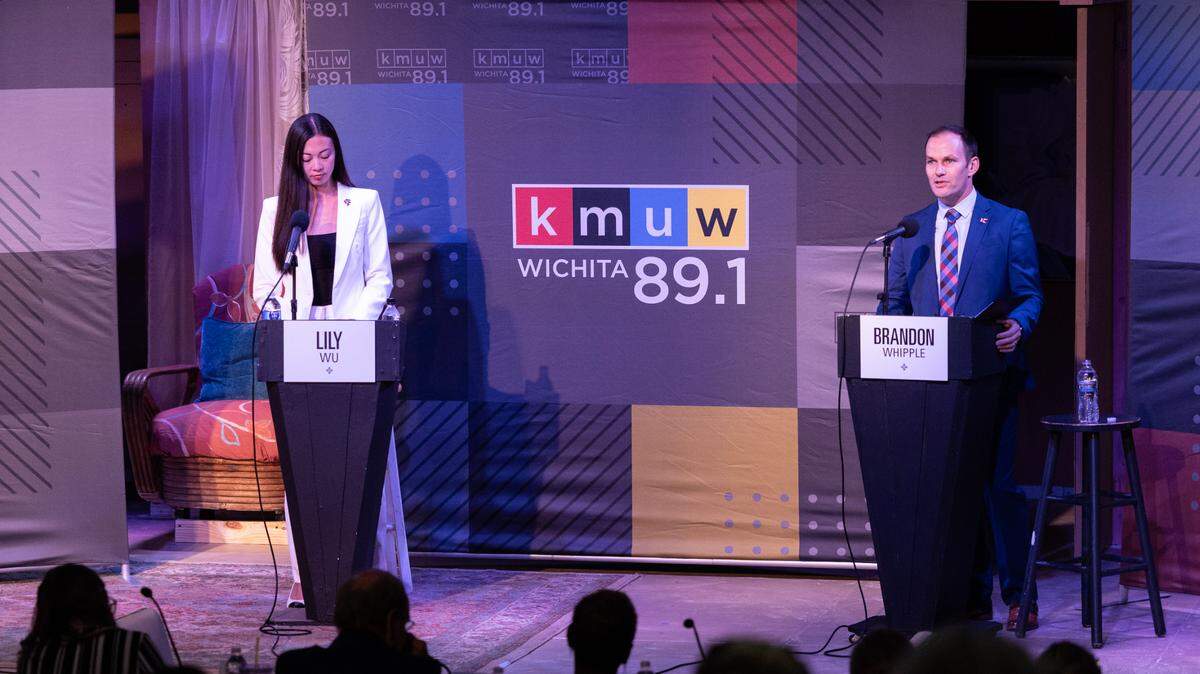
Brandon Whipple and Lily Wu traded barbs Monday in a lively 60-minute forum featuring policy debates and dark warnings about the direction the city could take under the other’s leadership.
Wu, a former television reporter and self-styled political outsider, accused Whipple of injecting partisan rancor into the work of city government and otherwise doing little to change the status quo as mayor.
“Four years ago, we were promised change. And leadership did not deliver,” Wu said. “Wichita deserves better.”
Whipple pointed to Wu’s support from affluent members of Wichita’s business community and from the Koch-backed Americans for Prosperity, characterizing her appeal to the working class as disingenuous.
“This election presents a clear choice,” Whipple said. “Either we continue on the current path of prosperity, powered by the voices of Wichita’s people. Or we turn our City Hall into (the) toxic far-right, dark-money politics of Americans for Prosperity.”
The debate, hosted jointly by KMUW, The Eagle, The Community Voice and the Wichita Journalism Collaborative, was the first between Whipple and Wu since the August primary, when voters narrowed the field of candidates from nine to two. Here are five moments that stood out.
Transgender rights
Wu made her first public statement on transgender rights, something she did not talk specifics about during the primary race.
In response to a question about the state law that bans transgender people from using restrooms that differ from their sex assigned at birth, Wu said she is an advocate for “family restrooms,” which are typically private restrooms for a single user that lock from the inside with one or two toilets inside.
“I want to reiterate that I am someone who respects all individuals,” Wu said. “My mother . . . would never let me be someone other than someone who respects and loves others. So I want to make sure that everyone understands that I come from a point of view that respects all, but we also need to have accessible bathrooms for all.”
She then pivoted to a different bathroom accessibility issue.
“When I have elderly individuals that tell me that there are no bathrooms for them to take their elderly parents who cannot get into a bathroom, that’s a problem, too,” Wu said. “So we need to think more outside of traditional methods and think about family bathrooms.”
Whipple touted Wichita’s nondiscrimination ordinance and the city’s perfect equality score from the Human Rights Campaign.
“We need to continue to push back and challenge the Legislature when they decide to take discriminatory policies to a new level when it threatens the lives of Wichitans who I represent,” Whipple said.
Wu said Whipple’s approach to passing the NDO, which banned discrimination in all workplaces, housing and public-serving businesses in the city, was “divisive.” The law, which Whipple championed, was approved 6-1 after the council voted to table it for three months.
“The way your brought forth that ordinance creates division,” Wu said. “And that’s not what we need.”
Whipple pushed back.
“Fighting for civil rights might not be the nice thing to do, but it’s the right thing to do,” he said. “And I’d rather be the good guy on the right side of history, even if it’s divisive, if it’s protecting the rights of the people I represent. And I’m never going to apologize for that.”
Downtown parking
The candidates were asked about the City Council’s new downtown parking plan, which replaces meters with new technology that increases prices and makes it easier for the city to issue tickets.
In his remarks, Whipple appeared to endorse a hybrid model that preserves at least some of the coin-fed meters that are set to be phased out.
“Moving forward, you’ll see some more strategic turnover with the new technology. But also, I get it. I get chewed on from folks who have done it the same way for years and now they’re doing it some other way,” Whipple said. “I’ll just fix — if I get my second term, I’ll make sure you have the meters you need as we transition over to some of the more technical modern approaches.”
Wu said that with all the discussion about parking options in the urban core, it’s time for Wichita to “think like a bigger city” and make peace with the idea of parking and walking downtown.
“Walking in our community needs to be something that we need to start getting used to,” she said.
“It is good to walk,” Wu said. “And when we think about parking in the downtown core, there are places to park — maybe not as convenient as others would like — but when you think of a big city and a growing city like ours, parking lots, they have real estate that could be used for those grocery stores that people keep talking about.”
The parking plan approved unanimously in March calls on the city to sell to private developers both its “underutilized surface lots and garages” and its “well-utilized surface lots” to promote downtown development.
“I believe that Wichitans want to be part of a growing city,” Wu said. “And that requires us to think like a bigger city, and that is sometimes parking is just a little bit farther away.”
Baseball stadium
Wu criticized Whipple for approving additional development deals around Riverfront Stadium, one of the key initiatives of former Mayor Jeff Longwell, without seeking community input. The City Council with the exception of Jeff Blubaugh voted in favor of buying back unused parcels of land and reselling them for $1 an acre to developers.
“You should ask our community what should have happened with that parcel being sold at $1 an acre,” Wu said. “We should have asked our community what are the other individuals, organizations or just entities that might want to help with fixing the problem. You’ve had those four years and knew this problem was lingering, yet you did nothing until you were pushed against the wall, and then you made a decision with the council.”
Whipple responded with a lecture on STAR Bonds, one of the economic development incentives used to fund the stadium. He said the time for seeking public input was before the previous administration moved forward with the stadium project.
“You can’t go back to the drawing board unless you have state approval and start the process all over again,” Whipple said. “And the fact that you think that, I think, means that you need to learn a little more about this before one thing, you become mayor, or two things, you start discrediting the entirety of the City Council that worked so hard to save baseball.”
Without the surrounding development, Wichita taxpayers would likely be on the hook for the majority of the costs for the stadium.
“We can’t afford an $80 million deficit, especially when we can save it,” Whipple said. “I’m not going to be lectured about public safety by someone who wants to crash our economic development project down there, costing $80 million that could go to our police.”
“There are needs, and there are wants,” Wu said. “And our community wants to feel safe.”
“A baseball stadium is great,” she said. “I love attending and seeing the community activated, but we need to prioritize the things that really move our community forward with economic development and safety. And that is making sure that we can truly ensure public safety for all around Wichita.”
Housing shortage
The mayoral candidates agreed that a lack of affordable housing options in the city impedes Wichita’s ability to support its workforce of the future.
“We’re about 20,000 to 40,000 units shy right now, and because developers have run City Hall for so long, the majority of the incentives actually go to only 30 percent of the market, which are single-family homes,” Whipple said. “So instead, we have to emphasize and incentivize in-fill. We have to incentivize multi-unit homes in our core, so long as they match the character of the neighborhood.”
Wu said the city has to be able to work with developers to solve supply issues without letting them steer local government priorities.
“Developers have a role to play,” Wu said. “Developers build. They build restaurants. They build homes. So we need them at the table. But we need to hold them accountable if we’re going to be in partnership with them.”
Wu said anybody who accepts city incentives must be held to a high standard and “be able to show a great return on investment on taxpayer dollars.” She did not say how she would like to see the success of city incentive programs tracked or how the city should go about clawing back money from developers.
Whipple defended his administration’s approach to ensuring public funds aren’t wasted on private deals that don’t materialize.
“I agree when it comes to transparency,” he said. “I’m the one who actually holds developers accountable. We’re actually suing people to get our taxpayer money back (from developers) who thought they could rip off the city with impunity. That doesn’t happen on my watch, and we’ve got to make sure we continue that practice.”
Environment
Wu said the lack of communication from local government on environmental issues in north Wichita, including the 29th and Grove chemical spill from decades ago that re-entered the public consciousness when the state published a report in May, “has created not only division but distrust in local government.”
She said crime, not the environment, is the most pressing issue for residents in the affected neighborhoods.
“When I knock on the doors of our neighbors on the North End, what they tell me they’re most tired about is rising crime,” Wu said. “And that is the issue that we need to focus our energy back on. It’s the priority of local government. Environmental issues have a place, but priorities need to come first.”
Whipple pointed to City Hall’s use of electric buses, wind-powered energy at city buildings and the Sustainability Advisory Board. He said he and his predecessor Mayor Jeff Longwell were left in the dark by the Kansas Department of Health and Environment about the chemical contamination in northeast Wichita.
“So, I mean, as a news reporter, Lily, you could have also done a story about this if we were not on top of getting the information out,” Whipple said.
He and Wu are set to debate several more times this fall, including at an affordable housing forum at the Advanced Learning Library on Oct. 11 and at Wichita State’s Rhatigan Student Center on Oct. 18.
Early voting in the general election begins Oct. 23 and Wichita will choose its next mayor on Nov. 7.
This story was originally published September 26, 2023 at 1:43 PM.