Dispute over a state law clouds James Thompson write-in vote in judge race
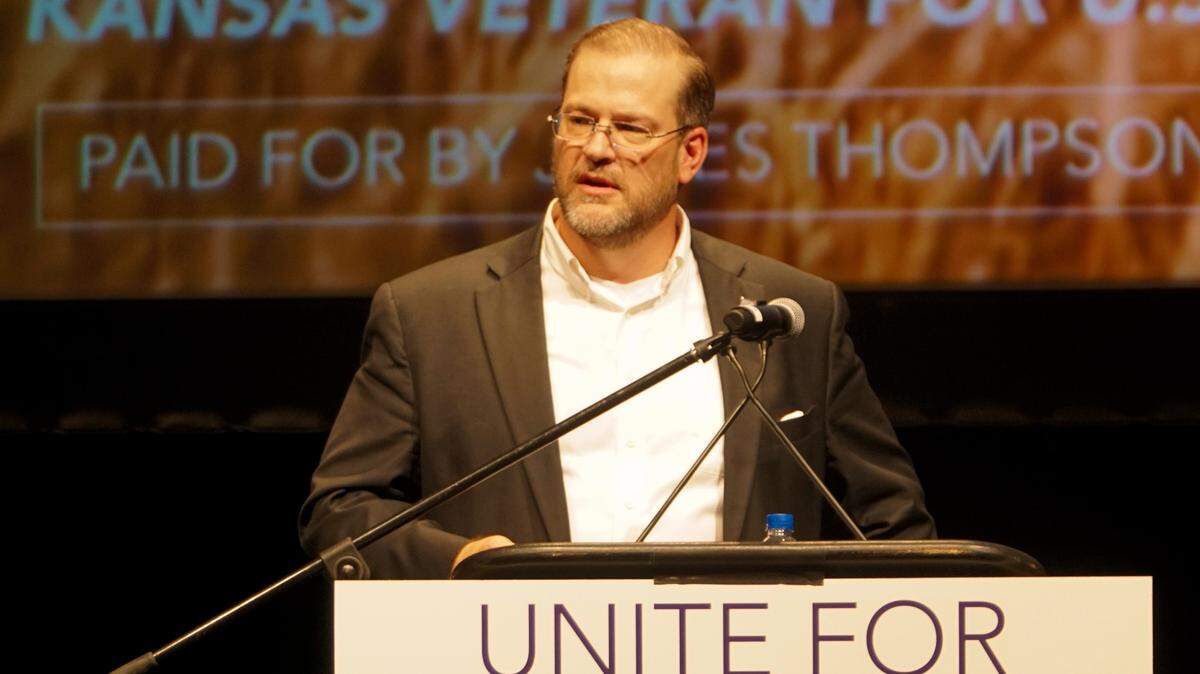
Civil rights attorney James Thompson says he got enough write-in votes in Tuesday’s election to put him on the November ballot for district court judge, but a lawyer for the secretary of state’s office says he would need more.
At issue is the interpretation of an obscure state statute that sets the rules for how many votes a write-in candidate needs in a primary to advance to the general election ballot.
The state law in question says if a candidate gets 5,000 write-in votes, he’s in automatically.
But that same law says a candidate can still qualify for the ballot with fewer votes, by getting “not less than 5% of the total of the current voter registration designated in the state, county or district in which the office is sought.”
Thompson is seeking a spot on the ballot to challenge sitting Judge Sean Hatfield in the election for Division 25 of the Sedgwick County/18th District court.
Hatfield is a former chairman of the Sedgwick County Republican Party, who was appointed to the bench in 2019 by former Gov. Jeff Colyer.
No Democrat filed to run against him, prompting Thompson to launch his write-in campaign.
Tuesday’s vote count shows there were 4,700 write-in votes cast by Democrats for Division 25.
Thompson won’t get all of them, but what he does get will likely be enough to get him over the 5% hurdle if it’s just 5% of Democrats.
But Clay Barker, a lawyer for Secretary of State Scott Schwab, says their interpretation of state law is that to qualify for ballot placement in November, a candidate needs 5% of all voters, not just voters registered in his own party.
That’s “just the way we’ve always interpreted the statute,” he said.
“My assumption is it’s to make sure someone doesn’t become a party candidate by just getting a small number of write-in votes and then maybe pushing issues that are different than the party’s position — that they make it hard to become a party candidate if you don’t go through the normal process,” Barker said.
Thompson, also a lawyer, disagrees. He says the statute clearly means he needs 5% of Democrats, not 5% of all registered voters.
“The word ‘designated’ refers to the party designation,” he said in a text message to The Eagle and a Facebook post to his supporters.
He added that “5% of registered Democrats is 3,900 based on the registration numbers I am aware of, which means I achieved the required number needed.”
Election office records indicate that approximately 75% of Sedgwick County voters weren’t allowed to cast a write-in vote for Thompson.
Independent and Libertarian voters, representing about 35 percent of the county’s total voters, weren’t allowed to participate in the primary at all.
And Republicans, representing about 39 percent of the electorate, were prohibited by election officials from writing in Thompson or anyone else’s name in the Division 25 race.
Thompson says that requiring 5% of all voters places an unfair burden on the minority parties. It would be much easier for a Republican candidate to meet the threshold because there are simply more of them to vote, he said.
And under the secretary of state’s interpretation, no Libertarian could ever get on the ballot as a write-in. It would be mathematically impossible because they represent less than 5% of the overall electorate, Thompson said.
There are still some ballots to be counted — provisional votes cast Tuesday and mail ballots that were postmarked by Tuesday but haven’t yet arrived at the election office.
Thompson says he hopes that puts him over 5,000, in which case the secretary of state’s interpretation would be moot. He said he’s willing to wait for all the ballots to come in before deciding his next move.
Then, if he doesn’t clear 5,000, “I’ll have a discussion with my wife first and then my team on how to proceed,” he said. “I think that I would be leaning towards challenging the interpretation of the secretary of state.”
This story was originally published August 5, 2020 at 4:58 PM.