
E-mails from Brownback administration to lobbyists about budget date back to Dec. 6
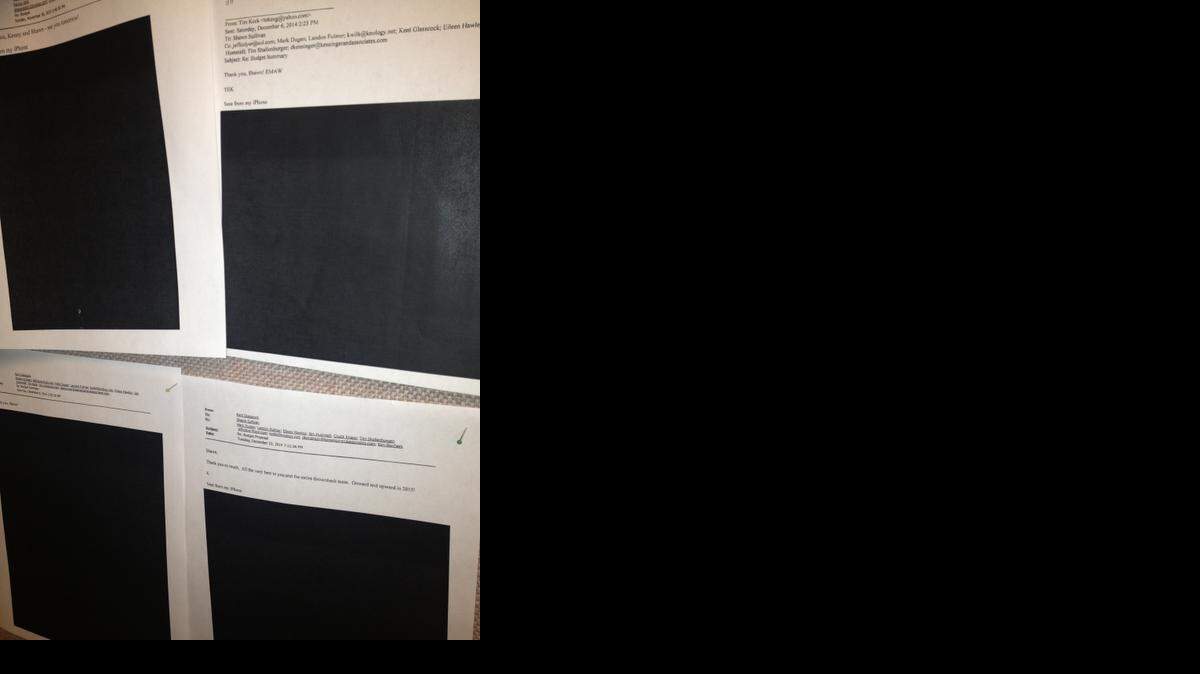
Gov. Sam Brownback’s administration began communicating with lobbyists via private e-mail about the state’s budget weeks before previously reported, e-mail records from Kansas State University show.
The heavily redacted e-mails show that Budget Director Shawn Sullivan and other administration officials were communicating about the state’s budget as early as Dec. 6 via private e-mail addresses with lobbyists David Kensinger and Mark Dugan, both former Brownback administration aides.
The Eagle reported last month that Sullivan had sent an e-mail to the lobbyists and several administration officials on Dec. 23; it obtained the e-mail from a source outside the governor’s office. When asked about the e-mail in January, Sullivan said he had used private e-mail because he was at home on the Christmas holiday.
A response from the administration on Wednesday did not directly address why Sullivan and other officials used private e-mails to discuss the budget 19 days before Christmas.
“As we have said several times now, the Governor consulted many people throughout the process. The use of email for the convenience of those consultations was entirely proper,” administration spokeswoman Eileen Hawley wrote in an e-mail.
Kensinger, the governor’s former chief of staff who now serves as a lobbyist for the Club For Growth and other entities, would not talk about what role he played in the budget planning process when approached at the Capitol on Wednesday afternoon.
E-mails sent to and from private e-mail addresses on private computers are not public documents and not subject to the Kansas Open Records Act.
The governor’s office has previously said it has no official policy about when administration officials can and cannot use private e-mails and electronic devices to communicate.
The only person on the Dec. 23 e-mail with a public e-mail address, and therefore subject to an open records request, was Kent Glasscock, a former House speaker and president of Kansas State University’s Institute of Commercialization.
Both The Eagle and the Topeka Capital-Journal submitted open records requests to K-State for Glasscock’s e-mail communications with Sullivan. The Capital-Journal received and reported on the heavily redacted records Tuesday.
K-State did not respond to requests for comment about why so much was redacted.
One of the few exchanges not entirely blacked out includes Tim Keck, deputy chief counsel for the Kansas Department of Health and Environment, who temporarily served as Lt. Gov. Jeff Colyer’s chief of staff. In it, Keck thanks Sullivan for sending an e-mail titled “Budget Summary” on Dec. 6, and Glasscock sends a message that reads “:) !!” in response. Sullivan’s e-mail and all other replies were redacted.
The records show that Sullivan began communicating with Glasscock about the budget as early as Nov. 30. The substance of their discussions is blacked out.
The e-mails also show that Sullivan e-mailed Glasscock an hour after The Eagle conducted an interview with him on Jan. 27 with the following message: “Hi Kent, Can you send me your cell phone #? Need to give you a FYI.”
He sent it from his iPhone and used his state account.
Last month, Rep. Don Hineman, R-Dighton, questioned Sullivan’s explanation that he used a private e-mail because he was home for Christmas, noting that he can access his state e-mail from any of his electronic devices.
Rep. Jim Ward, D-Wichita, introduced legislation earlier this month to make private e-mails about official state business public records. The legislation was rejected 86-30 when Ward offered it as an amendment on the House floor. He has since introduced it as an independent bill.
Ward introduced another bill on Wednesday seeking to close the exception to open records used by K-State to justify blacking out the e-mails. That bill says that the administration’s policy drafts are public records and cannot be redacted.
“They don’t think the rules apply to them,” Ward said of the administration. “They don’t believe in transparency. They just do what they want when they want, how they want.”
Kansas isn’t the only state grappling with the question of whether open record laws should extend to private communications. A pending case before the California Supreme Court seeks to settle the issue in the nation’s most populous state.
Twenty-six states have extended their open record laws to include private e-mails on official government business by public officials. The U.S. House also passed a bill in the fall that would have barred IRS officials from using private e-mails to conduct official business in response to the discovery that top agency officials, accused of targeting conservative groups, were using private e-mail for official business.
Reach Bryan Lowry at 785-296-3006 or blowry@wichitaeagle.com. Follow him on Twitter: @BryanLowry3.
This story was originally published February 11, 2015 at 10:45 AM with the headline "E-mails from Brownback administration to lobbyists about budget date back to Dec. 6."