
Allotments or new finance formula? Either way, Kansas schools will get less money
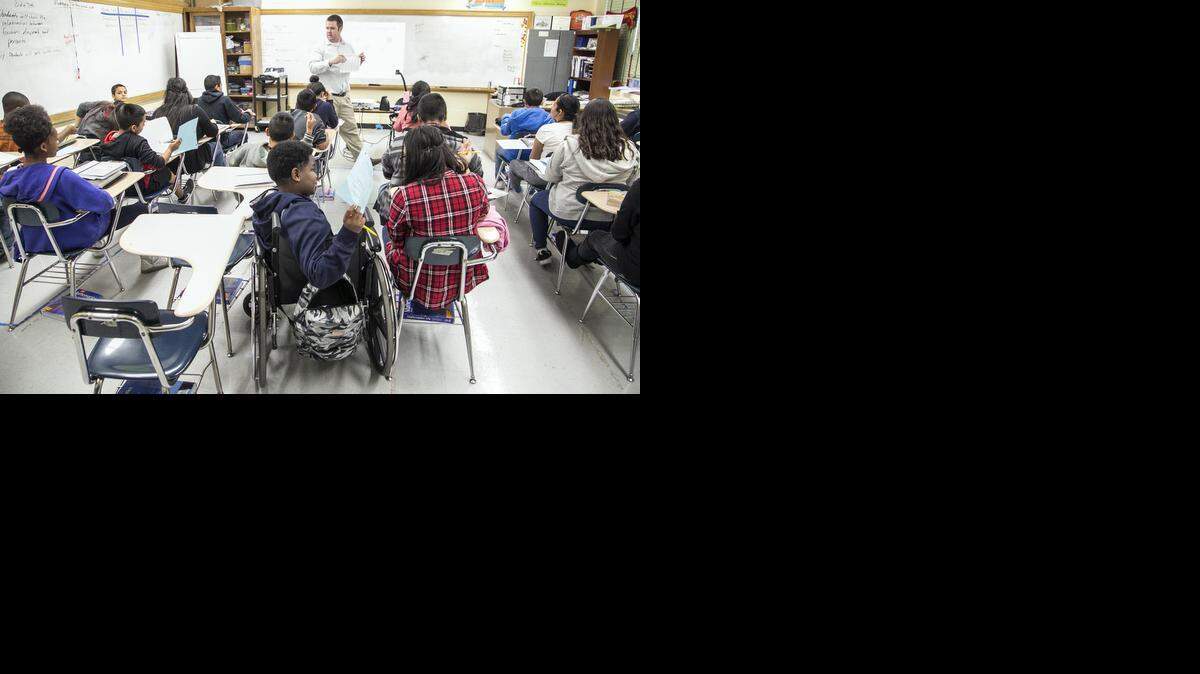
Gov. Sam Brownback has told Kansas lawmakers that they can allow his automatic cuts to school funding to take effect or they can change the way schools are funded and enact their own cuts.
Either way, schools will lose money they expected in this year’s budget. But some districts, including Wichita, will feel the impact more strongly if the Legislature proceeds with proposed changes to the school finance formula.
Brownback announced plans Thursday to reduce K-12 funding by 1.5 percent statewide starting March 7, a total cut of about $28 million.
Under that plan, the Wichita school district would lose $3 million from its current budget. These automatic cuts, known as allotments, do not require the Legislature’s approval.
Under a proposal to change the formula offered by Sen. Ty Masterson, R-Andover, the district would lose $3.9 million.
Is it a cut?
First, some background:
Last session, lawmakers passed a bill that increased school funding after the Kansas Supreme Court ordered them to make school funding more equitable.
The bill granted additional money to districts to supplement their local option budgets – money drawn from local property taxes. It also provided additional money for capital improvements.
The bill, estimated to cost about $130 million, ended up costing more than $190 million.
Now the governor and lawmakers say they want to scale back that amount.
He and some Republican lawmakers say the change is not a cut – it is less of an increase in funding.
“I’m getting calls about ‘stop the cuts to education.’ Well, we’re not cutting education,” said Rep. Steve Brunk, R-Wichita. “They’re still getting an increase … and that’s a point that’s not getting out to the public.”
Democrats and school districts say districts built their budgets in good faith based on the law increasing funding and object to reducing budgets in the middle of the year.
“It appears that the governor is saying that he is reneging on wanting to pay the supplemental state aid,” said Diane Gjerstad, the Wichita school district’s governmental relations director.
The Masterson plan
The level of supplemental state aid a district receives is based on assessed property value in the district divided by the number of students.
This means that some affluent communities in Johnson County receive additional state aid because of their high number of students and because they are primarily composed of residential property, which is usually worth less than industrial property.
Under this system, Burlington school district in southeast Kansas is considered the richest district because the Wolf Creek nuclear power plant drives up the assessed value per student.
Conservatives say this system is flawed and ends up awarding wealthy communities aid that’s meant to help poorer districts.
Masterson’s SB 71 would change the system so that total assessed value is used instead, which he says will better reflect the difference between rich and poor.
“I am not trying to put any district in the red,” he said. “I am trying to more clearly focus the dollars and create transparency for the guy paying the bills, which is the taxpayer.”
That change would reduce the overall cost to the state by about $39 million. It would mean $3.9 million less for the Wichita school district, the biggest in the state.
Gjerstad said these are operating dollars used to pay for salaries, technology, utilities and other daily costs of running schools.
About four-fifths of the state’s districts benefited from the extra aid approved last year.
Gjerstad pointed out that if the Legislature chooses this route over the governor’s cuts, called allotments, some districts will take a bigger hit, while others will be untouched.
“It’s some vs. all. The allotment impacts everyone. The alternative – what he appears to be saying he would trade it for – impacts some,” Gjerstad said.
That may not be the only cut.
The governor called on lawmakers to look at both the local option budget and capital outlay, “to stall the increase of $54 million” in these two areas “that was not appropriated by the Legislature.”
Masterson’s bill does not address capital outlay, and Gjerstad said if that money is cut it would be an additional reduction to the district of $4.2 million.
Brunk said the district should use money in its reserve funds to make up for any reduction.
Challenge for lawmakers
Senate Majority Leader Terry Bruce, R-Hutchinson, said the governor made an unpopular but necessary decision and now is challenging the Legislature to fix the school finance formula, which he contends is flawed.
“It’s a lot of heavy lifting for the Legislature to do in a short amount of time,” Bruce said.
He said one of the challenges of approving changes in the formula is that lawmakers will each have to weigh the impact on their individual districts.
“People are going to have to do some gut-checking overall this session. There’s just no way around it,” Bruce said. “There’s going to be some ugly votes, one on education … to get a sustainable balanced budget going forward.”
Rep. Pete DeGraaf, R-Mulvane, said he will vote for what’s best for Kansas. “And hopefully, it’ll be what’s best for my school districts,” he said.
DeGraaf’s district includes the Derby district, set to lose more than $350,000 this year under the governor’s allotment, and Mulvane, which will lose about $92,000.
Derby would take a $513,000 cut under Masterson’s bill and Mulvane would lose more than $150,000.
Democrats have uniformly opposed the reductions.
Rep. Gail Finney, D-Wichita, said the governor and Legislature should fund the original allocation to schools and consider revising tax policy instead.
“They really need to go and clean up the mistake they made in 2012 with that big tax cut because that’s affecting everybody. It’s affecting our children, our schools, our social services,” she said.
Reach Bryan Lowry at 785-296-3006 or blowry@wichitaeagle.com. Follow him on Twitter: @BryanLowry3.
This story was originally published February 7, 2015 at 5:20 PM with the headline "Allotments or new finance formula? Either way, Kansas schools will get less money."