Aviation safety bill inspired by Flight 5342 fails in U.S. House. What KS leaders said
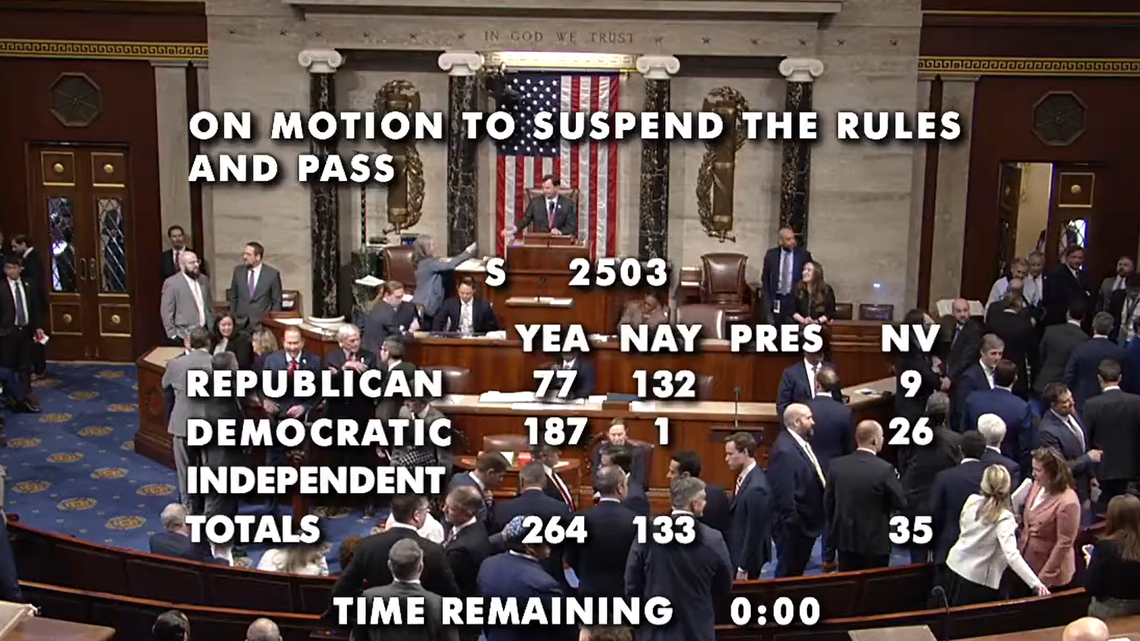
A bill intended to prevent fatal midair collisions like the one between a Wichita flight and a military helicopter last year failed in the U.S. House on Tuesday, falling one vote short of the two‑thirds majority needed to send it to the president.
The ROTOR Act, co-sponsored by Kansas Sen. Jerry Moran, passed the Senate last year via unanimous consent. The proposed legislation was Congress’s primary reply to the Jan. 29, 2025, collision above the Potomac River that killed 64 people aboard Flight 5342 from Wichita as well as three military personnel aboard an Army helicopter.
Victims from Kansas included Kiah Duggins, a Wichita State University graduate and civil rights attorney; Lindsey Fields, a mother and Butler Community College biology professor; Kansas City Chiefs super-fan and El Dorado IT professional Dustin Miller; 20-year-old engineering student Grace Maxwell; Kiowa couple Bob and Lori Schrock, who were flying to D.C. to visit their daughter in Philadelphia; and 30-year-old P.J. Diaz, a son and brother who loved to travel.
The National Transportation Safety Board concluded in its report that the collision was caused by a mix of preventable “systemic failures,” including but not limited to a failure to act on previous crash-prevention recommendations and the absence of collision avoidance technology.
“Such a system could have provided the crew of flight 5342 with the first alert regarding the helicopter 59 seconds before collision,” the report read.
The agency made 50 recommendations to a slew of federal agencies and the US Army. Many were included in the ROTOR ACT, which would have required all aircraft flying around busy airports to have key locator systems. It also would have required the Federal Aviation Administration to conduct a safety review of the flight routes at all large and midsize airports and limit where and when military aircraft can turn off advanced location broadcasting technology in proximity to airports.
The bill had support from the Defense Department until Monday, when the agency reversed course and said its passage “would create significant unresolved budgetary burdens and operational security risks affecting national defense activities.”
The bill failed Tuesday 264-133, one vote shy of the two-thirds needed for passage.
How did Kansas representatives vote for the ROTOR Act?
House records show Kansas Democratic Rep. Sharice Davids and Republican Reps. Ron Estes and Derek Schmidt voted in favor of the bill. Republican Rep. Tracey Mann was the only Kansan to vote against it.
Mann, a member of the Transportation and Infrastructure Committee, said in a statement that he cared “deeply about getting this policy right.”
He said he could not support the bill because it was drafted prior to the NTSB’s investigation and recommendations report. He also said that it did not move normally through the Transportation and Infrastructure Committee process, “where complex aviation policy is typically vetted and refined in a bipartisan manner.”
He said he remains “hopeful that we can continue working to reach a bipartisan, bicameral solution that comprehensively addresses the underlying problems and ensures aviation safety is strengthened for years to come.”
Davids is also on the House Committee on Transportation and Infrastructure. She supports the bill and said it was “an important first step in meaningful reforms for both the flying public and the victims and families.”
“I’m disappointed the ROTOR Act failed,” she said in a statement. “We must take action to ensure that this kind of tragedy never happens again and to honor the memory of the lives lost because the victims and families deserve nothing less.”
Estes, who is from Wichita, said he would continue working in support of implementing safer aviation practices.
“It is imperative we in Congress work to ensure tragedies like this never happen again, and that our skies are the safest in the world,” he said in a press release published shortly after the vote failed. “The ROTOR Act is a step in the right direction.”
Moran said he remains committed to passing the bill into law.
What friends and family of crash victims had to say
Several friends and family members of the crash victims posted a shared statement on social media about the bill’s failure.
“We are devastated,” Audrey Keene, the widow of crash victim Vikesh Patel, posted on Instagram. “The same risk that killed 67 people thirteen months ago is still in the sky tonight.”
The joint statement credited the bill’s failure to “eleventh hour objections built on misleading technical claims” and “a last minute Pentagon reversal of its explicit December endorsement, timed so there was no opportunity to correct the record before the vote.”
In Wichita, District 1 City Council member Joseph Shepard, who was close friends and served in Wichita State’s student government with Duggins, expressed his disappointment on Facebook.
“In the words of Momma Duggins,” Shepard wrote, “‘The fight is not over.’”
He encouraged constituents to contact Mann and ask him to explain his no vote.
“Not passing the act to prevent another tragedy is irresponsible, negligent and a disservice to the 67 families impacted by this tragedy,” Shepard wrote. “Kansas experienced tragedy and loss. Please prevent another.”
In a later post, Shepard announced he plans to bring a unified resolution from the Wichita City Council to the U.S. House, urging them to revisit and pass the bill.
“Faith without works is dead. It’s time for us to work,” Shepard wrote. “Justice demands we fight for this act to pass, and I won’t stop until it does.”
This story was originally published February 24, 2026 at 7:36 PM.