
Wichita Forward uses misleading calculator to promote sales tax hike as a tax cut
Wichita Forward is promoting a misleading tax calculator created by one of former Kansas Gov. Sam Brownback’s economic advisers to support claims that a 1% sales tax increase is actually a tax cut “for those that need it most.”
The calculator was created by Michael Austin, a former Brownback adviser and lecturer in economics at Washburn University who has done work for the Kansas Policy Institute and Americans for Prosperity. He most recently headed up Wichita City Council member Dalton Glasscock’s local version of DOGE, a project that inflated potential savings in the city’s budget.
Austin’s calculator overstates the financial benefits a seven-year, $850 million citywide sales tax would grant Wichitans while understating how much it would cost them, a Wichita Eagle analysis found. Others, including an economics professor and conservative think-tank Kansas Policy Institute, have also called the calculator into question.
The pro-sales-tax group says it didn’t commission Austin’s calculator. But it has promoted it and prompted potential voters in a recent mailer to use it to “See for yourself: your property taxes will go down!”
The sales tax proposal includes $150 million in property tax relief, which the City Council has not yet decided how to spend. Backers of the proposal and Mayor Lily Wu have said it should be used for a 4-mill property tax rate reduction.
Under Austin’s tax calculator, everyone — homeowners, renters, commercial property owners — stands to see substantial savings by paying an extra 1% on all purchases in the city limits. It’s impossible to lose money using the calculator, no matter your income level or living situation. It says “results may vary by household,” and Austin says it is simply “a scenario model,” meaning it represents what could happen under a set of assumptions, not what actually will.
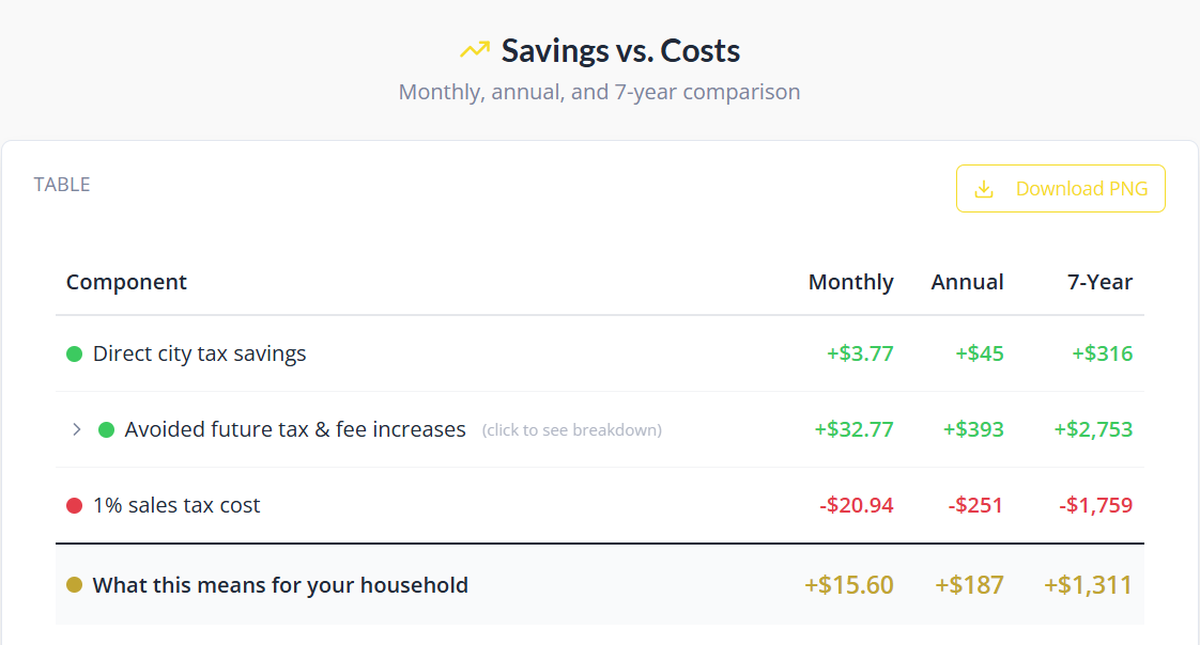
For example, a homeowner with a $100,000 property would save $1,311 over seven years, Austin’s calculator says. Direct city property tax savings would be $316 over seven years, and the 1% sales tax would cost $1,759, it says. That would represent a $1,443 tax hike.
Austin overcomes that deficit by creating a third category: “avoided future tax & fee increases.” The new category says that household would avoid $2,753 in future taxes and fees, thus, saving $1,311.
Those theoretical savings include questionable assumptions, such as savings of more than $900 over seven years on “avoided local sales tax increases,” according to the calculator’s methodology. In other words, Wichitans would avoid paying more in sales taxes over the next seven years by paying more in local sales tax under this methodology.
How?
Austin would not directly answer questions sent by The Eagle. Instead, he sent a written statement in support of the calculator.
Of the sales tax savings through increased sales tax, Austin said: “The calculator includes the full cost of the sales tax and compares it to the alternative taxes and fees households typically face over time. Your reading that as ‘saving on sales taxes’ confuses the metric with the mechanism.”
“The ongoing critique reflects a persistent framing error, evaluating a household incidence model as if it were a city budget forecast, or construction schedule, to name a few,” Austin wrote. “Like evaluating a fish on how well it climbs a tree, these specific criticisms judge the model by a standard it was never designed to meet.”
Austin did not say what standard his model was designed to meet. The calculator’s web page, hosted on his Knowledge & Decisions Economic Consulting website, says the calculator is “designed to answer a simple question: How might Watch Wichita Win change what a typical homeowner pays — compared to what they would likely pay without it?”
Some of the calculator’s other assumptions begin to unravel with a closer look at Austin’s methodology.
First, Austin assumes the city would move forward with Wichita Forward’s proposed spending — minus $150 million in property tax relief — even if the sales tax fails.
The City Council has indicated more than half of the projects wouldn’t happen without the sales tax — including $300 million for a convention center expansion and a new performing arts center and $150 million for a fund to support homeless and housing services and programs.
Austin’s homeowner’s calculator then places the full cost burden for those $700 million in “funded obligations” on Wichita homeowners.
That is misleading for a couple of reasons: $700 million is more than three times what the council has actually budgeted to spend on projects included in Wichita Forward’s “Watch Wichita Win” plan, and much of that cost would be paid by businesses, not homeowners.
The city’s capital improvement plan does not include $225 million for a convention center expansion, $75 million for a new performing arts center or $25 million for unspecified changes to Century II’s round building. It also does not include $150 million to create an endowment to fund future operations of about $4 million a year at Second Light homeless shelter.
Of the $210.4 million the city has budgeted in its capital improvement plan for projects that are also in the Wichita Forward proposal, $197.7 million is for public safety infrastructure and equipment and $12.7 million is for convention center improvements at Century II. Those Century II expenses are funded entirely by the transient guest tax, a 6% tax on hotel stays in Wichita — not by Wichita homeowners.
The $197.7 million in actual funded obligations would not be paid exclusively by Wichita homeowners. Wichita residential property owners make up 60% of the city’s property tax base while commercial property owners make up the other 40%, according to the Sedgwick County Clerk’s Office.
Combined, the failure to account for commercial property owners and the inflated list of projects considered “funded obligations” overestimates future costs for homeowners, resulting in misleading savings in Austin’s calculator.
Austin said his inclusion of $700 million in funded obligations “is a proxy for long-term needs cities routinely face, and faulting the model for not predicting future council votes is like faulting a weather forecast for not naming the exact storm.”
He said this about the omission of taxes collected from commercial property owners:
“Regarding commercial property taxes, once again, you treat this household impact model like a city budget spreadsheet; an exercise to allocate every dollar of city revenue across every taxpayer category,” Austin wrote. “Commercial property taxes don’t hit households as a clean line item and would require a separate model to estimate responsibly. Your insinuation to fold them in without modeling the pass-through would make this model’s analysis and interpretations misleading. For the sake of my integrity as an economist, I must decline.”
Adding sales tax calculators for businesses, renters
In recent weeks, Austin added calculators for renters and commercial property owners to his website.
He again uses the “avoided taxes & fees” assumptions to create savings where many Wichitans would actually see a tax increase.
Renters — who do not directly pay property taxes — would see no direct savings from the sales tax initiative. Austin estimates it would cost them an additional $932 over seven years, or an additional $11.10 a month, in new taxes.
But Austin creates two layers of savings for renters:
The calculator assumes that landlords would pass on property-tax savings by lowering monthly rent payments by small-dollar amounts, such as $2.34 a month for renters paying $800 a month or $2.75 a month for those paying $1,000 a month. Austin calls that direct rent savings.
In the avoided taxes and fees section, he again counts avoided future local sales tax increases as savings, along with other taxes, fees and charges to cover the $700 million in projects. The calculator makes up the difference between the direct cost of the sales tax to renters versus no direct savings by showing hundreds of dollars each year in savings from avoided taxes and fees.
For commercial property owners, whose properties are taxed at a higher rate, the savings of a 4-mill property tax reduction funded by a 1% sales tax creates a major windfall.
Many businesses don’t pay sales tax in Kansas under a laundry list of exceptions to state tax law. And a 4-mill property tax reduction would be worth more than double what it would be for a homeowner.
For every $100,000 in appraised value, each year homeowners would save $46 versus commercial property owners’ $100.
Austin’s calculations for commercial property owners — which assume a 3.93 mill reduction — include avoided future tax and fee increases but do not promise savings.
“Note: This tool is designed to be transparent and conservative,” Austin wrote in his methodology explanation attached to the calculator. “It reports ‘reduced pressure’ rather than promising savings or predicting market outcomes.”
Among those reduced pressures is the avoided cost of $700 million over seven years, spread evenly among commercial property owners as Austin did with homeowners.
Potential cost estimate problems with sales tax calculator
The other side of Austin’s calculator, the direct cost of the sales tax, is also misleading, according to an economist at the University of Kansas.
Donna Ginther, a professor of economics and director of the Institute for Policy & Social Research at the University of Kansas, said Wichita households are taxed on more of their income than Austin’s calculator suggests.
Austin’s formula estimates that households spend $3,000 a month, or $36,000 for the entire year. It uses that number for all households, whether they live in a $100,000 house or a $1.5 million house.
Ginther said that recent federal data show families actually spend about twice as much — closer to $6,500 a month. But expenses vary based on income and not all expenses are subject to a sales tax.
“A household spending $36,000 a year is very low,” she said. “I don’t think that number reflects household spending.”
Ginther said Austin’s calculator — which Austin says shows that the largest proportional savings go to those with the least amount of money — defies well-established economic realities surrounding sales taxes: They are regressive, meaning they hit the lowest earners the hardest.
“A sales tax is paid by everybody who buys things,” Ginther said, “and lower income households spend more of their income, so they consume most of their income. And when you consume most of your income, that means that your tax burden is higher.”
Coupled with a property tax cut that will offer larger tax breaks to commercial property owners than homeowners, the Wichita Forward plan would accomplish the opposite of what Austin claims it will do. It will cost the working poor while granting large tax breaks to the wealthy, Ginther said.
“You’re more exposed to the sales tax (the lower your income),” Ginther said. “So basically, you’re taking from less-well-off households to reduce the tax burden on wealthier households with this policy.”
Conservative pushback for Wichita sales tax proposal, calculator
Ginther, who served on Democratic Gov. Laura Kelly’s Council on Tax Reform, isn’t alone in her criticism of Austin’s calculator.
The Kansas Policy Institute, a conservative think tank and advocacy group that Austin worked for previously, has publicly rebuked Austin’s work. It criticizes Austin for other “flawed assumptions,” specifically the assumption that the Wichita Forward proposal will actually cut property taxes.
“The ballot merely says, ‘An amount not to exceed $150 million dollars of such tax applied for Property Tax Relief,’” Dave Trabert of KPI wrote. “That means the City could allocate $10 million … or even $10 and satisfy the legal requirements of the ballot language. … There’s also no stipulation preventing taxes from increasing.”
Former City Council member Bryan Frye criticized Austin’s calculations in a Facebook post.
“We need you to pay more taxes so you can pay less taxes. If that’s not a Yogi Berra-ism I don’t know what is,” he wrote.
The city’s own projections say the tax increase’s impact on Wichita families “is difficult to measure” but would “depend on family income and how that family income was spent.” Under the city’s estimate, the average family would pay about $352 a year in sales taxes while saving roughly $100 a year under a proposed 4 mill reduction. The city used conservative estimates of spending rather than the higher spending levels Ginther said are more realistic.
Wichita Forward promotes tax calculator, defends it
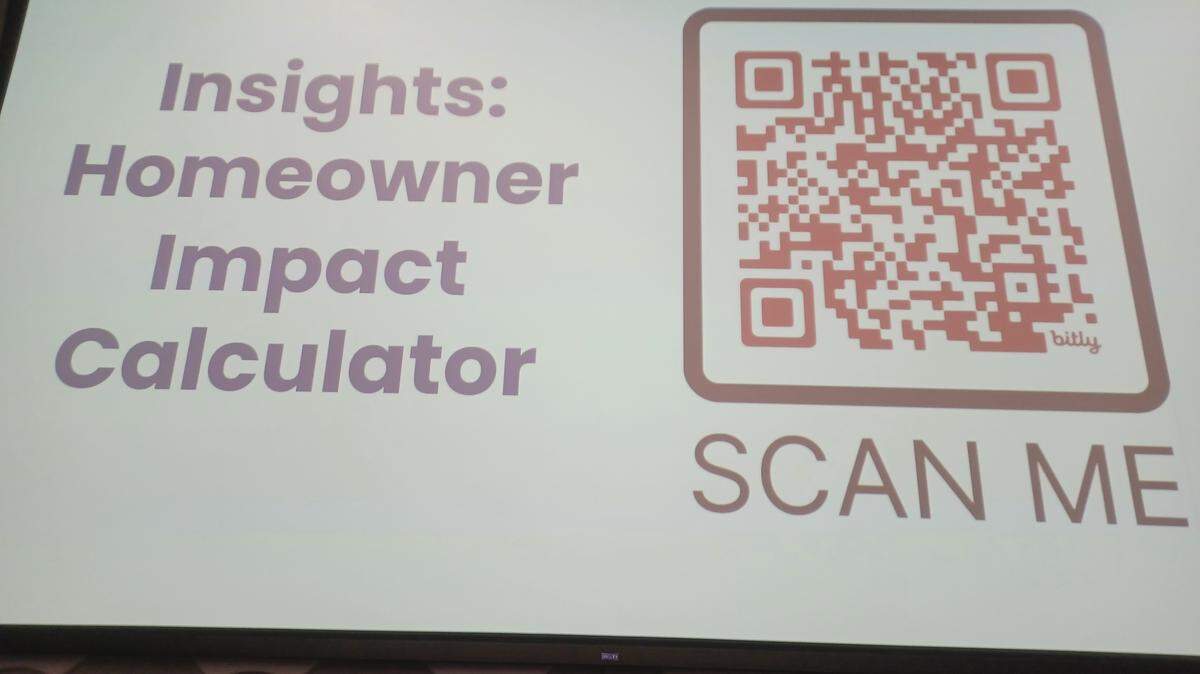
Wichita Forward directed voters to Austin’s calculator at a Dec. 15 community forum and provided a QR code to reach it quickly. The coalition also promotes it on its own website and social media pages, calling it “the independent property tax calculator” and a “neutral, data-driven analysis on the Wichita Forward Plan.”
The sales tax backers have also directed voters to the calculator in recent mailers.
“We did have an economist send a note this morning that had — he did a calculator on his website,” Matt Burchett, an executive at Thrive Restaurant Group and spokesman for Wichita Forward, told a room full of voters at the Advanced Learning Library in December. “So I’m going to put a QR code to that, to see what you may potentially save as it relates to the tax, or not save.”
Burchett called Austin an independent economist but did not mention him by name. Burchett, who was not taking questions from the crowd that night anyway, told the public that he would not be able to answer any questions about the calculator.
“I’m not an economist or a numbers guy, so if you want to argue with me around the numbers, I’m probably not the best person to do that with,” he said.
After the meeting, Wichita Forward campaign manager Ben Davis said Austin approached him with the calculator.
“He approached us about it, not us him,” Davis said, “and he’s the one who came up with the analysis independent of anything we asked him to do.”
He was not paid for the calculator, Davis said.
“As of now, there has been no exchange of funds to Michael Austin,” Davis said in December. He did not respond to a question on Jan. 30 about whether that has changed.
Davis acknowledged Wichita Forward may pay Austin for “something different,” but would not say what.
“Something different, yeah,” Davis said. “Michael Austin is a university economist who is independent, who worked formerly for AFP (Americans for Prosperity), who has seen a shift with governors and mayors and folks on the right around the country of people who are being crushed by rising property taxes.”
Davis said moving to sales tax in lieu of property tax is growing in popularity on the political right.
“Ron DeSantis is doing this,” Davis said. “The state of Texas is doing this. A lot of states are moving away from property taxes, going to consumption taxes. So Michael Austin, seeing the trend and agreeing with it, said, ‘Look, this is something that, independently, as an economist, I agree with. Do I love everything about the plan? No. But there are certain key fundamentals about the plan that I really do like, and I want to do an independent analysis,’ which is what he brought to us to see, is there really, actually going to be any significant tax savings or any savings at all. He ran that before we talked about anything going forward.”
Davis said Austin’s model is not perfect. But he said he thinks it acknowledges a reality that the city will need to find a way to fund its priorities, one way or another.
“Something’s got to give on all of that,” Davis said. “Where’s that money going to come from? The donor class is completely taxed. So this is why they’re having a really hard time doing any kind of private funding for Second Light or any of these homelessness services, as it stands right now. So it’s difficult to believe that some of these things, whether for first responders or homelessness or some of this other stuff, is not going to have to be made a priority for the city’s budget going forward.”
This story was originally published February 5, 2026 at 6:03 AM.