
Wichita council approves March special election on proposed sales tax
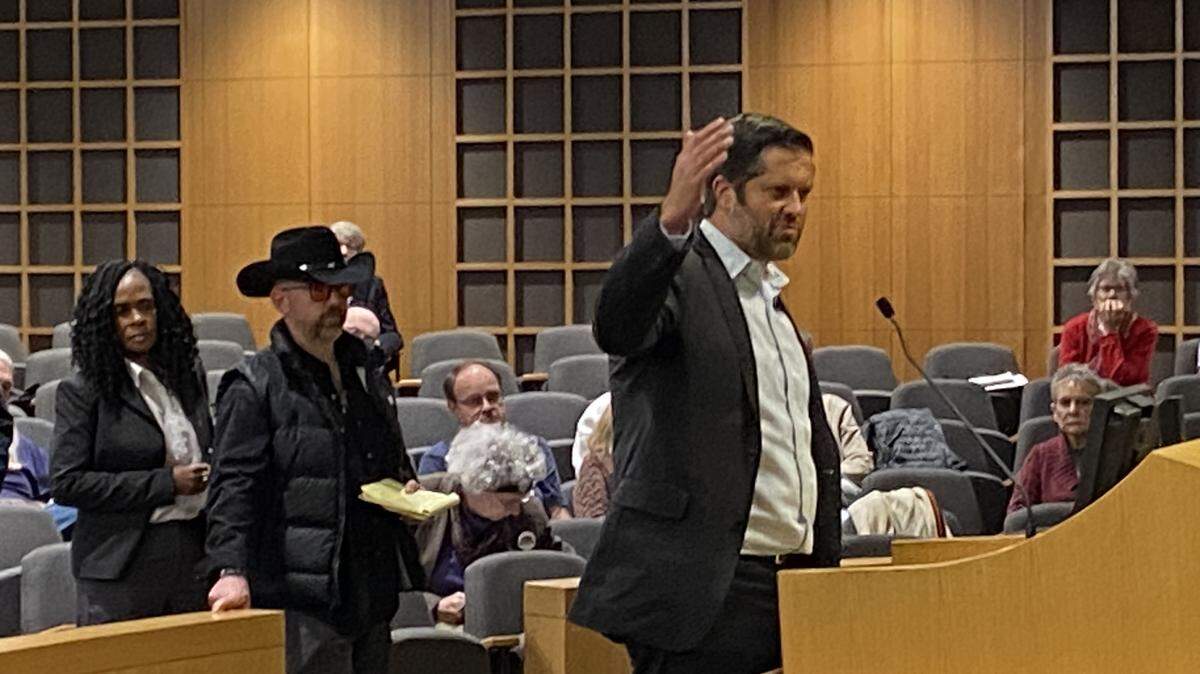
The Wichita City Council voted unanimously Tuesday to hold a special election for an added 1% sales tax on all retail purchases in the city — including groceries.
The election will be March 3 and will cost $150,000.
The council approved holding the election on the first reading after more than four hours of discussion and debate about the proposed tax hike. It will hold another public hearing next week and vote again; only council member Mike Hoheisel signaled he could change his mind.
If public speakers at the meeting are any indication, the proposal is supported by the city’s visitor’s bureau, the summer musical theater company, the firefighter’s union, the chamber of commerce and the nonprofit organization running the city’s homeless shelter while unpopular among people not directly benefitting from the sales tax revenue.
Thirty-three people spoke during the public comment session, with the majority in opposition.
The state removed a 6.5% tax on groceries earlier this year. Sedgwick County’s 1% sales tax approved in 1985, a majority of which goes to the city of Wichita, has remained in place. If the new tax passes, taxes on groceries in Wichita would double to 2%.
Some council members voiced concerns about the grocery tax and want the state to pass a law allowing food and other essentials to be exempt from local sales tax. But the law likely would not take effect until after the election. It’s unclear if it could be applied to Wichita’s sales tax.
The sales tax was proposed by Wichita Forward, a coalition made up of Wichita businessmen, including Aaron Bastian of Fidelity Bank; Ben Hutton of Hutton; and Jon Rolph of Thrive Restaurant Group. Under state law, local sales tax questions can go on a ballot with a vote of the city council or by gathering signatures on a petition of at least 10% of the city’s registered voters.
The tax hike would take effect July 1, 2026, and would end in seven years.
What’s in the Wichita sales tax plan?
Wichita Forward said they based the funding priorities on a 500-person survey and research of previous city plans, election results and community conversations. The coalition has not released the survey questions or responses.
The $850 million plan would set aside $25 million for Century II, the city’s convention and performing arts center, while dedicating $225 million to a convention center expansion and $75 million for a new, private-public partnership to build a $150 million performing arts center.
Another $225 million would go to unspecified public safety capital improvement projects.
$150 million would go to a nonprofit to run the city-owned Second Light homeless services — or any other “multi-agency center” — and an affordable housing fund, although the share of funding each of those projects would receive is unclear.
Justice Together, a grassroots coalition of interfaith communities in Sedgwick County, is suggesting the council allocate $10 million toward the city’s affordable housing fund.
“Ultimately, I believe the council will determine what the most effective use of those dollars would be for affordable housing,” City Manager Robert Layton said.
The sales tax increase would allow the city to cut property taxes by an estimated 4 mills, saving property owners $150 million over seven years. That would result in $46 of savings for every $100,000 of appraised value on a home and $100 in savings for every $100,000 of appraised value on a commercial property.
A 1% sales tax is estimated to cost an average family in Wichita nearly $352 a year, according to the city’s estimates. A married couple and two children making the median household income of $63,072 would spend an estimated $183 a year on a 1% sales tax, according to an IRS sales tax deduction calculator.
Wichita City Council members on support for sales tax public vote
A majority of the council had signaled their support for a sales tax ballot initiative before the meeting. But each member explained his or her vote Tuesday.
“I believe that Wichita is worth investing in,” council member Dalton Glasscock said. “I believe that our best days are ahead, and I think this is just one step on how we can get there together as a community. And we’ve had this conversation, and I’m glad for a group that has stepped up to push this forward, to bring this before council, and I think now it should be in the hands of the citizens to determine whether or not we will take a generational step forward.”
“I think that this is overall a really good step forward,” council member Brandon Johnson said. “And especially when we look at convention space, we’ve been talking about that for a while, and we know the challenges we face with convention space right now. This offers an opportunity to improve those things.”
Council member Becky Tuttle said she’s concerned that Wichita isn’t growing.
“We can’t cut our way into prosperity,” Tuttle said. “We have to invest in ourselves if we want to grow. And this is an incredibly unique opportunity to ask the residents of our great city what they want for the future of Wichita.”
Council member J.V. Johnston said he would like to see more property tax relief included in the proposal but that he’s learning to compromise.
“As Councilman Glasscock and Hoheisel and Johnson tell me, local government’s about compromise,” Johnston said. “So, it took me a while to get that message, but I’m finally getting it.”
Council member Maggie Ballard said Wichitans have gotten in their own way in the past, and this is a chance to change course.
“Sometimes, Wichita feels like they say ‘No’ to everything,” Maggie Ballard said. “And we’re actually stunting our own growth. Is this perfect? Absolutely not. Do I still have questions? Of course. But I feel like we should put this on the ballot and leave it up to the public and let them tell us.”
Hoheisel was the only council member to express any consternation about voting to put the tax on the ballot. He said he would vote against it next week if the council is unable to fund a rebate program for low income earners. He said he is also working with state legislators to pass a state law that would exempt food and certain other essentials from the city sales tax, but it’s unclear if it could be applied retroactively since the ballot language would be approved before the state law.
“I have a lot of concern here, a lot of concern,” Hoheisel said. “I also see this is probably going through and being the one chance that we have at funding homeless services, affordable housing and public safety, which are important to me. . . . (But) I have to make sure that we’re not going to be hitting people over the head who can’t take it.”
Mayor Lily Wu was in support of the sales tax to help fund Second Light and offset the city’s upcoming budget deficits in 2028 and 2029. She spoke in favor of putting it on a ballot for voters to decide on.
“This would allow individuals to vet if this is really the best idea,” she said.
Is the Wichita sales tax proposal moving too quickly?
Some Wichita residents spoke in opposition to the plan, with many citing frustrations with how quickly the council is moving on the proposal with minimal public engagement or specifics.
“This is such a rushed thing,” District 6 resident Janice Bradley said. “You’re trying to suppress votes, that’s why you want it on March 3.”
Many of those who thought the sales tax vote was rushed asked the council to table the sales tax question and put it on the August primary or November general election ballot.
The plan to raise sales taxes to lower property taxes also came under fire. Sales taxes are often criticized for placing a larger tax burden on the working poor while property tax cuts benefit commercial property owners more than homeowners.
Hutton said Tuesday that Wichita Forward has mostly “heard strong support” in its conversations with local businesses and government officials. He said he has been working on many of these priorities for 20 years.
“I don’t think it’s too fast,” Hutton said. “I think we’re a decade late.”
“I understand that we all have specific issues or causes that we care about most,” Hutton said. “If it were up to each of you or up to me, the suggested projects included in the plan would be different or maybe differently funded, but it’s not. The plan was created by combining the issues that we know we face as a city with the results of a poll asking the citizens what they want, not you or me.”
Rolph said now is the time to spend on the priorities outlined by Wichita Forward.
“As I’ve been involved civically for the last 20 years, I’ve never felt Wichita have more momentum than it does right now,” Rolph said. “The wind is at our back as a community, and when you have momentum, and you can keep momentum as the powerful decades of growth for community, and so I think this continues to put this community in its best posture for future success.”
Bastian said the “temporary tax would make generational investments in our city.”
“Many of our peer communities, such as Tulsa and Oklahoma City, have implemented similar sales tax programs that help grow their communities while making long-term investments in their city,” Bastian said. “I’ve seen it firsthand as a former citizen of Oklahoma City and our company does business today in both Tulsa and Oklahoma City.”
Here’s the ballot wording for Wichita sales tax proposal
City documents show how the sales tax question would appear on the ballot:
1. Shall the City of Wichita, Kansas, be authorized, pursuant to K.S.A. 12-187 et seq., to impose a one percent (1.0%) city-wide retailers’ sales tax to be effective July 1, 2026, and which will terminate no later than June 30, 2033, the revenues derived therefrom to be applied as follows?
A. An amount not to exceed $225 million dollars of such tax applied to Public Safety costs for support of City police and fire facility construction and maintenance, the acquisition of vehicles, apparatus and equipment and other purposes related to providing Police and Fire Services for the City;
B. An amount not to exceed $250 million dollars of such tax applied to pay the costs for Revitalization of Century II (not to exceed $25 Million) and Upgraded and Expanded Convention Center Improvements (not to exceed $225 Million);
C. An amount not to exceed $150 million dollars of such tax applied for Property Tax Relief;
D. An amount not to exceed $150 million dollars of such tax applied to establish a restricted-special fund, with earnings from such fund to be reinvested into this special fund, to support Homeless and Housing Services by funding affordable housing projects and programs, shelter facilities, a multi-agency center and its operations and related services for people experiencing homelessness; and
E. An amount not to exceed $75 million dollars of such tax applied for Development and Construction of a New Downtown Public Performing Arts Center.
Susie Santo, director of Visit Wichita, said the city’s tourism bureau favors the sales tax because it helps businesses with property tax relief and would help draw additional visitors to the convention center and performing arts center.
“Ensuring a safe and welcoming environment is critical,” Santo said. “The investment in public safety and homelessness and housing solutions is not just about residents’ well-being. It also ensures that leisure visitors, sports, families, convention attendees, feel confident and comfortable visiting Wichita. Compassionate homelessness solutions and a strong safety presence create a positive first impression for all who’ve come to our city.”
Speakers voice opposition to proposed sales tax
Wichita Forward’s sales tax proposal faced strong opposition during its first informational meeting Monday night. More than a hundred people attended the meeting, with most of the speakers voicing opposition to the proposal and citing a lack of transparency.
The criticism continued Tuesday at the City Council meeting, even from those who favor a local sales tax.
“What I saw last night was really surreal,” Wichita resident and former political strategist Joseph “Tex” Dozier said. “Where the night before ballot language would be finalized is a public forum. The public should be co-authors as a part of this language, not the audience.”
“And I remember the line that was said in the one hour that was allotted,” Dozier said. “‘We only want your questions. We don’t want your comments.’ And I think that sums up the experience of many Wichitans from different political backgrounds when it comes to this.”
Others voiced frustration and concern that the City Council is rushing to put the sales tax question on the ballot without enough input from residents.
“I’m still perplexed as to who gets to decide what’s important to the citizens when it’s our tax dollars that are going to be expended,” District 1 advisory board member LaWanda DeShazer said. “I think we need to table this, or just say no for now, go back to the drawing board, reach out to the citizens and see what’s really important to us, because it’s our tax dollars that are going to be expended.”
Mark Barlow, a District 2 resident, said all the priorities in the sales tax are worthy of funding. But he said they should be funded differently.
“I just think it’s ridiculous to push for additional taxation against already struggling Wichitans when we should be talking about levying taxes on our local oligarchs — the Kochs and other subversive mega-wealth hoarders already unduly influencing our politics and our democracy,” Barlow said. “And it’s high time we the people put this tax burden where their dark money resides.”
Karl Peterjohn, a former Sedgwick County Commissioner, expressed frustration with “disparate treatment” by the city council of the Wichita Forward group and the Save Century II group, which he was a part of. The city sued Peterjohn and the group’s founder, Celeste Racette, after they gathered more than 17,000 signatures in 2020 to block the city from tearing down Century II and the former Central Public Library.
“Let Wichita Forward start a petition drive and get 12,500 signatures in a 180-day time frame,” Peterjohn said. “They don’t have to do it during a pandemic, and I would urge you don’t sue them.”
Racette vowed to the council that she would fight against the sales tax.
“One of you told me if I didn’t support this sales tax proposal, Century II would be torn down and destroyed,” Racette said. “As a fraud investigator, if I’ve been lied to, threatened or attempted to be bribed, it really puts me on a fight, and so you’re in for it on this one if you’re using this kind of pressure to get this approved.”
The Wichita Regional Chamber of Commerce also voiced frustrations with the plan, even though they support it as an organization. Toni Porter, vice president of government relations and military affairs for the Wichita Regional Chamber of Commerce, said it doesn’t go far enough to cut property taxes for businesses.
“The chamber and much of the business community are concerned that the proposal does not allocate a greater share of sales tax revenue to property tax relief,” Porter said.
A second informational meeting for the sales tax proposal will be held at 5:30 p.m. Dec. 15 at the Advanced Learning Library.
This story was originally published December 9, 2025 at 5:35 PM.