
Mayor Wu pitches transfer of city-owned WaterWalk site to developers — with a catch
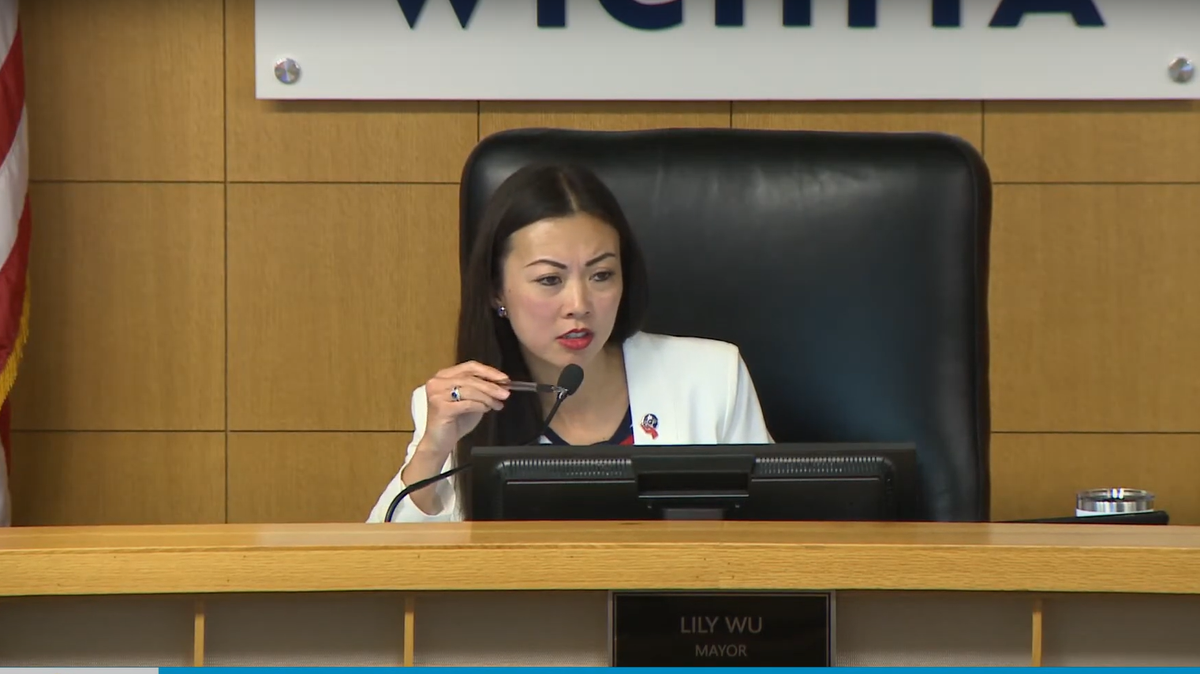
Mayor Lily Wu is calling for the city of Wichita to end its 99-year lease agreement at the WaterWalk by transferring ownership of several acres of city-owned land near the downtown east bank of the Arkansas River to private developers.
But to keep the land, they would have to build within a set timeframe or return it to the city.
The proposal came to light Tuesday as city staff, at Wu’s direction, detailed a history of the WaterWalk development, which is widely viewed as a disappointment.
The developers seem interested in striking a deal, which would hinge on future approval by the City Council.
Jim Korroch, one of three trustees of the late WaterWalk developer Jack DeBoer’s estate, told Wu on Tuesday that he’s “delighted” to begin conversations surrounding a transfer of ownership, even as the City Council shot down his request for additional incentives to develop apartments on the site.
“We have had developers come to us, and when they realized, ‘Oh, this is a land-lease deal, never mind. We’ve got other places we can go,’” Korroch said. “So what this potential proposal allows, frankly, is it allows us as a developer to have a lot more opportunities to be able to seek development on this ground.”
Wu said she wants to transfer ownership to the DeBoer trust as a way to potentially claw back the land if developers fail to hold up their end of a deal that’s been in place for decades. Without the property transfer, the city would take ownership of the buildings in the WaterWalk project site in 2101.
“I hope that in good faith, the estate will come back and speak with the city manager and the law team on how to move forward with not keeping us hostage on a 99-year deal,” Wu said.
City Manager Robert Layton said he and Korroch have already had discussions around a potential deal, but the details have not been agreed upon.
“At the request of the mayor, I’ve had some conversations with Mr. Korroch on behalf of the estate,” Layton told the City Council on Tuesday.
“The concept would be that the title would be conveyed to the developer,” Layton said. “We’d have to determine the terms for that. And then what we had . . . talked about — not been committed to at all by the developer — is that it could be possibly a 15-year period. And if that’s the case, if nothing is developed or it’s not fully developed in 15 years, then it’ll come back to us. But that was an initial concept, not bringing something to you today to review.”
Layton did not give a timeline for when the WaterWalk proposal could come before the City Council. He is expected to retire at the end of the year.
Layton said in a phone interview Wednesday that the city would only transfer the land with financial considerations for the city from the developers.
“It would either be some type of payment on the front end when the land is conveyed or something that’s more consistent with the original agreement and that is that there would be some kind of financial consideration given to the city as a result of the development that would go beyond property tax,” Layton said. “Back then, I think it was something like a profit-share type of thing.
“So I don’t know what avenue we would go, but the whole idea is that there would be some revenue stream coming to the city beyond property taxes.”
The city spent millions of dollars — including exercising eminent domain — assembling what became a 29-acre project site south of Century II in the late 90s and early 2000s as part of a public-private partnership plan to revitalize downtown, draw tourists and activate the river. It was supposed to be an economic catalyst, setting off a chain reaction of private investment and development downtown.
Instead, the city spent almost $44 million in public funds compared with almost $37 million in private investment, or about $50 million less in private investment than city officials said when the project was approved in the early 2000s, according to numbers presented by Assistant City Manager Troy Anderson on Tuesday.
That doesn’t count the tens of millions of dollars in public funding the city has spent on other projects aimed at accomplishing what the WaterWalk project promised — but failed — to deliver.
Korroch acknowledged on Tuesday that the developers have “fallen painfully short” of the original vision for WaterWalk and apologized on behalf of the DeBoer estate, saying “we could and should have collaborated better, asked for help and been more transparent.”
“There’s nothing we can do about the past. It’s time to move forward,” Korroch told the City Council. “Today should not be so much about airing grievances of the past, although we’re ready to hear those, but more about dreaming about WaterWalk’s future and the opportunity we have to dream and start fresh.”
Wu wasn’t alone in supporting a transfer to the DeBoer estate. Council member Dalton Glasscock said he wants to get out of the 99-year lease and that he, too, would like a redo on the WaterWalk.
“I do hope, Jim (Korroch), that we can maybe move forward with an agreement to have a new day on this development project in the future,” Glasscock said. “And I think that that’s something that this council supports. How can we move forward? And how can we press the restart button on WaterWalk? I think that we need to restart.”
Celeste Racette, a local activist and citizen budget watchdog, said she supports Wu’s proposal to transfer ownership to the developers on the condition that they develop the land or give it back to the city.
“You have got to do whatever you can to get out of this bungled development deal,” Racette told the City Council.
Council member Maggie Ballard said she supports taking another look at the WaterWalk agreement and that it’s important to make sure the public benefits from any future deals.
“We need to look at the WaterWalk development overall and see what makes sense to fix this,” Ballard said. “It’s definitely not selling the land, but we can’t keep doing the same thing because it’s not working. I’d like to see us find a way to look at our riverfront property on how to make all of these areas work together as an exciting public asset along our river and not a developer’s playground.”
This story was originally published August 12, 2025 at 6:10 PM.