Judge green-lights Kansas ICE detention, tossing city’s lawsuit. What happens now?
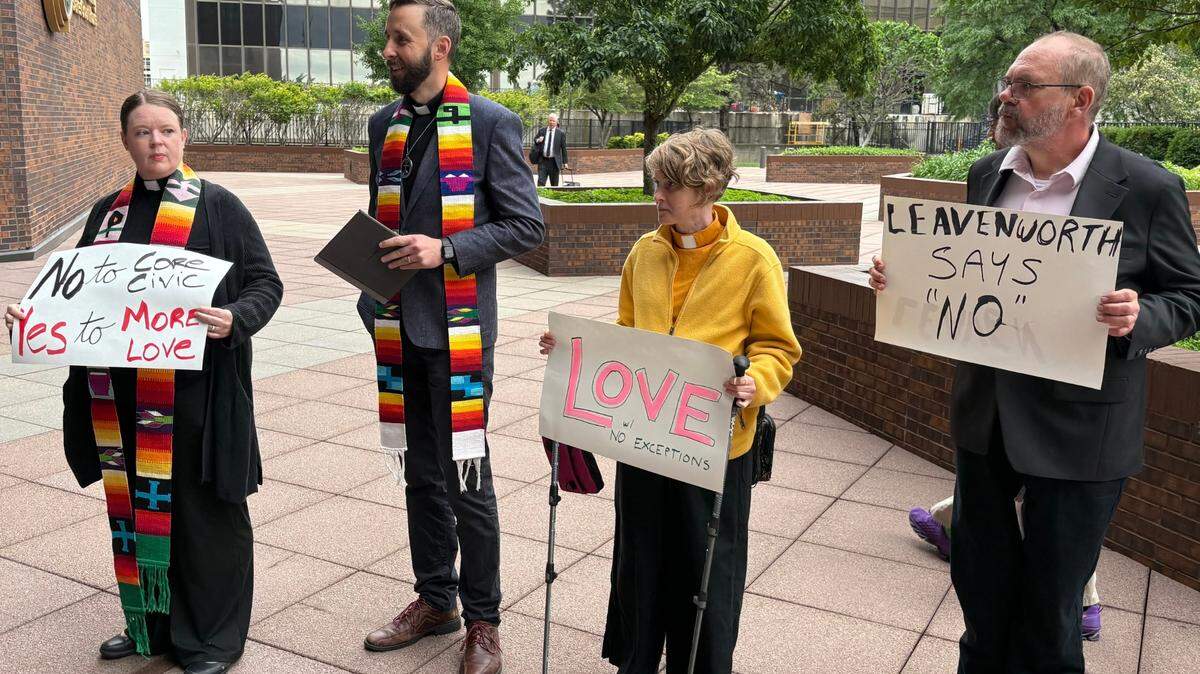
A federal judge has thrown out the lawsuit brought by the city of Leavenworth against CoreCivic, paving the way for the private prison company to begin housing immigrant detainees at its maximum-security facility there as soon as next month.
The city is expected to appeal the ruling.
U.S. District Court Judge Toby Crouse dismissed the complaint on Thursday. The lawsuit sought to block the company from reopening its shuttered detention center on the outskirts of town without first requesting and receiving permission from local officials.
CoreCivic initially agreed to follow local zoning rules that would have required several public hearings before reversing course and taking the stance that it could operate its Leavenworth facility by right.
Crouse, a former Kansas solicitor general who was appointed to the bench by President Donald Trump in 2020, ruled in a written opinion that the city failed to establish that federal courts have jurisdiction to intervene in the dispute.
The city filed suit in federal court instead of state court because CoreCivic is incorporated in Maryland and headquartered in Tennessee, W. Joseph Hatley, an attorney representing Leavenworth, told reporters after a Tuesday hearing in Topeka.
To establish diversity jurisdiction, plaintiffs must demonstrate that the amount of money at stake is at least $75,000. In its complaint, Leavenworth argues the criteria are met because the property value of CoreCivic’s 1,033-bed Midwest Regional Reception Center comfortably exceeds that minimum threshold.
“The City fails to allege that the sum or value of the dispute exceeds $75,000 as required to establish diversity jurisdiction under Section 1332,” Crouse wrote. “In particular, unlike in many suits where there is a breach of contract or a common law tort claim in which damages are sought, the Complaint asserts no cause of action seeking any monetary damages.”
Stating the monetary value of the property in question does nothing to demonstrate that CoreCivic broke a law or violated a contract in a way that will cost the city at least $75,000, Crouse said.
For the first time in court Tuesday, attorneys for the city pointed to a state law that makes it a misdemeanor to violate municipal zoning laws, punishable by up to $500 or six months in prison for each offense.
Inability for a municipal government to enforce its own laws constitutes irreparable harm because it undermines legitimacy, Hatley argued.
ICE detention center
Instead of seeking damages, Leavenworth asked the court to grant an injunction blocking CoreCivic from detaining anyone at its facility without first being granted a special use permit that local zoning regulations require for all jails and prisons.
In a separate motion, Leavenworth asked Crouse to temporarily block detentions there while the suit worked its way through the court system.
“What we do know is that CoreCivic intends to detain inmates there soon — possibly early June,” Hatley said during the hearing.
In an earnings call earlier this month, CoreCivic CEO Patrick Swindle highlighted an agreement related to the Leavenworth facility that the company entered into with U.S. Immigration and Customs Enforcement, or ICE, on March 7.
That contract has not been made public, and ICE has so far not provided a copy in response to The Star’s Freedom of Information Act request.
Hatley argued Tuesday that a temporary injunction was necessary because if CoreCivic started housing immigrant detainees before the court ultimately ruled in the city’s favor, ICE could simply refuse to move them elsewhere.
Crouse was unsparing in his assessment of the city’s legal argument, indicating he likely wouldn’t have sided with Leavenworth even if he did believe the court had jurisdiction.
“One may (and Core Civic does) reasonably argue that the City’s claim must be dismissed … for failure to state a claim because it fails to assert any valid cause of action … But that is a dispute concerning the substantive merits, something federal courts may not consider in the absence of jurisdiction to do so,” Crouse wrote.
An appeal of the district judge’s ruling would be handled by the 10th U.S. Circuit Court of Appeals in Denver.
“I wouldn’t say it’s necessarily a bad news decision, right? We’ve just got to figure out what the next step is and then go from there,” City Manager Scott Peterson told The Star Friday morning.
Violence and prejudice
CoreCivic, the nation’s largest for-profit prison chain, has repeatedly approached city and county officials about entering into a contract with ICE after the detention center was forced to close at the end of 2021 under a Joe Biden executive order.
In 2023, county officials scuttled negotiations by refusing to continue serving as an intermediary between the company and ICE after loud opposition from residents.
A renewed effort in 2024 was met with similar resistance. Some residents voiced concerns over the prison’s history of chronic violence, drug abuse, and understaffing, and others said they didn’t want to see immigrants brought to Leavenworth take up permanent residence there.
Taylor Concannon Hausmann, an attorney representing CoreCivic, suggested in court that opposition to the prison’s reinvention is motivated by prejudice.
“The city’s not concerned about it being a prison. They’re concerned about the type of detainees the company intends to house there,” Hausmann said, adding that the city’s goal is “to control the company’s business with ICE.”
Leavenworth argued that if CoreCivic had followed through with its special use permit application, local officials would have likely rendered their final decision before the end of May.
“We’d entertain any business but they need to do it the right way,” Mayor Holly Pittman told reporters after the hearing.
In the first few months of the second Trump administration, federal agencies have scrambled to expand their capacity to accommodate the president’s calls for mass deportations.
An unspecified number of immigrants rounded up by ICE agents are already being held in a different Leavenworth facility. FCI Leavenworth is one of five federal prisons designated to hold ICE detainees under a February agreement obtained by The Star.
CoreCivic has said reopening its facility will create 300 jobs and generate upwards of $2 million a year for Leavenworth between fees paid to local government, agreements with law enforcement to support the facility and property taxes that are already being paid.
The company has also worked to soften its image and endear itself to residents, even as it accuses the city in court filings of violating its property rights and due process. This week, CoreCivic took to Instagram to announce that it had donated $10,000 to Leavenworth’s Salvation Army to fight food insecurity in the community.
Hausmann said the dire conditions that led to multiple inmate deaths and physical attacks against prison employees in the year before its closure are immaterial.
“All the harm outlined in the city’s motion is past harm,” Hausmann said.
“There’s no basis to believe that harm is going to happen again.”
This story was originally published May 23, 2025 at 10:35 AM with the headline "Judge green-lights Kansas ICE detention, tossing city’s lawsuit. What happens now? ."