Kansas Gov. Kelly campaigned as the ‘childcare governor.’ How will she confront crisis?
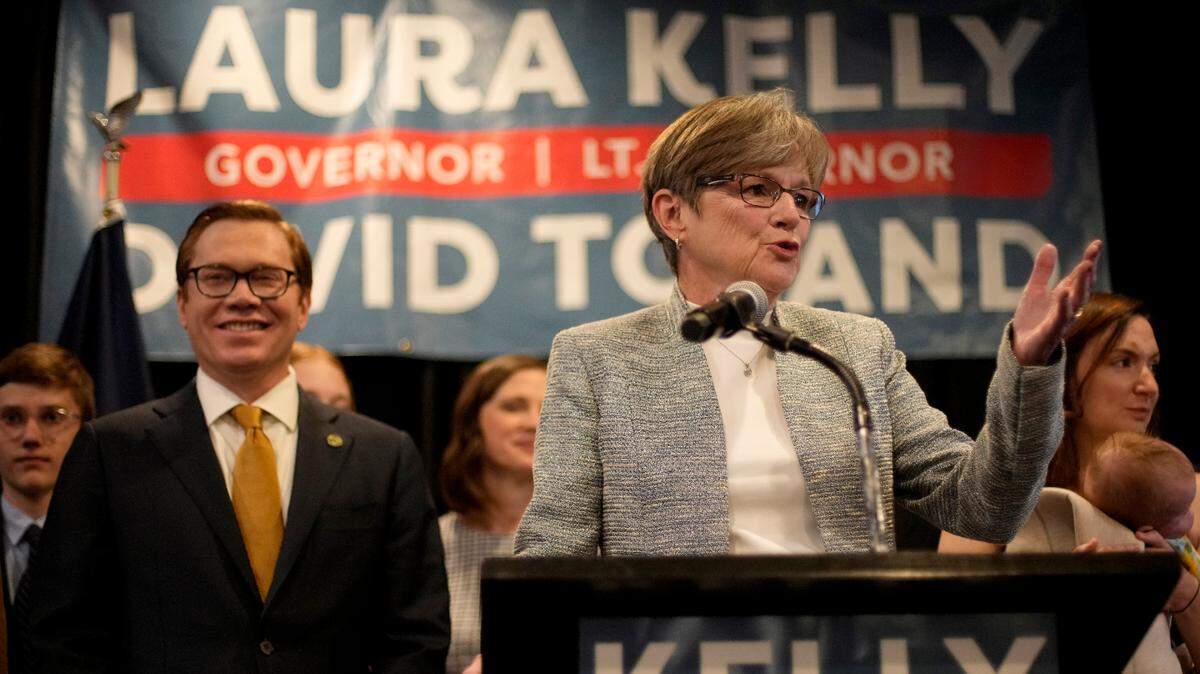
Campaigning four years ago, Democrat Laura Kelly promised to be Kansas’ education governor.
As she sought votes a second time this year, she pledged to be the childcare governor in her next term.
In an interview at her Capitol office in Topeka Wednesday, Kelly indicated the details of her commitment are likely to play out over the next four years. While she said she had considered immediately creating an office to coordinate childcare activities, she instead chose to spend the next year developing a strategic plan for it.
“I believe very much that ultimately a system like this is going to have to be a public-private partnership,” Kelly said in an interview at her Capitol office in Topeka. “This will have to be local units of government, the state and the private sector all working together to be able to provide that comprehensive, really quality early childhood.”
From the time she entered office in 2018, Kelly said, her goal was to leave Kansas with the most comprehensive early childhood education system in the country.
Access and affordability
Currently, providers, researchers and policy advocates alike agree there is a crisis in childcare in Kansas and across the nation.
“We have a situation where providers cannot be paid what they need to be paid and parents cannot pay what they are being asked to pay,” said Emily Barnes, the vice president of the Child Care Providers Coalition of Kansas.
According to Child Care Aware of Kansas the state needs more than 85,000 more child care slots to meet demand in the state. The state currently has just over 56,000 children enrolled in childcare.
Kansas childcare costs as a percent of women’s income are higher than the national average.
A report from United WE, a nonpartisan policy and research group focused on enhancing equity for women, found on average child care for an infant will cost a family 30% more each year than it would to send the child to a Kansas public university. The average cost of $11,222 accounts for 29.4% of median earnings for Kansas women.
The issue was compounded by childcare centers that closed and did not reopen during the early days of COVID-19.
On Wednesday, Kelly said she plans to spend the next year working with stakeholders and establishing a plan to create a cabinet level position to oversee child care initiatives.
“We have a lot of agencies involved with early childhood,” she said.
She indicated a need for additional state funding and said she envisioned programs across the state similar to TOP early learning center in Wichita, which works with children and families from the time they enter child care through high school.
“It’s finances,” she said. “We know child care is expensive and in order to be able to do this, much like there’s no way a family could provide K-12 education on their own dime, nor could any private entity provide K-12. We’ve got to partner with them.”
Already the Kansas Legislature last year approved a tax credit for businesses that provide childcare to employees or cover the costs.
She said she hoped for cooperation from Republican lawmakers in new initiatives.
“It’s hard to be against little kids. We’ll use that,” she said.
Kansas Senate President Ty Masterson, an Andover Republican, said he agreed with the governor that action was needed on childcare but said discussions about exactly what to do remained in their early stages.
“Generally, our disagreements are around the state’s engagement,” Masterson said. “We might want to reduce regulation and make it easier to participate in childcare and they might want to do something more on a government funding standpoint.
“I think we all agree we need to be figuring something out.”
He referenced the imperative to look at child care solutions in part to get more Kansans to work. Kansas currently faces a major workforce shortage. The United WE study identified childcare as a key barrier to women participating in the workforce.
Providers seek support
Policy advocates and providers say they’re grateful for the governor’s commitment, but laid out a wide variety of work needed to improve the current landscape.
Barnes, with the child care providers coalition, said providers have been plagued by workforce shortages recently but that there has long been a lack of understanding of the amount providers must spend to provide quality care.
“We took care of these kids and we kept them safe and we kept them in care as we were able to (through COVID-19),” Barnes, who operates her own child care business, said. “It is expensive to provide quality care, it is expensive to give the care, it is expensive to be the family paying for the care. “
Barnes said since the pandemic conversations have ramped up in earnest about ways to solve the problem. Kelly’s move over the summer to provide bonuses to childcare workers using federal dollars, she said, sent a needed message to workers that they are appreciated.
But more is needed.
Barnes has been able to keep rates steady for her families since 2016, in part, she said, because of federal dollars that went to child care centers in COVID-19 relief packages. But that money is about to run out.
“I am concerned that if we do not address the current system that, yes, I will in fact have to ask my parents to pay more,” she said.
She advocated for a comprehensive approach and said money need to be a part of that conversation.
“I’m optimistic that we have people who want meaningful change. I don’t know that we have the momentum yet to actually put bold new strategies into place that have never been tried,” she said.
Proposed solutions
John Willson, president of Kansas Action for Children said Kansas needs to consider expanding eligibility for federal child care assistance programs, enrolling more providers to accept childcare subsidies, and making greater investments in the existing programs.
“Because we know that employers are having a hard time finding employees and one of the things we think one of the biggest reasons is because people lack affordable, accessible child care,” Wilson said. “If they aren’t able to access programs because of state imposed barriers … then that’s contributing to the problem.”
The solution to Kansas’ child care challenges, Willson said, will not be as simple as funding K-12 education.
“We’ve had decades of the public understanding that a free public education is there for their child and it’s an expectation,” he said. “We haven’t yet created the public understanding of early learning and child care being just as important as K-12 education.”
United WE is studying Kansas’ regulations to determine where it is possible to loosen the burden on providers without endangering staff or children in the process.
“Let’s really look closer at what is the line? And what are some of the barriers that are not impacting children’s safety but are impacting child care providers and being able to serve more of those children,” said Angie Heer, chief development officer at United WE.
Heer said four years down the line solutions will likely be varied and require Kelly to bring various stakeholders to the table if she wants to cement her legacy in the area.
“Multiple angles are going to have to be taken,” she said. “We are at a point now where it is a crisis. We are going to need to move farther and faster on this issue than we ever have before.”
This story was originally published December 22, 2022 at 7:00 AM with the headline "Kansas Gov. Kelly campaigned as the ‘childcare governor.’ How will she confront crisis?."