
Wichita City Council poised to finalize new district boundaries after contentious debate
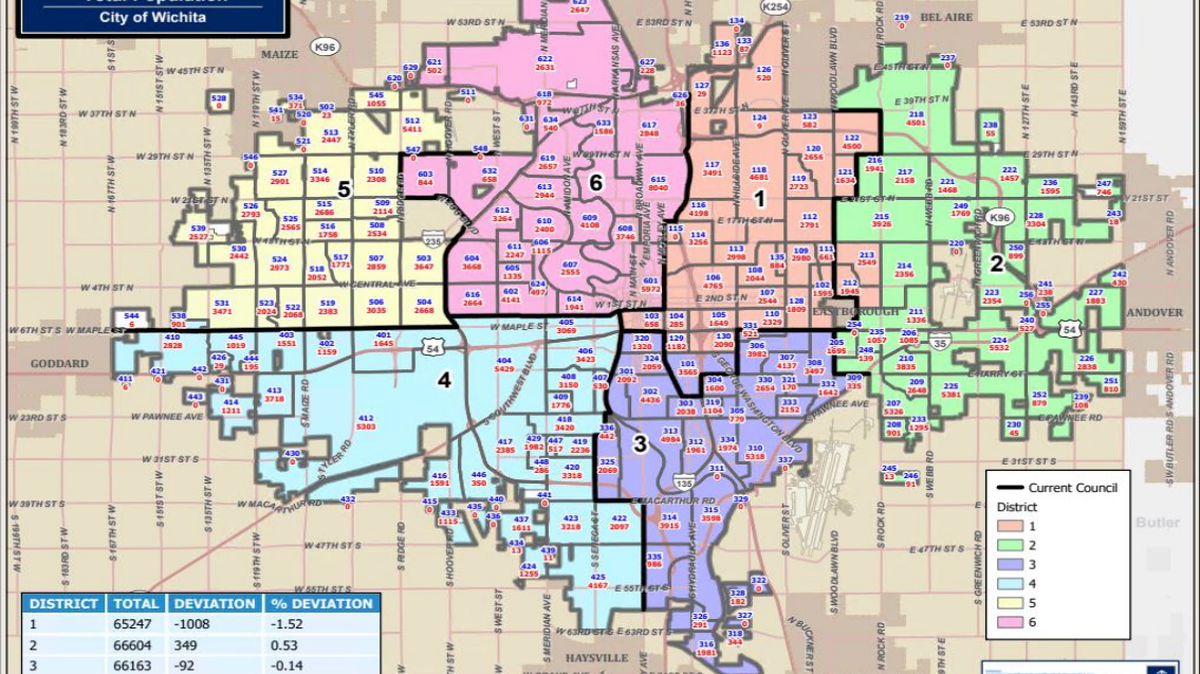
The Wichita City Council is poised to finalize council district boundaries for the next 10 years after a contentious debate over two nearly identical maps yielded a 4-3 initial vote.
Districts are redrawn once a decade to rebalance populations based on U.S. Census data. Both maps considered by the council at last Tuesday’s meeting were submitted by a seven-member redistricting board, which finalized its recommendations in August.
There were only minor differences between the two maps, which both shift some precincts in rapidly growing east and west Wichita to account for projected population change. The biggest difference between the two options is that the map passed on by the council would have moved an additional two precincts into District 1.
“I feel like today, we’ve allowed misrepresentation, misunderstanding and misinformation to impact our vote to redistrict the city of Wichita,” District 1 Council Member Brandon Johnson said after joining Republicans Bryan Frye and Becky Tuttle in voting against Map B.
But Republican Jeff Blubaugh joined Mayor Brandon Whipple and fellow Democrats Maggie Ballard and Mike Hoheisel in approving Map B on first read at last week’s meeting. Map B will appear on Tuesday’s consent agenda for final approval.
Joseph Dozier, Johnson’s appointee to the commission of electors, drew Map A, which would have moved an additional 2,000 northeast Wichita residents into District 1.
Map A was recommended without opposition while Map B was put forth by the same 4-3 margin the council approved it.
Javan Gonzalez, Ballard’s rep on the commission, jointly submitted Map B with Lamont Anderson, Frye’s appointee to the redistricting board. Gonzalez told the council Tuesday that they should support Map B because it moved the fewest people from one district to another while keeping population counts within the acceptable 5% standard deviation range.
“When you move residents unnecessarily, it creates issues with voter turnout, knowing which polling location they’re going to, knowing which district they reside in, knowing which years their elections are,” Gonzalez said.
The map turned down by the council would have moved 1,941 residents in precinct 216 to District 1 along with 36 north Wichitans from Ballard’s District 6.
Tuttle favored Map A even though her district advisory board unanimously recommended Map B. Under Map A, two of Tuttle’s advisory board members would have been moved to Johnson’s district.
“I’ve had discussions with my district advisory board members, and they are cognizant of the fact that we should do what’s best for the community, and so my district advisory board and the two members who would be impacted in 216, in my opinion are comfortable with either map being approved — whichever map is better for the city of Wichita,” Tuttle said.
She and Frye argued for Map A, saying projected growth could render Map B’s population count outside the acceptable standard deviation in a matter of years. The highest population increases are projected to be in east Wichita’s District 2 and west Wichita’s Districts 4 and 5.
“Having that deviation loss in District 2, I believe you’ve probably already seen enough growth since the census to make that up,” Frye said. “And with map B, having more numbers will put it out of whack.”
That assertion was supported by Stephen Banks of the city’s planning department.
“There’s been enough growth out there that yes, we would be seeing the numbers going out of whack fairly quickly,” Banks said.
“If you look at the development trend reports that we do each year, both District 2 and District 5 have the highest percentage of homes being built.”
Whipple asked if the redistricting board had made its recommendations off of faulty data.
“The argument it seems here is that current data wasn’t accurate. That now the data that isn’t being shown, that isn’t available at this moment, is accurate and we’re supposed to, I guess, just take projection opinions without anything that I can see as concrete to back that up,” Whipple said.
“If there is evidence that things have changed already, should the board re-look at this? Did the board have the wrong information?”
After a review of city ordinance, staff advised that council districts were to be redrawn based on the most up-to-date population data, which is still the 2020 Census.
“The confusion that was added to the discussion today historically is, through the process of redistricting, we’ve used projections and census data,” Johnson said. “The projections have thus far been accurate. District 2 grew the most. That was said in the last redistricting. We saw District 2 grow by 7,000 people, and with all the development that’s going on around K-96 and other areas, District 2 is going to continue. Their deviation is positive and not negative.”
After the vote, the Sedgwick County Democratic Party thanked Johnson’s fellow party members, going on to list how each voted in a triumphant social media post.
“Thank you Mayor Whipple, Councilmember Ballard and Councilmember Hoheisel for leading the charge for a fair and representative map for Wichita!” the Sedgwick County Democratic Party posted.
The commission of electors put forth its two recommendations after considering at least 25 different options.
Community input guided the board’s efforts to keep neighborhood associations from being split between multiple city council districts. Neither Map A nor Map B made drastic changes to existing district boundaries.
This story was originally published November 7, 2022 at 5:27 AM.