
Wichita school board redrawing voting districts. See how the changes could affect you
Wichita voters will have less than two weeks to offer feedback on major changes to school board district boundaries that would move several public schools and neighborhoods — and thousands of voters — into new voting districts.
Redistricting does not change attendance boundaries for the district, meaning students’ base schools remain the same no matter which map is approved.
The plans were discussed publicly for the first time Monday during a special meeting of the school board. The board plans to adopt a new map on July 25.
“The timeline in the process is consistent with what we’ve done in previous post-Census years,” said Stan Reeser, president of the Wichita school board. “Since we are a nonpartisan board, we wanted to make sure that this was a map that was drawn organically.”
The district will accept online comments until July 22 to give board members at least three days to review feedback before approving a plan. Members of the public may also voice their opinions at the July 25 meeting.
The quick turnaround is a departure from other government bodies in Kansas, which often take months to gather public comment and deliberate over the potential consequences and political advantages or disadvantages offered by each proposed change. Both the city and county selected special commissions to help them redraw their district maps
Unlike members of the City Council, County Commission and Kansas Legislature — who are elected by members of their district — all seven school board members are elected at large in the general election. School board district boundaries determine eligibility to run for office and only come into play for voters in primary elections, where school board candidates are selected by district before moving on to the at-large general election.
Reeser said Sedgwick County’s division for geographic information services — GIS — created five maps for the school board to consider, based on population. The school board on Monday narrowed that list to two that give each district at least one high school. You can find those maps here and here.
“We took a very dry, bureaucratic way of saying how do you draw these maps so that they fit those criteria and are also compact,” he said.
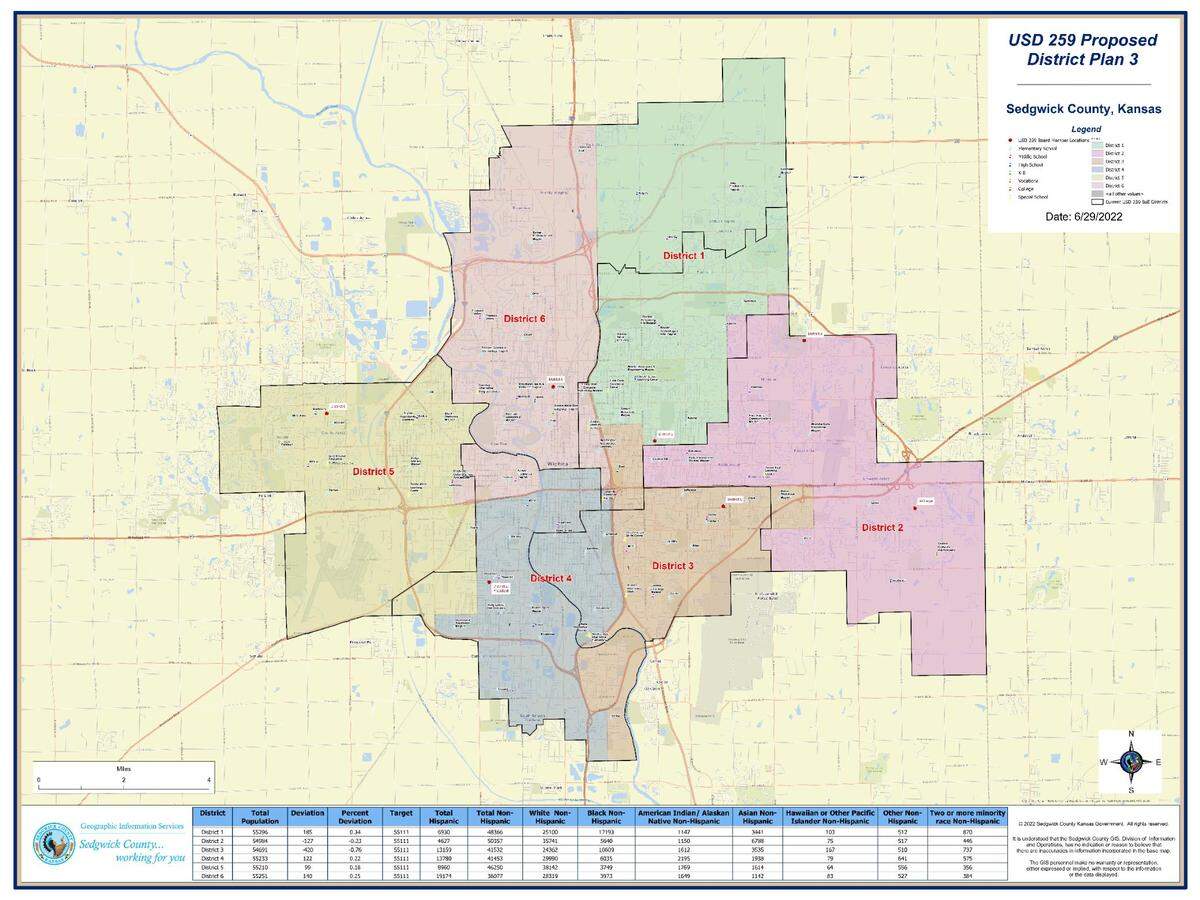
Under both plans, District 1 — represented by Diane Albert — would nearly double in geographic size, and District 6 — represented by Hazel Stabler — would be nearly cut in half. The population numbers still would balance.
Both maps would shift the McAdams neighborhood from Albert’s district to Stabler’s. They would also move East High School and the surrounding neighborhoods into District 3, represented by Ernestine Krehbiel.
The move seeks to balance populations in school board districts after growth nudged District 2 in east and southeast Wichita above the allowable limit by 1 percentage point. All of the other districts are within 5 percent of the target population.
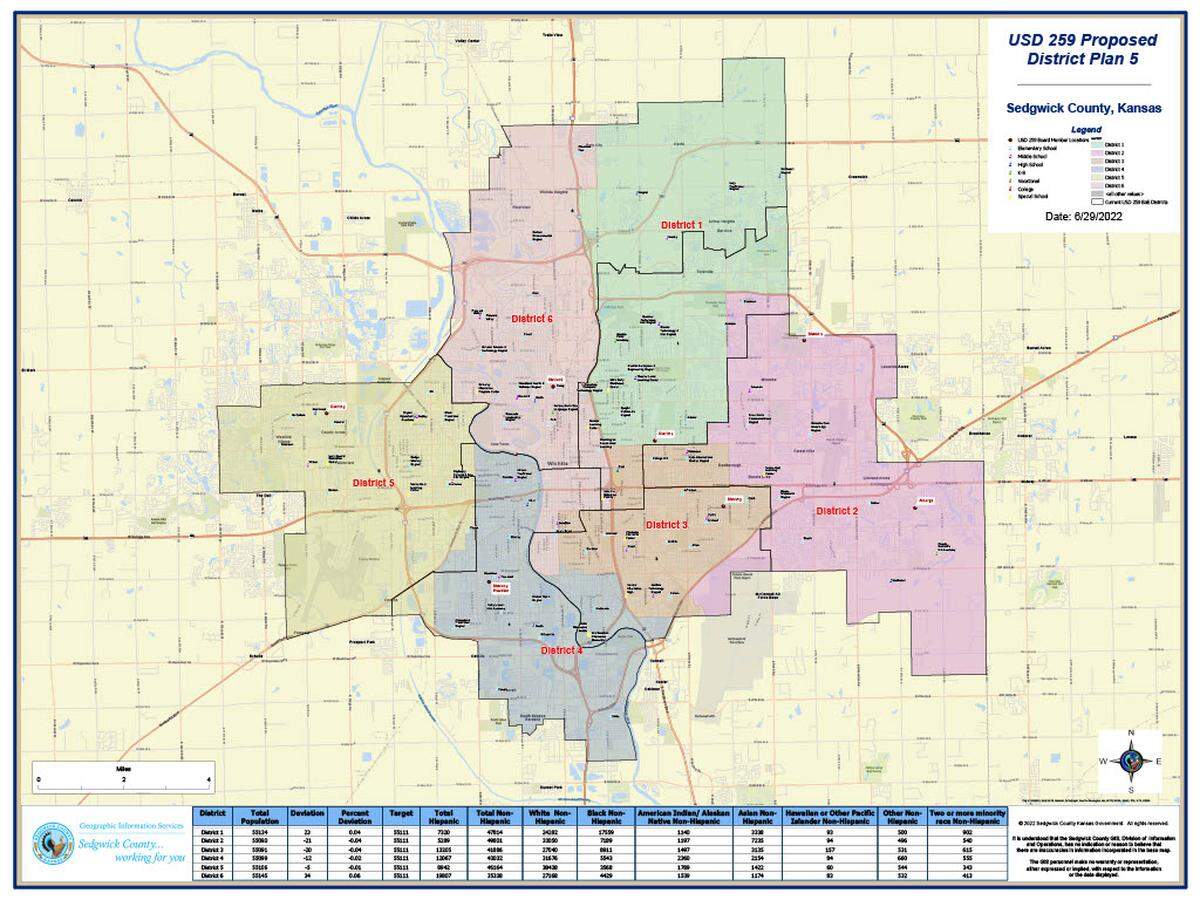
State law requires the Wichita school board districts to be within 5% of one-sixth (55,110) of the total district population (330,665) in the 2020 U.S. Census count. District 2 is 6% above the target population.
“District 2 is out of balance, and so we have an obligation to correct that imbalance and align with state statute,” Wendy Johnson, USD 259’s director of strategic communications, told the school board on Tuesday.
Minor tweaks to district boundaries would bring USD 259 into compliance with state law. But board members and district officials said additional changes were needed after the district closed the old Southeast High School in District 3 and reopened it at a new building in District 2, leaving District 3 without a high school in its boundaries.
“There were two things that staff looked at as we prepared to bring maps to you for your consideration,” Johnson said. “One is that the population requirement be met, . . . and two, to consider whether at least one comprehensive high school could be located within each board of education district.”
As it stands, District 6 has three high schools (North, Northeast and Heights), District 4 has two (South and West). Districts 1 (East), 2 (Southeast) and 5 (Northwest) each have one high school in their districts.