Ahead of food sales tax fight, Kelly signs Kansas budget that had bipartisan support
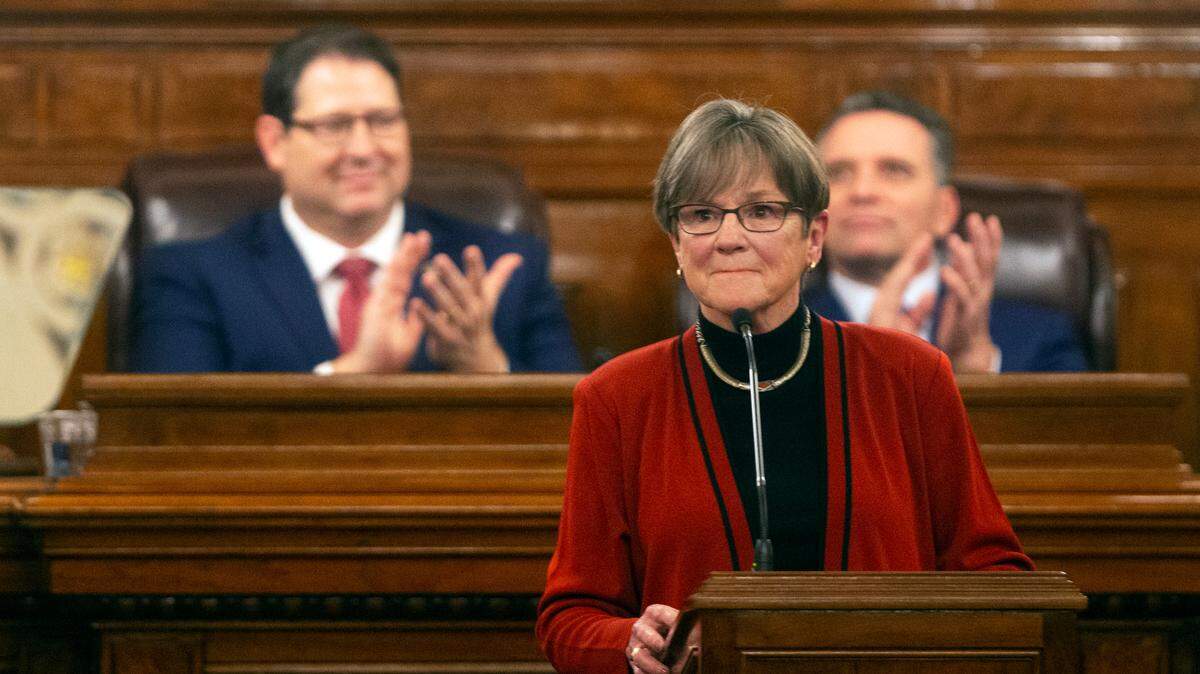
Kansas Gov. Laura Kelly on Wednesday signed a state budget that received support from a large majority of lawmakers — a bipartisan achievement ahead of potentially bruising partisan battles over tax cuts and education funding in the coming days.
The budget places $500 million into the state’s rainy day fund, providing an extra cushion if tax collections fall in the future. It provides $65 million in new funding for housing over two years, including the development and renovation of moderate-income housing.
And it fully funds the state’s water plan for the first time since 2008 as Kansas continues to fight the depletion of the Ogallala Aquifer, which provides water to western Kansas.
The $16 billion budget — including $4.6 billion in state general fund spending — does not include funding for the Kansas State Department of Education or school districts, an amount expected to exceed $6.4 billion. Lawmakers are in dispute about allowing out-of-state students to qualify for a career and technical training scholarship program and allowing out-of-district students to enroll in schools if there is space.
Education aside, the budget easily passed the Legislature. On April 1, the House approved it 104-12 and the Senate followed the same day, 33-5.
The state’s rosy revenue outlook has lowered the temperature on what can be a highly contentious budgeting process when money is tight. In addition to appropriating $16 billion for the next fiscal year, the budget also adds $1.2 billion — much of it federal funds — in spending to the current fiscal year, which ends June 30.
The additional spending approved for the current fiscal year includes $20 million for the Highway Patrol to purchase two aircraft and replace the executive aircraft, which is used transport officials, including the governor, around the state. It also includes $1.9 million for the Secretary of State’s office to pay voter fraud litigation settlements — the amount Kansas agreed to pay the American Civil Liberties Union and other attorneys related to former Secretary of State Kris Kobach’s failed effort to defend voter registration rules in court.
Kelly announced she had signed the budget ahead of the release Wednesday afternoon of a new state revenue forecast — the latest projection of how much revenue state officials expect to collect in the coming year. Collections have regularly beat monthly estimates, a sign the forecast for next year will likely be upgraded.
As of April 1, Kansas had collected about $302 million more in total taxes than originally estimated for the fiscal year that began July 1. That’s 4.9% above projections.
Fears about economic slowdown triggered by the war in Ukraine and rising interest rates to combat inflation may temper expectations for revenue growth somewhat. But any forecast that anticipates additional growth will almost certainly fuel calls for tax cuts, especially reductions on the state sales tax on food.
Kelly, a Democrat up for re-election in November, reiterated her call to eliminate the food sales tax when signing the budget on Wednesday.
“This budget delivers on promises I made when I was first elected, including investing in our economic development tools, funding higher education, stopping the irresponsible practice of robbing from our highway fund, and much more,” Kelly said in a statement. “Kansas is stronger than it was four years ago, and as a result, we can confidently make critical investments in our state while at the same time eliminating the state food tax to help Kansans have more room in their own family budgets.”
Both Republicans and Democrats say reducing or eliminating the food sales tax is a priority. At 6.5%, the rate is among the highest in the nation. But cutting the tax has become entangled in fights over whether it should be a standalone proposal or bundled with other tax measures — and whether it should be eliminated in one fell swoop or reduced gradually.
Kelly and other Democrats want the food sales tax dealt with in its own bill, while some Republicans are more inclined to include it in a larger package.
Attorney General Derek Schmidt, Kelly’s likely Republican opponent, has voiced support for reducing the tax rate. On Wednesday, his campaign and the Republican Governors Association circulated a report that purports to show that the sales tax on food would have been nearly eliminated by now under legislation Kelly vetoed in 2019 that included a stair-stepped reduction.
The legislation included numerous tax changes, including provisions that would have held down corporate taxes. At the time, Kelly said the bill would have created a “senseless fiscal crisis” just as Kansas’s fiscal situation was stabilizing.
“When Governor Kelly says she wants to ‘axe the food tax’ she’s not being up front about the fact Kansans would be paying close to zero right now in grocery taxes if she hadn’t vetoed House Bill 2033 in 2019,” Schmidt said in a statement. “I would have signed that bill into law, and as a result Kansans would already have some relief from Joe Biden’s out of control inflation at the grocery store. Once again, the Legislature is left to clean up Laura Kelly’s mess.”
Kelly issued just two line-item vetoes when signing the budget Wednesday. She rejected a provision that she said would have allowed lawmakers to enroll in the state’s public pension system after opting out of it, a decision that’s not normally reversible.
The governor also vetoed $200,000 for an engineering program at Benedictine College. She said the school should instead apply for grants under a program set up for private and independent colleges.
This story was originally published April 20, 2022 at 12:35 PM with the headline "Ahead of food sales tax fight, Kelly signs Kansas budget that had bipartisan support."