‘A slap in the face’: Will Kelly’s move against sanctuary cities cost her KCK support?
When Alejandro Rangel-Lopez met Laura Kelly as she ran for governor in 2018, he thought she would be “a champion for immigrants.”
Four years later, Rangel-Lopez contends that label is “a bit inaccurate to say the least,” now that Kelly, as governor, has signed Republican legislation banning Kansas localities from passing sanctuary city policies.
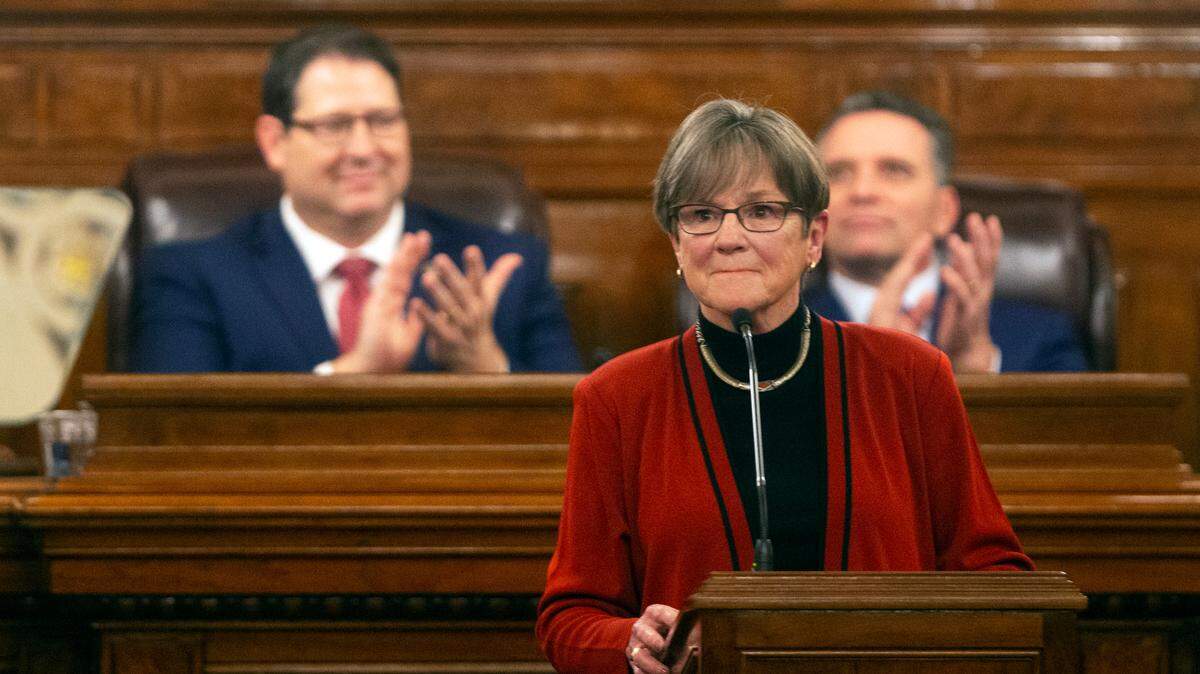
Kelly, a Democrat up for reelection in November, announced Monday she was signing the bill after weeks of pressure from Kansas Republican activists who appeared poised to make immigration a key campaign issue.
“I don’t think that throwing part of your base under the bus was the right move,” said Rangel-Lopez, lead coordinator of the southwest Kansas civic-engagement group New Frontiers Project. “Either way (Republicans) are gonna attack you for it, so you might as well stand principled and tall in your support and defense of immigrants across Kansas.”
“When you treat immigrants as something disposable, it resonates.”
Political observers said Kelly was in a difficult political position. Republican campaign groups and the presumptive GOP nominee for governor, Attorney General General Derek Schmidt, were gearing up to make immigration a campaign issue. And the GOP-controlled Legislature passed the bill with a veto-proof majority, meaning Kelly would need to flip votes to keep it from becoming law.
Advocates for immigrants and Hispanic communities in Wyandotte County and across the state, however, said the governor had alienated a key voting bloc she will need to win in November.
Kelly insisted Tuesday morning that politics did not play a role in her decision to sign the bill. She reiterated her statement Monday that immigration policy was the job of the federal government, not localities.
“I am a true policy wonk and I look at this through policy lenses and I have been very consistent on immigration for nearly 20 years now,” Kelly said.
The bill she signed was proposed by Schmidt. It nullified much of a Wyandotte County ordinance that created municipal IDs and governed how the Unified Government and Kansas City, Kansas, police interact with federal law enforcement. The bill specifically said localities cannot prohibit cooperation with federal immigration authorities.
‘This was deeply personal’
Wyandotte County activists had worked for five years to pass the local ordinance, called “safe and welcoming,” and said Kelly took them by surprise.
She took statewide office in 2018 by beating former Secretary of State Kris Kobach, a Republican known for anti-immigrant policies and rhetoric.
Wyandotte County, the target of the new legislation, is a Democratic stronghold in Kansas, and Kelly has long voiced opposition to policies that she says would have the state government overstepping into local issues.
Grassroots activists in Wyandotte County called Kelly’s decision a “slap in the face” and warned it could reduce turnout among Democrats.
Marcus Winn, an organizer in KCK with the Metro Organization for Racial and Economic Equity, said Kelly had “crossed a red line” that left Wyandotte County residents with a choice between a Republican attorney general who proposed the bill and a Democratic governor who put her name on it.
“There’s a calculus that those of us who care strongly about this issue can simply be taken for granted because who else are we going to vote for. It’s political gaslighting,” Winn said.
Karla Juarez, executive director of Advocates for Immigrants Rights and Reconciliation, said she now finds it difficult to support Kelly in her reelection campaign.
“This was deeply personal for some of us individuals who worked really hard,” Juarez said. “I’m a Kansas resident. I know what we want and I know where we want to see the state go, and really it felt like (the state went) 50 steps backward with her not vetoing this bill.”
Juarez pointed out that Kelly, citing local control concerns, vetoed a bill that would have barred cities from banning plastic bags.
“A plastic bag,” Juarez said. “Couldn’t she stand with humans?”
Even outside Kansas City, Kansas, the move is likely to reverberate.
Monica Vargas-Huertas, political and community outreach director for the United Food and Commerce Workers in Kansas, said the passage of the bill showed that Hispanic Kansans are “just considered a pawn in the political game.”
Kathleen Alonso, an organizer in Seward County, Kansas, said the governor’s actions reinforce a sense that Hispanic voters do not have a voice in Kansas politics.
“It is a discouragement and it’s something that makes it a little difficult to drive out people to the polls,” Alonso said.
Kelly’s gamble
Immediately after the Legislature approved the bill, the Kansas Republican Party was pressuring Kelly on it.
“While Laura Kelly has refused to speak out against Joe Biden’s border crisis, deadly drugs like fentanyl are flowing over our border and into Kansas communities. It’s about time Laura Kelly puts the safety of Kansans ahead of her party’s radical agenda and she can start by signing this bipartisan legislation into law,” Kansas GOP Executive Director Shannon Pahls said in a statement at the time.
By signing the bill, former Democratic national committeeman Christopher Reeves said, Kelly took a “gamble.”
Kelly, Reeves said, was in an impossible position. She wasn’t likely to draw anti-immigration voters by signing the bill but she could make a likely Republican line of attack more difficult. Furthermore, because the Legislature had approved the bill with a veto-proof majority, the bill was likely to become law anyway.
Signing the bill, Reeves said, could allow Kelly to save her political capital for later veto override fights.
“The calculus is, will my base stand with me through this decision? And I think her answer is going to be for the most part, yes but do they turn out with the same fervor?” Reeves said.
“There’s some political strategy in just saying I’m going to do this up front and it will make some of my base unhappy, but I’ll say to the Republicans, game on.”
But high turnout in Wyandotte County can be critical for Democrats to win statewide races in Kansas.
“Democrats depend on churning out people who are not necessarily usual voters, and some of those people are not going to vote because of this,” said Judy Ancel, president of Kansas City based Cross-Border Network. “For anybody who cared about this particular thing and who was aware of her turning on immigrants in Kansas, I think they will be less likely to vote.”
But Bob Beatty, a Washburn University political scientist, said Democrats also need to build a coalition that includes independents and moderate Republicans. While Kelly may have angered Democratic voters in the short term, Beatty said, there is time for her to recover.
“Kelly’s job is to figure out ways to unite the Democratic voters before the election. She doesn’t have to do it now.”
Sen. David Haley, a Kansas City Democrat, agreed. Though Haley said he was initially shocked to hear the news, he said he understood the political calculus. In the long term, he said, Wyandotte County voters wouldn’t punish Kelly for her choice.
“Thinking it through, I think it was the right thing to do,” Haley said.
But Winn, the Wyandotte County organizer, said Kelly had won no votes with her decision but may have lost thousands.
“The idea there is some mythical anti-immigrant yet pro-Laura Kelly voter is just nonsense,” Winn said.
“My message (to Kelly) would be don’t come to Wyandotte County looking for votes. You won’t find them.”
This story was originally published April 13, 2022 at 5:00 AM with the headline "‘A slap in the face’: Will Kelly’s move against sanctuary cities cost her KCK support?."