Cheaper groceries, medical marijuana: How Kansas lawmakers might change your life
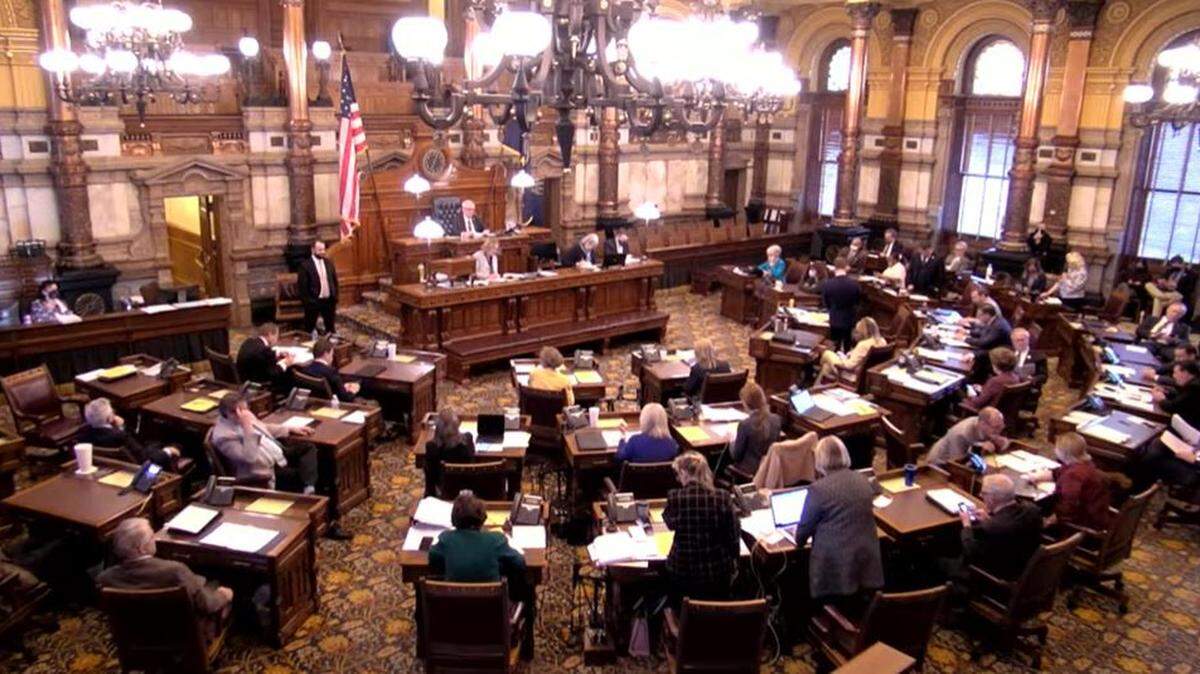
The Kansas Legislature returns to Topeka Monday for a 2022 session certain to be colored by electoral politics.
With Democratic Governor Laura Kelly running for reelection against Republican Attorney General Derek Schmidt and lawmakers preparing for their own campaigns, every agenda item is likely to be viewed with an eye on November.
Here’s seven issues to watch.
Medical Marijuana
Kansas is one of the last states in the country without some form of legalized marijuana.
A fairly restrictive medical marijuana bill, with a limited list of diagnoses and a prohibition against smokable cannabis, passed the House last year.
Sen. Rob Olson, an Olathe Republican and chair of the committee that will review the bill, said he plans to hold an informational session on medical marijuana policies on Tuesday.
Olson said he’s expecting some in the Senate to want changes to the House bill, but he’s optimistic that some medical marijuana measure can pass and become law before the end of the year.
“I do see some version of this bill coming out probably this year,” Olson said. “I’m not going to hold it up.”
House Democrats aren’t so sure. They announced plans last week to introduce two constitutional amendments that would legalize medical and recreational marijuana.
“I hope (the Senate) would act on (medical marijuana),” said Rep. Jason Probst, a Hutchinson Democrat. “But, prior behavior is the best indicator of future performance.”
“I have zero faith that they’ll move either of those pieces of legislation. We got it out of the House but it was a very stringent version.”
Education
Lawmakers plan to introduce bills banning what they consider critical race theory and establishing a parents’ bill of rights.
Critical race theory, a body of legal scholarship evaluating the impact of racism on America’s institutions, has become a catch-all term in conservative circles for a wide range of instruction related to race and bias.
Legislators held two days of hearings last month that included testimony from parents frustrated over curriculum and the handling of the pandemic.
“Our parents understand their rights and that children should not be segregated based on race or gender or any other reason,” Rep. Kristey Williams, an Augusta Republican who chairs the K-12 budget committee, said last month.
Kelly has called complaints about critical race theory a “nothing burger” and reiterated that curriculum should be left to school boards, not the Legislature.
Lawmakers are also expected to continue debates from last year on school choice, student achievement and funding. That could include allowing students to use public funds for private school education.
Last year, lawmakers expanded an existing program of tax credits for funding scholarships to private schools.
“With new, more conservative school board members it potentially will change the issue,” said Rep. Valdenia Winn, a Kansas City Democrat.
Taxes
Flush with a massive budget surplus, Kansas Democrats and Republicans are talking tax cuts.
Kelly and Schmidt have both proposed eliminating the food sales tax this year.
Kansas’ 6.5% sales tax on groceries is the second-highest in the nation. Relief from that burden appears to have strong bipartisan support.
If there are sticking points, they will probably be over what kind of food and whether the cut is passed on its own or in combination with other tax reductions.
One concern of backers is that if the food tax cut doesn’t pass early in the session as a stand-alone bill, it could end up competing with other tax-cut proposals late in the session.
In 2020 Kelly vetoed food tax cut because it included other breaks for wealthy Kansans and multinational corporations.
Some conservative Republicans have embraced the idea of limiting tax relief to staple food items. A Democratic bill uses a much broader definition that includes non-essentials such as candy, soft drinks and dietary supplements.
A related measure would extend relief to personal hygiene items, such as shampoo, soap, diapers, toilet paper and feminine hygiene supplies.
Kelly has also proposed a $250 tax rebate for each Kansan, a proposal that was met by GOP leaders with calls for permanent reductions.
Aaron Coleman
The Kansas City, Kansas, freshman, repeatedly accused of abusive behavior, will face a second Legislative investigation that could result in his censure or expulsion.
Coleman is charged with misdemeanor domestic battery in Johnson County following an incident with his brother in October. He was arrested in November for allegedly driving under the influence of drugs or alcohol. Charges have not yet been filed in that case.
Last year, lawmakers investigated Coleman and found that allegations of a longstanding pattern of abuse were substantiated. However, they declined to act because Coleman’s behavior occurred before he took office.
Since his DUI arrest, Republican and Democratic Legislative leaders have called for Coleman’s resignation. Rep. John Barker, an Abilene Republican who chairs the investigating committee, said he believed it would be “prudent” to wait to begin hearings until after the criminal cases have concluded.
“It’s kind of wait and see,” Barker said. “They’re just allegations at this point.”
Coleman is one of three Kansas lawmakers who faced criminal charges last year. Rep. Mark Samsel, a Wellsville Republican, pleaded guilty to disorderly conduct after he allegedly kicked a student in the groin while substitute teaching. Sen. Gene Suellentrop, a Wichita Republican, drove the wrong way down Interstate 70 in Topeka while drunk. He pleaded guilty in October to driving under the influence and reckless driving.
All three remain in office and will return to Topeka this year.
Redistricting
On its face, it seems like a simple exercise.
Once every ten years, lawmakers are required to redraw the boundaries of state legislative and congressional districts to account for shifts in population revealed by the U.S. Census.
But partisanship usually turns it into a protracted ordeal. Depending on where the lines are drawn, redistricting can hugely influence the electoral landscape, making and breaking political careers.
This session, Republicans who dominate the Legislature are expected to try to use redistricting to target Kansas’ lone Democratic member of Congress, Rep. Sharice Davids, who represents the Kansas City suburbs.
At the state level, expect the Republicans to look to protect their veto-proof majorities in the House and Senate.
The last time the Legislature took up redistricting, a brutal political fight between conservative and moderate Republican lawmakers led to an impasse that was handed off to federal court. A panel of judges drew maps that forced multiple incumbents to run against each other, the worse-case scenario for sitting politicians.
Running in the new districts in 2012, conservatives backed by then-Gov. Sam Brownback succeeded in purging nearly all of the Legislature’s Republican moderates.
Mental health
This issue has been simmering for years, but the recent death of 17-year-old Cedric Lofton has led to increased scrutiny.
Lofton, a Black foster child with mental-health issues, died after being restrained at the Sedgwick County Juvenile Intake and Assessment Center. He was taken there after becoming combative with police who responded to a mental-health call by his foster parents.
Some lawmakers are seeking statewide reform of the system for handling emergency calls involving mentally ill individuals, emphasizing treatment instead of jail.
Local governments in south-central Kansas also are pleading for a 50-bed state mental hospital to be built somewhere in the Wichita area.
And advocates are pushing for higher reimbursement rates for mental-health providers to address a statewide critical shortage of mental-health workers.
COVID
Gov. Kelly has asked that within the next two weeks the Legislature make permanent through March two executive orders she announced Thursday.
The orders lift regulatory barriers for hospitals and nursing homes as they face severe staffing shortages brought on by the latest wave of COVID-19.
In statements last week, House Speaker Ron Ryckman and Senate President Ty Masterson each said they would consider the request and believed the executive orders were needed at the hospitals.
The Legislature is also likely to tackle other COVID-19 issues.
Conservative lawmakers have also indicated plans to expand work started during November’s special session and pursue more legislation pushing back on COVID-19 vaccine requirements.
This story was originally published January 10, 2022 at 5:00 AM with the headline "Cheaper groceries, medical marijuana: How Kansas lawmakers might change your life."