Governor and county ‘gotta feel pain’ for passing COVID restrictions, senator says
The underlying purpose of a state Senate bill that would compensate business owners for lost income from the coronavirus pandemic is to punish the governor and county commissioners who put limits on businesses to try to slow the spread of COVID-19 — and discourage any future restrictions, according to a key state senator.
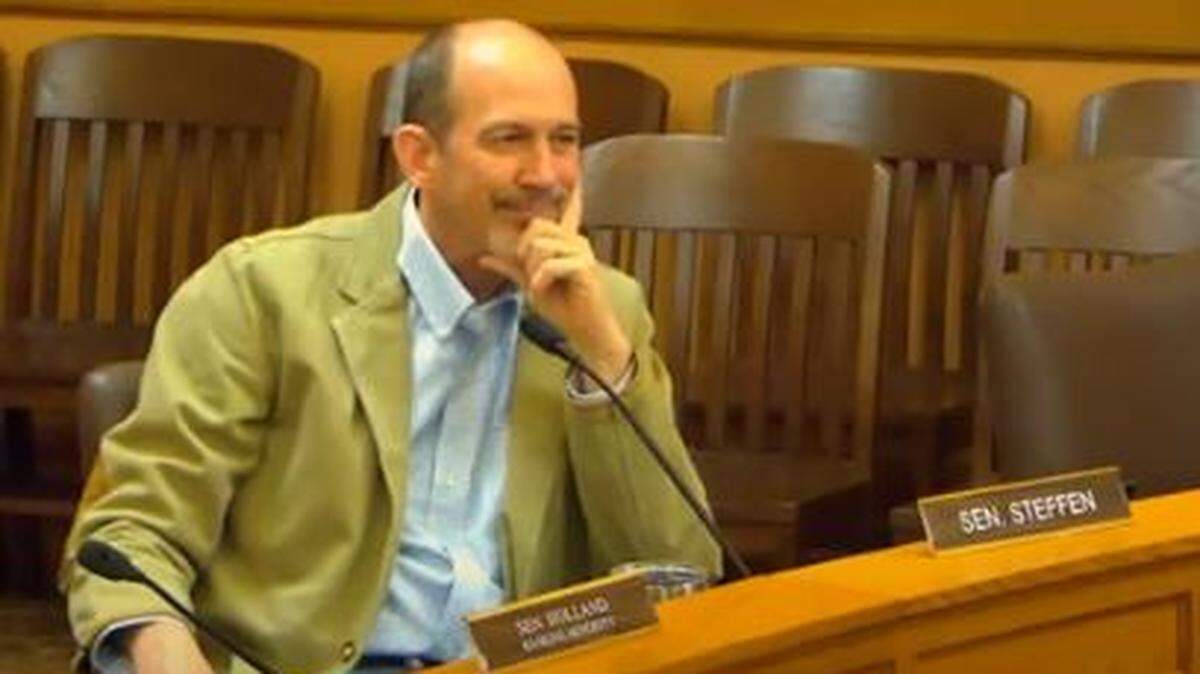
“If our leaders don’t feel some pain, they’re not gonna learn anything from this,” said Sen. Mark Steffen, a Republican from Hutchinson and member of the Senate tax committee. “The levels of the government that interceded in our economy with marginal, marginal, marginal to non-existent scientific data, they gotta feel pain, they got to feel pushback on this.”
Sedgwick County Commissioner David Dennis said the senator’s comments confirm what county officials have suspected all along about the compensation bill, Senate Bill 286.
“Their whole goal is to punish us for any decision we made that they disagree with,” Dennis said.
Steffen made his comments Friday morning during the first part of a tax committee hearing on SB 286.
The bill looks to set aside at least $100 million of federal COVID-relief funds to pay claims from businesses and property owners who feel they were wronged by temporary closures, curfews and capacity restrictions ordered by state to fight the pandemic over the past year.
Attorney General Derek Schmidt, a Republican who is running against incumbent Democratic Gov. Laura Kelly, would decide who gets those SB 286 payments.
However, Schmidt himself has questioned whether the recent $1.9 trillion federal COVID relief law allows Kansas to use federal funds for tax breaks as the state bill envisions.
In addition, at the county level, SB 286 would require counties to tap into their general funds to pay businesses for claims based on local health regulations.
Businesses would have the option of taking the money in a lump sum or as credits against future income tax liabilities in the case of the state, or as property tax credits in the county’s case.
The bill also would create a new entitlement for businesses to file claims for government money if a county continues to require use of face masks after May 1.
Sedgwick County has estimated that if SB 286 passes, it could cost the county as much as 26% of its budget.
That would have to be covered by either dramatic increases in residential property taxes and/or deep cuts in services such as the Sheriff’s Department, the jail, ambulances and public health, Dennis said.
“They don’t realize they’re punishing the local homeowners,” by shifting the post-pandemic tax burden from business to residential properties, Dennis said.
Mandates attacked
Proponents of SB 286 were primarily represented by Ryan Kriegshauser, a lawyer for Omega Boot Camps, a Wichita gym that sued the state over business restrictions.
“Listening to how the County Commissions have talked about this bill, they seem to think it’s somehow retributive — that we are going after them to punish them for imposing restrictions on businesses,” Kriegshauser said. “That’s not the case at all. This is brought to compromise and come up with a settlement.”
But later, he complimented Steffen’s comments about inflicting pain on Kelly and counties.
“I think you make a very good public policy point,” Kriegshauser said, immediately following the senator’s remarks.
He went on to argue that county decisions on health orders should be subjected to a cost-benefit analysis.
“If they had to have skin in the game, then they would they would weigh that,” Kriegshauser said. “You know, KDHE (Kansas Department of Health and Environment) says 1% of cases come from bars and restaurants. 1%. And they imposed massive restrictions on bars and restaurants to get 1%. Now, if they had to pay those bars and restaurants for those restrictions, I think the analysis would be quite different.”
A KDHE official disputed the 1% number.
“I’m not sure where he is pulling those numbers from,” KDHE spokeswoman Kristi Zears said in an email.
KDHE only tracked and reported cases that were associated with specified COVID clusters, not where each individual may have caught the coronavirus, she said.
Steffen sided with Kriegshauser and said SB 286 will discourage mandatory actions to fight disease.
“What it will ultimately do in time is push those county commissioners and county health boards and all that, to a position of making recommendations instead of mandates,” he said. “That was a huge constitutional point for me through this whole thing. They never should have been making mandates.
“You put some feedback that makes them fiscally responsible and all sudden they’re going to be wanting to make recommendations.“
Asked by an Eagle reporter to clarify whether he agreed with Steffen, Krieghauser said, “In the pandemic, government acted as it did and rang up a tab, now it must pay the bill. That’s not retributive. At the same time, it is always important for policy makers to weigh the possible costs associated with their actions.”
Help or handout?
One question hanging over the SB 286 debate is whether the money is intended to offset businesses’ actual damages or to compensate them for profits they didn’t make since the pandemic hit Kansas last March.
Kriegshauser said a separate House bill under consideration would exclude “things like loss of profits or speculative relief for opportunity costs.”
But he was contradicted by lobbyists for the Kansas and Wichita chambers of commerce, who argued that federal payments to businesses so far fell short because they didn’t take lost profits into account.
“Even though they received that compensation, it’s not like it went toward the, you know, profit or income of the business, necessarily,” said Eric Stafford of the Kansas Chamber.
“That had to be spent on mortgage or utilities or payroll, so it’s not like it was free money, like the stimulus check that everybody’s been receiving,” Stafford said.
Andrew Wiens of the Wichita Chamber said more money should go to businesses from the county and state to “even the playing field.”
“We have bars and restaurants in Sedgwick County, in Wichita, but other industries as well, that have truly been harmed by (government COVID rules),” Wiens said. The federal payments were “just kind of covering some of the losses and expenses they had to pay during this.”

SB 286 would empower the attorney general to decide how much money each business is entitled to. The applications saying what the compensation is for would be confidential and blocked from public disclosure.
Kriegshauser said the attorney general’s office review would ensure businesses aren’t being overcompensated.
Can they do that?
Kansas businesses have already received billions of dollars in coronavirus relief, according to data compiled by the Committee for a Responsible Federal Budget. Those payments include:
▪ $6.55 billion in forgivable Paycheck Protection Program loans, which cover payroll costs; operating costs such as utilities, software, rent, mortgage payments, accounting services and interest payments; supplier costs; property damage due to looting not covered by insurance; and worker protections such as personal protective equipment, installing barriers, expanding outdoor dining, and health screenings.
▪ $2.1 billion in Economic Injury Disaster loans and grants for normal operating expenses, such as health care benefits, rent, utilities and debt payments.
▪ A large portion of an additional $1.25 billion in local coronavirus relief funds, including $6.3 million in Safe Operating Grants to small businesses and nonprofits in Sedgwick County.
The new American Rescue Plan Act prohibits states from using federal coronavirus relief to cut taxes or offer tax credits, like those offered under SB 286.
But Schmidt and 20 other attorneys general have threatened to sue the Biden administration unless it narrowly interprets the law.
Kriegshauser said when SB 286 was written, it underestimated how much federal money would flow into Kansas.
The new federal stimulus is forecast to bring $1.58 billion to the state, along with an additional $100 million to Sedgwick County and $73 million to the city of Wichita.
“I mean, we only asked for $100 million in federal funds, and now have $1.6 billion coming in,” Kriegshauser said. “It’s arguable that $100 million was way low. We should have asked for a lot more.”
That gave pause to Sen. Caryn Tyson of Parker, the Republican chair of the tax committee.
“I’m going to be very candid here, that statement bothers me,” she said. “You’re not looking at the actual damages. You’re looking at how much money is available.”
Who’s responsible?
Throughout the hearing, Kriegshauser and other proponents justified their stance that compensation is owed to business by citing an existing state law, Kansas Statute 48-933.
However, that law is primarily a recognition that citizens have a responsibility to pitch in during emergencies.
“Each person within this state shall act and manage the affairs of such person and such person’s property in any way which reasonably will assist and not detract from the ability of the state and the public successfully to meet disasters,” the law says.
The law does provide for compensation in some cases for “ the use, damage, loss or destruction of property” but “only if the property was commandeered (by government) or otherwise used in coping with a disaster.”
The key legal question is whether the state and county action restrictions constituted a “use” of business property.
The statute also says an owner can only collect damages if the use of their property went beyond their responsibility to assist in an emergency situation.
Kriegshauser said his client agreed to pause the lawsuit in order to give the Legislature time to come up with an alternative compensation plan that could avoid further litigation.
Assistant Sedgwick County Counselor Justin Waggoner said although county orders are mentioned in the Omega Bootcamp lawsuit, the state is the only named defendant.
He also said the county’s health orders didn’t hinge on Section 48-933.
They were done under an “entirely different” section of law that empowers a county health officer to take action when a business is endangering the public, he said.
This story was originally published March 21, 2021 at 5:01 AM.