
Michael O’Donnell hit with $25,000 fine after admitting to campaign law violations
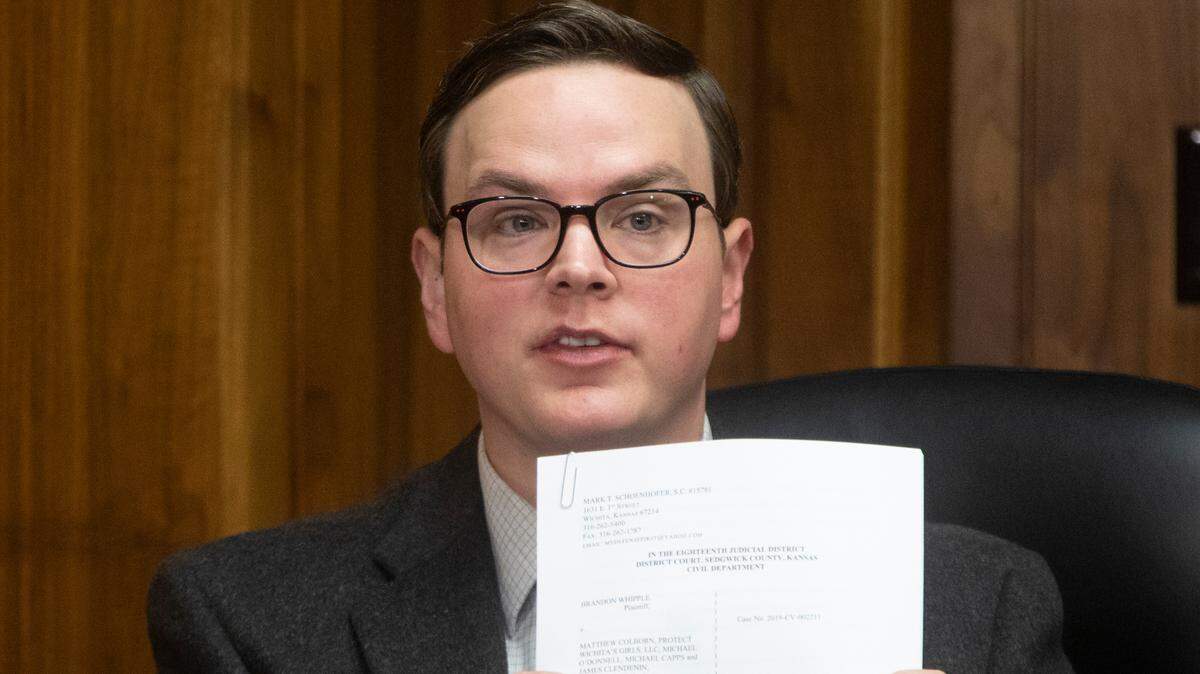
Michael O’Donnell was fined $25,000 after admitting to nine violations of Kansas campaign finance law Wednesday, including using campaign money for personal use, fraudulent reporting and moving campaign funds into his personal bank account.
In a teary-eyed plea to the Kansas Governmental Ethics Commission, O’Donnell asked for leniency, saying since resigning as a Sedgwick County commissioner he is now “broke” and would have to pay the penalty with loans from people he knows.
“I’m no longer in government, but I still want to make this right,” he said. “I just hope that it would be something that I can afford. I’ve been helping my mom financially because my dad passed away unexpectedly in February. And she’s a teacher.”
O’Donnell asked for the penalty to be reduced to below $10,000, which he said was as much as he could get from loans. But ethics commissioners settled on $25,000. Half will be forgiven if he pays $12,500 within 90 days.
The maximum fine he could have received was $90,000.
“I understand the desire to levy a huge fine,” O’Donnell said. “But I think if you look at the media coverage of this and my federal trial, I’ve paid a huge fine — both through my legal fees, and through my reputation.”
The hearing covered alleged campaign finance violations from 2015 to 2017 during his campaigns for state senate and the Sedgwick County Commission.
O’Donnell admitted to funneling thousands of dollars from his campaign account to his personal checking account and to four friends, whom he fraudulently reported as campaign workers, according to a consent decree approved by the Kansas Governmental Ethics Commission.
The ethics commission held a hearing on the complaint against O’Donnell on Wednesday.
Mark Skoglund, executive director of the Kansas Governmental Ethics Commission, said the laws O’Donnell broke are “the backbone of the campaign finance act.”
“If these can be violated, the campaign finance act has no meaning,” he said. “It certainly undermines the public’s ability to trust governmental decision making, which is the cornerstone of the campaign finance act.”
The specific charges were four counts of prohibited use of campaign funds, four counts of fraudulent reporting and one count of comingling, or mixing campaign funds with personal funds.
O’Donnell’s fine is the second highest in the history of Kansas campaign finance laws. The largest fine was given out in 2007 at $45,000. The campaign finance violations are the latest round of legal proceedings tied to O’Donnell’s controversial political career.
O’Donnell resigned in November under pressure from party leaders rather than face ouster proceedings by the Sedgwick County district attorney for his role in a false attack ad against Wichita Mayor Brandon Whipple and a subsequent cover-up during the 2019 mayoral race. He lost re-election to Sarah Lopez and is being sued for defamation by Whipple in state court.
The allegations by the state watchdog agency largely rehashed federal money laundering and wire fraud charges filed in federal court by the U.S. Attorney’s Office in 2018.
In March of 2019, jurors acquitted O’Donnell on 21 counts of wire fraud. They deadlocked on two counts of wire fraud and three counts of money laundering and federal prosecutors asked the court to drop the charges. O’Donnell served in the Kansas Senate from 2012 to January 2017 when his term on the Sedgwick County Commission began.
O’Donnell reportedly asked the Kansas Governmental Ethics Commission to investigate him before his federal trial in 2019. After the federal trial, the Kansas Governmental Ethics Commission requested transcripts of testimony by four of O’Donnell’s friends who testified against him.
Two of those friends, Colby Rankin and Jonathan Dennill, testified in federal court that they were given a pair of $1,000 checks by O’Donnell after an Aspen ski trip. Both testified they did not work on O’Donnell’s campaign to earn the money.
One of those friends cashed and returned the money to O’Donnell when O’Donnell asked; the other wrote O’Donnell a personal check back in the same amount when O’Donnell asked for it. Federal investigators said the money went from O’Donnell’s campaign account to his friends and then into his personal account.
Two others, David Jorgensen and Jack Masterson, testified that they did nothing to earn a series of payments from O’Donnell in 2015 and 2016 totaling $8,500.
The consent decree, signed by O’Donnell’s attorney Joshua Ney, acknowledges those payments were violations of the state’s campaign finance laws that require campaign expenses to be used for “legitimate campaign purposes” or other eligible expenses.
The nine counts O’Donnell admitted to are as follows:
▪ Prohibited use of political contributions (Four counts) — Jan. 2, 2016, O’Donnell paid $1,000 each to Colby Rankin and Jonathan Dennill out of his campaign account; Between Feb. 2, 2015, and Dec. 27, 2016, O’Donnell paid $6,400 to David Jorgensen out of his campaign account. Between Dec. 15, 2015, and May 5, 2016, O’Donnell paid $1,500 to Jack Masterson out of his campaign account.
▪ Fraudulent reporting (Four counts) — The ethics commission alleges O’Donnell “intentionally ma(d)e a false material statement in a report made under the campaign finance act” by listing Rankin’s payment as compensation for “help/campaign services,” Dennill’s as “photography services,” Jorgensen’s as “campaign services and accounting services” and Masterson’s as “campaign services.”
▪ Comingling (One count) — O’Donnell mixed campaign contributions with personal funds by moving $2,000 from his campaign account to his personal checking account.
“I see now that was wrong,” O’Donnell said. “I would obviously never do that again. I would advise anybody against that because of where I am right now in my life.
“But I am trying to move on, and I hope that you can see that contrition and desire to get this behind me in a way that I can’t afford,” he said. “But what this has caused me over the last few years is the biggest fine I could ever have.”
The Kansas Governmental Ethics Commission will send its findings to the Sedgwick County District Attorney’s Office and the Kansas Attorney General. Those offices will decide whether to criminally prosecute O’Donnell for the campaign violations.
This story was originally published January 27, 2021 at 3:38 PM.